A new generation of artificial intelligence is arriving. Corporations have transitioned from rule-based chatbots to generative AI assistants, and now a more sophisticated form of AI has appeared: Agentic AI.
As conventional AI responds to prompts, Agentic AI is capable of making decisions and taking actions, adapting to evolving circumstances and striving for set objectives, with limited human oversight. These skills are revolutionizing how businesses approach customer service, sales, marketing, operations and automation of workflow.
Strong industry forces support the increasing enthusiasm. As per research by McKinsey & Company, generative AI has the potential to contribute from $2.6 to $4.4 trillion yearly to the world economy across different business functions. While businesses are exploring opportunities beyond traditional AI, autonomous AI agents seem to be the coming wave of business disruption.
Whether it is handling customer touch points or managing complex business processes, agentic AI solutions are allowing organizations to reach new heights of scalability, efficiency, and productivity.
This article will cover what Agentic AI is, compare Agentic AI to chatbots, its workings, and the reason why large companies are investing in Agentic AI consulting services, Agentic AI development services, and AI agent implementation services.
What is Agentic AI?
Agentic AI is a type of AI that is autonomous, where it can form and achieve goals without the need for human involvement.
Classic automation has been based on rule-based logic. Agentic AIs bring reasoning, planning, retention and execution.
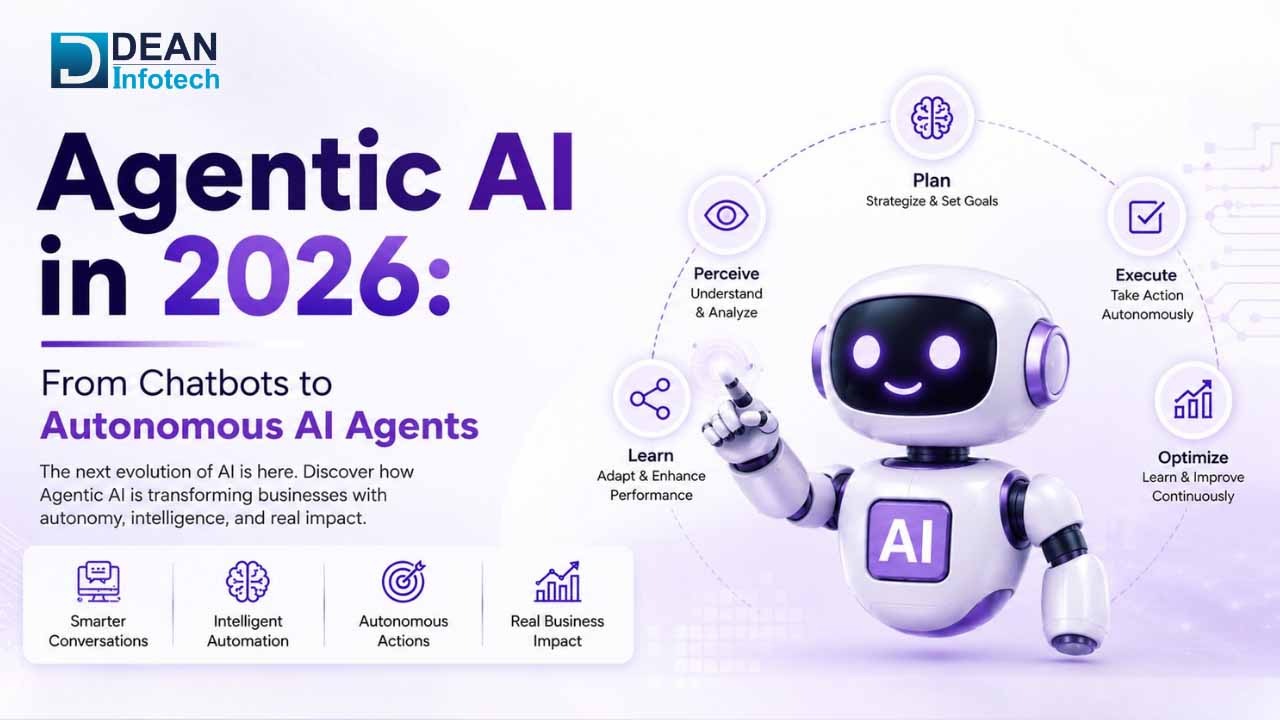
These AI agents can:
- Explain the business objectives.
- Evaluate what information you have.
- Execute tasks on systems.
- Follow-up results.
- Modify behavior according to outcomes.
For instance, a customer service chatbot may reply to a query asked by a customer about the status of an order. An Agentic AI system cannot only reply but also diagnose a shipping delay and take a series of actions such as pausing a common account, offering compensation, updating the CRM, notifying a logistics department, and following up.
This move away from reactive help to proactive execution is exactly what separates Agentic AI from earlier versions of automation.
Why Agentic AI Matters for Modern Businesses
Organizations are under increasing pressure to move faster, become more customized, and operate more efficiently.
Customers expect:
- Immediate reaction.
- Customization of experiences.
- Smooth interactions.
- Multi-channel, individual support.
Simultaneously, there is pressure from organizations to cut costs and increase productivity.
Agentic AI addresses this issue by processing more or all of the entire workflows, as opposed to pieces of it. As opposed to employees painstakingly “walking” from one system to another to perform task interactions, AI agents could handle such operations independently.
This enables them to enhance the customer experience further while freeing up the team to focus on high-value strategic activities.
Traditional Chatbots vs. GenAI Chatbots vs. Agentic AI
To trace the development of AI, look at the three key transition points: traditional chatbots, generative AI chatbots, and Agentic AI.
Capability | Traditional Chatbots | GenAI Chatbots | Agentic AI |
| Answer Questions | Yes | Yes | Yes |
| Natural Conversations | Limited | Advanced | Advanced |
| Generate Content | No | Yes | Yes |
| Understand Context | Basic | Strong | Strong |
| Multi-Step Reasoning | No | Limited | Advanced |
| Autonomous Decision-Making | No | No | Yes |
| Workflow Execution | Limited | Limited | Extensive |
| Goal-Oriented Actions | No | No | Yes |
| Cross-System Operations | Minimal | Limited | Advanced |
Conversational agents we have today are based on hard-coded responses and sometimes decision trees.
It's good for responding to common questions, but it isn't comprehensive enough to go beyond the confines of expectations.
Common limitations include:
- Limited speaking skills.
- Finding it hard to tolerate it when a request is not what is needed.
- Limited decision-making capabilities.
Generative AI Chatbots
Generative AI was a huge step forward, allowing for more natural interaction in a conversation.
- These systems can:
- Get a sense of intention.
- Create human-like answers.
- Write content.
- Engage in complex dialogues.
Agentic AI
Agentic AI is a new stage in the evolution of AI.
These systems can:
- Establish goals.
- Make plans.
- Execute workload.
- Take decisions.
- Be flexible.
Contemporary organizations are, however, moving beyond the use of simple chatbots and towards advanced AI agent workflows capable of executing complex, multi-step processes and interacting with many enterprise systems on their own.
For companies trying to run more efficiently, Agentic AI can do much more than talk to their customers.
How Agentic AI Works
Agentic AI integrates various rapidly advancing technological platforms to develop autonomous systems that are able to meet business needs.
Examples include:
- Qualify leads.
- Handling onboarding procedures.
- Addressing support requests.
- Making appointments.
- Refining the campaigns.
The AI agent defines the goal and creates a plan of action to reach it.
Planning and Reasoning
In contrast with traditional automation systems, Agentic AI reasons through several potential actions before determining the course of action to take.
It can:
- Examine data.
- Assess options.
- Recognize dependencies.
- Find the best actions.
This allows the AI to operate more freely in exciting, unforeseen circumstances.
Tool and System Integration
Perhaps the strongest feature of the Agentic AI is its ability to work with the business systems.
AI agents can connect with:
- CRM systems.
- Automate for marketing.
- ERP systems.
- Customer service software.
- Communication platforms.
- Databases on your system.
A lot of organizations work with Dean Infotech to determine integration points and architect an AI ecosystem that perfectly complements existing investments and business goals.
Continuous Learning and Adaptation
Agentic AI constantly monitors results and modifies its actions accordingly.
For example, if a certain sales outreach technique results in more positive responses, the AI can favor it in its next set of calls.
This flexibility allows organizations to continually update and refine information that will enhance, rather than hinder, performance.
Intelligent Workflow Automation
Agentic AI provides for dynamic decision-making, offering native generality and thus making workflows much more flexible and productive.
As opposed to traditional automation, Agentic AI fuels Intelligent workflow automation, which, through continuous analysis of context, intelligence, decision, and change of actions, goes on without human intervention.
Organizations that have already implemented AI-powered automations often see Agentic AI as the logical evolution of their digital transformation.
Benefits of Agentic AI for Businesses
The increasing proliferation of Agentic AI is credited to its capability to generate tangible business value throughout various departments and functions.
Improved Operational Efficiency
Perhaps the most immediate benefit of Agentic AI is its capacity to automate complex workflows that until now required a considerable amount of human intervention.
AI agents are not necessarily designed to do something automatically, but instead can take control of a process from beginning to end.
Examples include:
- Lead qualification and routing.
- Customer onboarding:
- Appointment arrangements.
- Managing service requests.
- Internal approvals.
This reduces human work and enhances efficiency.
Enhanced Customer Experiences
Customers are demanding more personalized and real-time interactions.
Agentic AI enables businesses to provide:
- Faster responses.
- Customized suggestions.
- Proactive support.
- Continuous communication.
These abilities will overall assist in boosting the satisfaction of the customer as well as the long-term loyalty of that customer.
Better Decision-Making
AI agents are capable of searching for information and filtering through many pieces of data to spot trends otherwise undiscoverable by humans.
Consequently, companies are able to obtain more accurate insights, recommendations and predictive capabilities.
Greater Scalability
The additional staffing and resources of business as usual, like people, teams, tools and infrastructure.
Agentic AI enables organizations to extend their customer engagement and business operations without significant cost overhead.
An advantage of this is for fast-growing businesses.
Smarter Business Operations
Numerous companies are now starting to look at adopting methodical approaches to AI. The same as a positive HubSpot AI implementation, Agentic AI programs have defined goals, process mapping, and receive continuous optimization to unlock their aggregate value in the long run.
Challenges and Risks of Agentic AI
However, despite the many benefits of Agentic AI, organizations will also have to cope with the issues associated with switching to autonomous systems.
Successful implementation will need to achieve a balance between innovation and sound governance, security and operations.
Governance and Accountability
One of the major issues of concern with Agentic AI is accountability.
As AI agents become more autonomous, organizations must establish clear policies regarding:
- Who makes decisions?
- Escalation procedures
- Requirements for human supervision
- Monitoring of performance
- What decisions should be delegated to AI agents?
- Which actions or decisions should require human approval?
In the absence of good governance, organizations may be exposed to compliance, operational or reputational risks.
Data Security and Privacy
Our agentic AI systems can at present access a range of business applications and enormous amounts of customer data.
This creates several important considerations:
- Data protection requirements
- Access control management
- Regulatory compliance
- Information security standards
Any organization adopting autonomous AI agents needs to be sure its systems are compliant with industry rules and regulations as well as internal security policies.
Integration Complexity
The majority of businesses exist within complicated technology ecosystems.
Agentic AI often needs to interact with:
- CRM systems
- Tools for marketing automation
- ERP Systems
- Software that assists Customer Service
- Internal databases
Effective integration of these systems will require planning and technical skill.
Several companies work with Dean Infotech, building scalable, robust AI architectures capable of supporting large-scale expansion in the future while reducing the risk of unsuccessful implementation.
Transparency and Explainability
Business leaders require transparency into decisions made by AI systems. Questions such as the following must be addressed:
- What is the motivation for the AI to act?
- What data led to the decision?
- In which way can the results be tested?
Transparency is especially relevant in highly regulated industries where it becomes critical for processes to be explainable to and compliant with industry regulations.
Change Management and Adoption
Employees need to know how to work well with AI agents. Organizations should invest in:
- Trained programs
- User adoption initiatives
- Frameworks for governance
- Performance measurement
As more and more organizations automate in HubSpot and throughout other business systems, governance, transparency, and oversight are becoming critical to ensure that the system can be responsible.
Why Businesses Are Investing in Agentic AI Consulting Services
As the industry matures and Agentic AI applications come into play, businesses are discovering that the key to successful adoption is more than buying a platform.
The organization has to discover high-value use cases, re-engineer processes, integrate and set forth governance.
This is the reason why demand for Agentic AI consulting has been ever-increasing.
Consulting services help businesses:
- Evaluate the preparedness of AI.
- Find opportunities to automate.
- Develop implementation roadmaps.
- The development of governance models.
- Capture business impact.
Leveraging the expertise and experience of a mature consulting team can mitigate the inherent risks and speed the time-to-value.
The Growing Need for Agentic AI Development Services
Each business has its own working procedures, operational needs and technology environment.
Hence, there is a need for many companies to have machine learning customized to their requirements.
Professional agentic AI development services enable organizations to develop AI agents that are aligned with their specific business goals.
Common development services include:
- Custom jobs for an AI agent.
- Orchestration of workflows.
- CRM integration.
- Automating business processes.
- Solutions built on AI technology for engaging your customers.
- Enterprise AI architecture design.
Custom development allows AI to adapt to enterprise objectives and business operations.
Why AI Agent Implementation Services Matter
Developing an AI agent is just the initial phase.
What are some other key areas? Organizations would need to embed the following aspects of deployment, testing, governance and optimization of AI systems.
This is the point at which the services of AI agent implementation services are needed.
Implementation services typically include:
- The configured solution.
- System integrations.
- Lack of training for the user.
- Security configuration.
- Performance monitoring.
- Continuous optimization.
Firms that implement structured approaches see a more sustainable, long-lasting effect.
The Future of Agentic AI
Agentic AI is anticipated to be one of the most groundbreaking business technologies of this decade.
As AI models continue to improve, future agents will likely offer:
- Higher-level reasoning functions.
- Increased Independence.
- Better cooperation with people.
- Better personalization.
- Greater decision support.
- Deeper enterprise integrations.
Those who are taking steps toward developing AI features now will be well placed to benefit from the innovations that they make later.
Instead of replacing human employees, Agentic AI is starting to be envisioned as a “digital workforce” complementing people's activities and allowing teams to concentrate on more valuable work.
Final Thoughts
Agentic AI is a step ahead of even chatbots and Generative AI assistants. Through integration of reasoning, planning, execution and adaptation, autonomous AI agents will be able to handle ever-complex business processes at an unprecedented level of efficiency and customer experience.
Organizations are finding innovative ways to automate processes and build smarter business systems, from customer service and marketing to sales and operations.
As usage grows, organizations that implement the appropriate agentic AI will be able to increase productivity, demonstrate resilience, and scale more effectively in an AI-enabled world.
In the years to come, organizations that strategically leverage Agentic AI, whether via agentic AI consulting services, agentic AI development services, or agentic AI agent implementation services, will be primed to attain substantial business benefits.
Transform Business Operations with Agentic AI
Agentic AI is revolutionizing the way companies automate, reach clients, and grow their business. Dean Infotech provides agentic AI consulting, agentic AI development and end-to-end AI agent implementation services that take businesses to the next level with an intelligent AI ecosystem.
No matter what you're investigating, autonomous customer support, intelligent automation of business processes or enterprise-wide AI transformations, our experts can guide you to develop scalable solutions that will produce measurable business value.
Need expert help with your next project?
Get expert guidance across Salesforce, HubSpot, GoHighLevel (GHL), AI, and web development — tailored to your business.









Comments
Jeffrey
Thursday, July 2nd, 2026, 11:37:20 AM
A well-written article that clearly explains how Agentic AI is evolving from traditional chatbots into autonomous AI agents capable of handling complex business workflows. The practical examples and focus on implementation challenges make it valuable for organizations exploring agentic AI development and AI agent automation. Readers looking to dive deeper into enterprise-grade solutions should also check out this excellent resource on AI agent development services: It offers additional insights into building scalable AI agents and real-world implementation strategies. Great read!