When a business is small, manual processes don't feel like a big deal. Someone enters the data, updates a spreadsheet, fires off an email, pulls together a report, processes a document, handles a routine request, and it all gets done without much friction. But as operations grow, those same repetitive tasks start eating up a lot more time and resources than people expect.
And the real cost isn't just what you're paying employees to do this work. It's the delays. The rework. The data-entry errors that slip through. The miscommunication between teams. The workflows that just aren't built to scale. Over time, all of this chips away at productivity, and at the customer experience too. So businesses need to look past the obvious, visible cost of a process and actually track how much time and effort is quietly getting lost along the way.
That's the gap AI automation is built to close: cutting down on repetitive work, keeping processes consistent, and helping teams run day-to-day operations more efficiently.
What Are Manual Processes?
Manual processes are basically any business task where employees are doing the work by hand, step by step, instead of letting a system handle it. And you'll find these processes tucked into almost every department, not just one or two.
Think about it: employees entering data into systems, checking documents line by line, putting together the same reports week after week, replying to similar customer requests, updating records, or manually moving information from one application to another. On their own, none of these tasks seem like much. But when they're repeated day in and day out, they start adding up to a real operational drag.
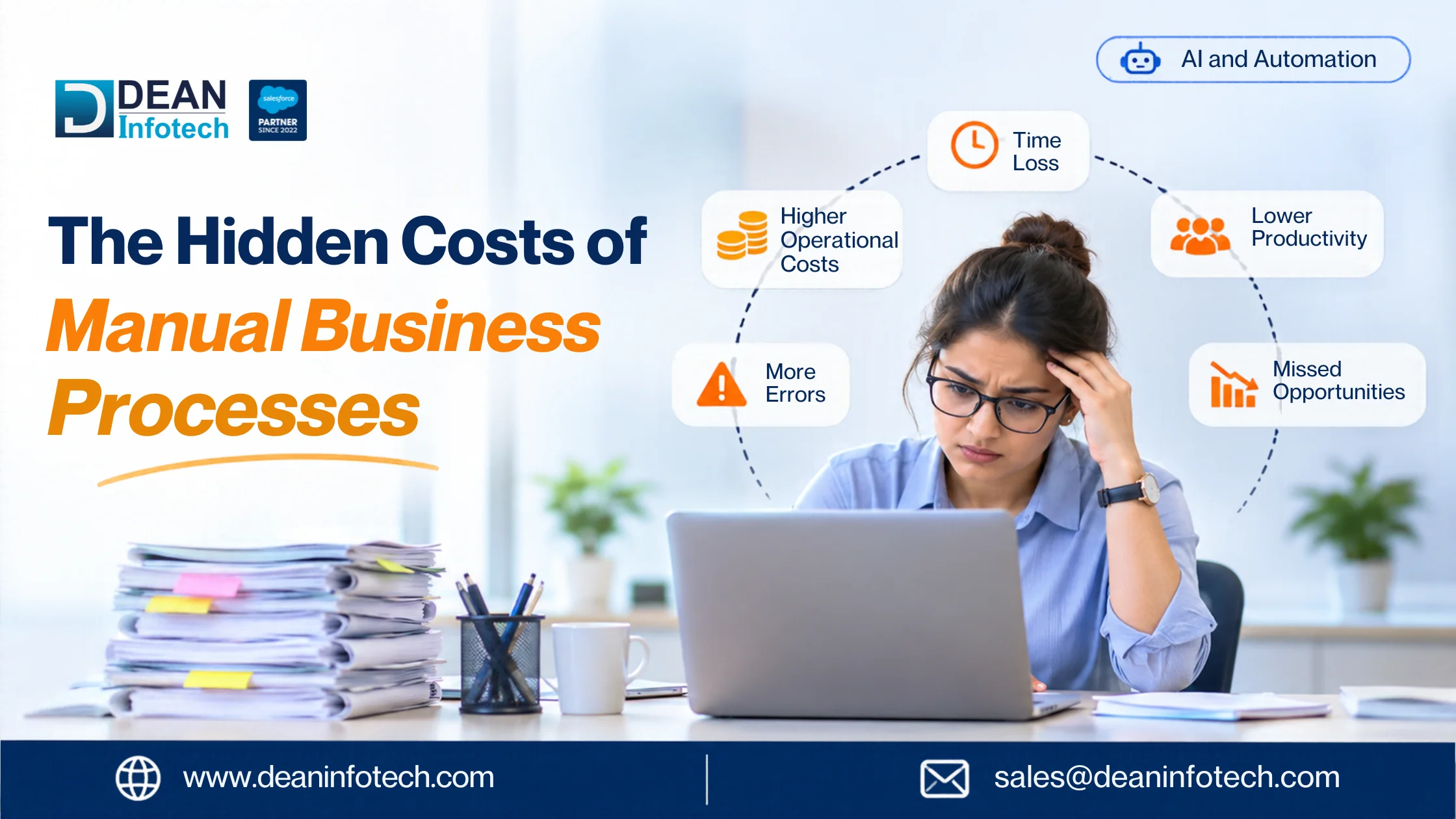
The problem gets worse when a business starts growing fast. More customers, more transactions, more documents, more internal requests, all of that just means more repetitive work piling onto employees. And if a company doesn't improve its processes along the way, it often ends up hiring more people just to keep up with routine work that shouldn't need that many hands in the first place.
How Do They Affect Productivity?
Productivity tends to take the first hit when manual work starts to build up. A workday only has so many hours in it, and every one of those hours spent on repetitive admin work is one less hour going toward the tasks that actually push the business forward.
Take someone on your team who's stuck gathering information, updating records, or churning out the same routine reports week after week. All that time comes straight out of what could've gone into talking to customers, digging into data, planning ahead, or solving actual problems.
There's also the bottleneck issue. When one person needs to wrap up their part before the next person can even start, a small delay on one end can hold up the whole chain. And the more work that comes in, the more those delays start to show.
That's really the value automation brings. It takes the repetitive load off people's hands, freeing them up to focus on the kind of work that genuinely needs human thinking and judgment.
How Do Manual Errors Impact Business?
The cost of human error, however, is one which tends not to be considered sufficiently when discussing the costs of manual processes. It is quite possible that a person will simply make an inputting error because the process is done every day, and the mistake may not even be noticed.
And even a tiny slip-up can turn into a lot more work. Someone has to spot the mistake, trace it back to where it started, fix it, and sometimes redo a whole chunk of the process. If that bad information already moved into another system, cleaning it up might mean looping in several departments just to sort it out.
Manual work also tends to create inconsistency, simply because different people handle the same task in their own way. Without a standard process to follow, keeping quality steady gets tougher the more a team or operation grows.
That's the real argument for cutting back on unnecessary manual steps. It keeps things more consistent and saves businesses from dealing with rework caused by mistakes that could've been avoided altogether.
How Can AI Automation Help?
The AI Automation system allows businesses to perform tedious processes using the help of intelligent systems to control the data and process decisions.
In place of forcing the employees to perform tedious processes, the automated tools can perform some activities based on the business logic and data. This could help decrease the tedious tasks and let the employees concentrate on tasks requiring communication skills and other special skills.
Automation processes can also enhance business responsiveness. Tedious processes can be done faster, data can be automatically managed, and some tasks can be undertaken without human intervention.
It is not about replacing a manual process with an automated process. Efficient automation is aimed at enhancing processes and cutting down unnecessary tasks.
Visit Here For More: Top 7 AI Tools for Customer Support: The 2026 Guide
What Is AI Workflow Automation?
AI workflow automation is less about automating one task at a time and more about automating how connected processes work together as a whole.
A single workflow can span several stages, multiple employees, different applications, and all kinds of information moving between them. Trying to manage all of that manually is where delays creep in, and where the chances of something going wrong start to add up.
With AI workflow automation, the right activities get coordinated across the whole process, and information moves between stages with a lot less human back-and-forth. Intelligent systems can also look at incoming information and figure out what should happen next, based on how the workflow is set up.
This really pays off for businesses handling a high volume of repetitive processes. Instead of employees constantly having to figure out what comes next, the workflow moves through its routine steps on its own and only brings people in when their input is genuinely needed.
Dean Infotech builds AI automation and workflow solutions that help businesses cut down on repetitive work and run their processes more efficiently.
How Does AI Integration Help?
Most modern businesses run on more than one software platform to keep operations moving. Customer data could exist in one system, financial data in another, and internal processes might be handled on a completely different toolset altogether.
What this means is that if these systems do not talk to each other properly, employees resort to manually moving information from one platform to another. This is a work in itself, but that also means there are more opportunities for the data to go stale or be entered incorrectly in-between.
This is where AI integration services factors in to fill the gap between existing business applications and infrastructure and solutions powered by AI. Get integration right and information moves more easily between systems, much of that tortious manual data wrangling just goes away.
This remains critically important for businesses with an existing software system. Instead of building and rebuilding everything from scratch, enterprises can hook the automation to what they already have.
Ultimately, a good integration strategy enables businesses to operate for the long haul and facilitates automation of scaling operations significantly.
When Is Custom AI Needed?
Not every business requires an entirely custom solution. For simple processes that have predictable requirements, standard automation platforms work just well enough. However, not all organizations operate with simple workflows and sets of data; some may have legacy systems to deal with or specialized industry-specific requirements, this is where things get more complicated.
In such scenarios, custom AI development services can provide an approach that is many times more personalized.
Going custom means businesses can build a solution around their actual processes, instead of trying to force every process to fit the limitations of an off-the-shelf tool. It can be shaped around existing systems, business rules, data requirements, security needs, and whatever the operational goals happen to be.
This kind of custom approach really shows its value when a business needs things like advanced document processing, specialized data analysis, intelligent customer interactions, or automation that spans several existing systems at once.
At the end of the day, the right approach comes down to how complex the process is, what technology infrastructure is already in place, how much work volume is involved, and what the organization is actually trying to achieve.
Conclusion
Manually driven processes may not appear to be overly costly. However, over time, the effects may prove to be more significant than expected. Hours spent on repetitive tasks, delays from waiting on approvals, data-entry mistakes, corrections that have to be redone, systems that don't talk to each other, all of this quietly builds into real operational cost.
Moving toward AI automation gives businesses a real chance to cut back on repetitive work and rethink how everyday processes get managed. AI workflow automation helps coordinate connected activities, AI integration services connect automation with the technology already in place, and for more complex needs, custom AI development services can build something tailored to the specific business.
The best point to begin would be with identifying where employees are wasting their time with redundant activities, and where mistakes and inefficiencies are constantly occurring. This way, the companies will be able to decide which processes should be automated and which require human intervention.
For companies that want to bring innovation into their processes, Dean Infotech can provide AI automation, AI workflow automation, integration, and custom development solutions built around different business needs.
Need expert help with your next project?
Get expert guidance across Salesforce, HubSpot, GoHighLevel (GHL), AI, and web development — tailored to your business.









Comments