The business enterprises of today collect the customer data from various platforms like CRMs, websites, marketing platforms, applications, and many more. Collecting all these types of information is important for delivering personalized experiences and data-based decisions. The Salesforce Data Cloud makes sure that the organizations bring all their data from various sources under one roof so that they get a holistic picture of the customers. It offers the ability to connect, analyze, and activate the data in real time and provides AI-based functionalities like Agentforce. Let us understand everything about the Salesforce Data Cloud in this article.
What Is Salesforce Data Cloud?
The Salesforce Data Cloud is an innovative platform that allows you to unify the information about your customers by combining data from different sources. It allows integrating data from Salesforce solutions, website, marketing tools, databases, other business applications and unifies the data to give a better understanding of your clients without using disconnected data sources.
Salesforce Data Cloud ingests, structures and harmonizes the data, which makes it possible to have all the necessary information at hand and use it for analyzing customers' behavior, building target segments, personalizing interactions and making data-driven decisions.
With proper Salesforce Data Cloud implementation, organizations will be able to connect to the relevant sources of data, build the data models, identify customers, and define how the information should be used in Salesforce solutions. After the configuration of the Data Cloud solution, you will be able to activate unified data for marketing, sales, service, analysis and AI-based workflows.
How Does Salesforce Data Cloud Work?
The functioning of the Salesforce Data Cloud involves integration of data from various sources, organization, matching of customer records and availability of the unified data for business purposes.
Data Ingestion: Data Cloud collects data from various Salesforce applications, web sites, databases, marketing platforms and other sources to offer businesses a platform to collect all their customer data together.
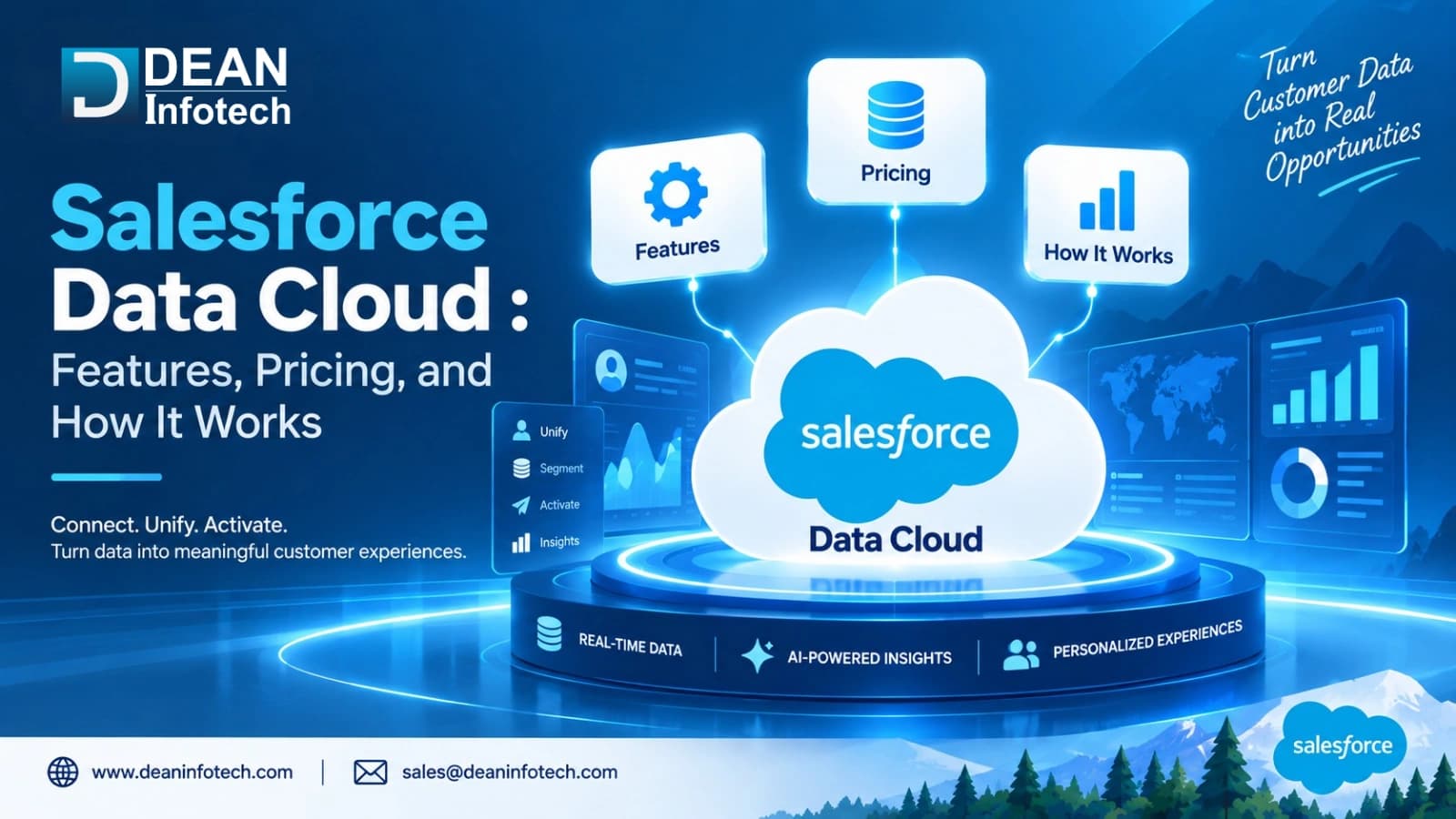
Data transformation: Raw data is transformed into a uniform structure which makes it easier for businesses to process data from various sources and avoid format or field duplicity problems.
Identity Resolution: Data Cloud matches records of the same customer even if the data is collected from various systems using matching logic, and provides a more comprehensive and integrated view of the customer.
Real-Time Data Activation: With data now integrated, organizations can leverage data across marketing, sales, service, analytics, and AI work flows. Segments can be built, customers can be personalized, actions triggered and relevant data provided to tools like Agentforce.
Do You Need Salesforce Data Cloud for Agentforce?
Agentforce is Salesforce’s AI agent service that is aimed at assisting enterprises to automate their processes and provide personalized customer experience. Although Agentforce could work with the existing data in Salesforce, having access to the unified, trustworthy and current data would greatly help with creating a better context for AI agents.
This is when Salesforce Data Cloud comes to play. With the help of Salesforce Data Cloud customer data from various sources is collected in one profile that will allow Agentforce to utilize bigger amounts of business data. During the Salesforce Data Cloud Implementation data sources are connected and information prepared for the usage by AI.
It is also possible to collaborate with a Salesforce Data Cloud Partner certified for planning, integration, and optimization purposes. Salesforce Data Cloud Consulting may assist in figuring out what data should be available to Agentforce and how it should be governed.
For companies having a complex structure, Salesforce Data Cloud managed services can guarantee that monitoring and optimization are continuous. Therefore, Data Cloud is not essential for Agentforce at all times, but it enhances the intelligence, relevancy, and efficiency of the AI agents.
Salesforce Data Cloud Features and Capabilities
There are certain characteristics of the Data Cloud of Salesforce that can help businesses to bring together customer data, learn from data and make the data actionable for sales, marketing, services, and AI processes. They are as follows:
Unified Data Management: Data Cloud is a tool that allows businesses to bring together data from Salesforce and other sources in one data ecosystem. This results in reduced cases of data silos and greater availability of data to employees of the company.
Data Ingestion and Integration: Businesses can bring together data from their CRM systems, website, applications, databases, and other sources of data. This becomes particularly important when talking about implementing Salesforce Data Cloud.
Identity Resolution: It can link customer records that come from multiple sources to form a consolidated profile. This reduces duplication in the records as well as enhances the precision of insights about customers.
Real-Time Data Processing: Usually Companies operate on customer data which is currently in nature in spite of just on old or batch processed data. This helps in making decisions for the upper level of the management based on up-to-date data obtained.
Segmentation & Activation: Salesforce Data Cloud performs user segments using customer characteristics, activities, and interactions. These segments help the companies in planning the right next move for the campaign and other marketing and sales activities
AI and Agentforce Support: With unified data, Salesforce AI agents have more customer context, which allows Agentforce to provide more and more relevant answers and make decisions appropriately.
Data Analytics and Insights: With the help of the Salesforce data cloud companies can leverage unified data obtained to find patterns, gain insight into customer behaviors, and apply data-driven decisions and strategies.
Businesses can take a lot of advantages of the Salesforce Data Cloud Consulting service in order to land on the right data architecture and integration planning. Working along with a Certified Salesforce Data Cloud Partner can be helpful in implementing, optimizing, and managing unified data. Based on business needs, Salesforce Data Cloud managed services can be helpful in maintaining data and platform performance after implementation.
Salesforce Data Cloud Pricing and Credits Explained
Pricing for Salesforce Data Cloud can be considered consumption-based, hence the price for its services may depend on the amount of data processed by the company and features used. Instead of being based on a traditional flat-rate pricing model, companies have to consider consumption-based credits for certain Data Cloud operations.
Model of consumption and credits: Credits may be provided for data ingestion, data processing, segmentation, and activation. The exact price will depend on the company’s needs in terms of consumption and usage of features, thus companies should estimate their data volumes in advance.
Determining factors for price: Volume of data, number of data sources, data processing frequency, integrations, segmentation needs, and the extent of activation can all impact the price of using Data Cloud services.
Cost of Implementation and Operation: Costs of the implementation and operation for the salesforce data cloud depends on many factors such as the way platform utilization is done, setup cost, data integration and data modeling, testing, and platform enablement. Companies require Salesforce Data Cloud Implementation Services for setup and integration while Salesforce Data Cloud managed services can assist companies with the post-launch support and optimization, data quality management, and platform maintenance.
Salesforce Data Cloud vs. Traditional Data Management Systems
Both Salesforce Data Cloud and traditional data management tools differ from each other primarily in terms of the process and ways by which customer data is collected, aggregated, and activated for the decision makers. Usually Traditional tools need separate databases and integration processes, whereas Salesforce Data Cloud is intended to simplify and facilitate the creation of a single data view for the companies.
Comparison Area | Salesforce Data Cloud | Traditional Data Management Systems |
Data Integration | Connects data from Salesforce and external sources | Often relies on multiple integrations |
Customer Data | Creates unified customer profiles | Data may remain separated across systems |
Data Processing | Supports near real-time data processing and activation | Often depends on scheduled or batch processing |
Identity Resolution | Matches records to build a more complete customer view | May require separate tools or manual matching |
AI Readiness | Provides unified context for AI and Agentforce | AI capabilities may require additional data preparation |
Data Activation | Can activate insights across Salesforce workflows | Often requires additional systems or integrations |
Scalability | Designed to support growing data and customer needs | Scaling may require additional infrastructure |
For organizations considering Salesforce Data Cloud Implementation, this difference can make it easier to connect customer data, improve insights, and support personalized experiences across sales, marketing, and service.
Salesforce Data Cloud Use Cases for Marketing Teams
Salesforce Data Cloud is suitable to resolve the issue of transforming the data about clients’ activities into useful information and organize individualized marketing offers. The tool allows the marketers to gather the data from different sources into one database.
Customer Segmentation: Marketers are able to define accurate audience segments by making use of various customer characteristics, behaviors, transactions, etc.
Customized Campaigns: Customized campaigns can be initiated with the help of a single customer profile.
Customer Journey Analytics: The Data Cloud offers a wider perspective of customer engagement through various channels, and thus, it assists in analyzing ways in which the customer journey can be optimized.
Real Time Marketing: Marketers can react to the ongoing activities of customers and initiate marketing campaigns according to their changing behaviors.
Using Salesforce Data Cloud Consulting, companies can determine the appropriate use cases for marketing and data sources required by them. Further, using Salesforce Data Cloud Implementation Services, these data can be connected and activated for marketing purposes.
Salesforce Data Cloud Benefits for Small Businesses
The Salesforce Data Cloud enables smaller businesses to be able to use the information about customers more effectively without the problem of fragmented data handling through various systems.
Insight into the customer: The idea of having a single view of the customer implies getting insights into their behavior and preferences.
Automation: Data integration will enable automation in marketing, sales, and services.
Scalability of data management: With the growth of a company, Data Cloud can assist in managing the growing volume of customer data and linking new data sources.
Salesforce Data Cloud managed services might be handy for companies that have limited technical support because these managed services let a company watch over, refine, and administer its data while employees focus more on customers.
Final Thoughts
Salesforce Data Cloud gives companies a kind of practical way to gather all their customer data in one place,boost their overall visibility, and then actually pull useful insights for marketing , sales , service, and also AI operations. With things like real time data processing and Agentforce, the platform’s capabilities can be used by organizations to design a more connected customer experience, at least that’s the idea. Still, to get the best results, a proper Salesforce Data Cloud Implementation will have to happen, otherwise it’s easy to underuse it. With the Salesforce Consulting & Implementation Services from Dean Infotech, companies can use Data Cloud in line with what their data requirements are, and then make it feel more… coherent in practice.
Need expert help with your next project?
Get expert guidance across Salesforce, HubSpot, GoHighLevel (GHL), AI, and web development — tailored to your business.






Comments