
Why Salesforce Data Cloud Is No Longer Optional for Salesforce Teams

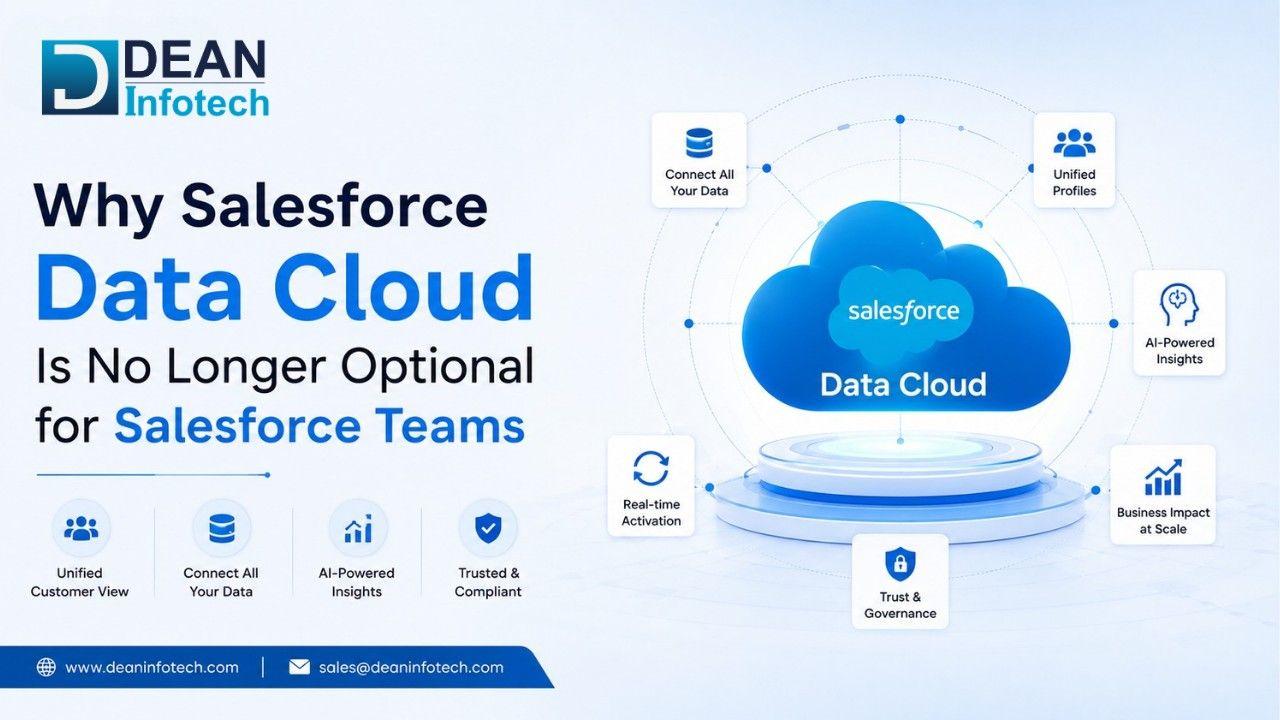
Customer data has always been one of the most valuable assets for any business, but it is often stored on multiple systems. This makes providing a consistent customer experience across channels and interactions a challenge. The sales, marketing, service, and commerce teams often have outdated and fragmented information, which makes their interactions disconnected and sluggish.
As per Salesforce, the data cloud handles over 30 trillion records on a monthly basis for the purpose of unifying customer data and supporting AI-powered experiences at a large scale. Faster adoption signifies the crucial need for centralised and real-time customer data for businesses today.
While organisations continually increase investments in AI, automation, and customised customer engagement strategies, having a single customer data platform (CDP) is no longer a competitive differentiator for any firm. It has become a business imperative.
Salesforce Data Cloud allows organisations to unify data across sources and channels, build a single customer record, and activate that data across the Salesforce platform. When implemented successfully, Salesforce Data Cloud can accelerate customer engagement, make business operations more efficient, and prepare organisations to make better decisions powered by AI.
What Is Salesforce Data Cloud?
Built for Salesforce users, a Customer Data Platform Salesforce solution, Salesforce Data Cloud, enables organisations to unify various customer data sources in a single location. It aggregates both structured and unstructured data from Salesforce applications, other business systems, websites, mobile applications and third-party platforms into a complete customer profile.
While traditional data administration solutions work on set updates, Salesforce Data Cloud gathers and unifies data near-time, providing all teams with real-time, accurate customer data.
The platform also deduplicates records, normalises customer identities and creates a single customer view. Instead of creating separate data silos for sales, marketing, customer service, and commerce, companies can now make this reliable information accessible to all departments.
This data foundation can only grow more important with the proliferation of AI-enabled initiatives. As AI models require trustworthy, federated data to learn from, Salesforce AI Data Cloud is able to enable robust insights, tailored recommendations, and intelligent automation.
Why Data Cloud Is No Longer Optional for Salesforce Teams
As organisations grow and store ever-increasing amounts of customer data, maintaining disconnected data sources can be an arduous task. Using many separate databases and siloed applications leads to duplicate records, inconsistent reports and a disjointed customer experience. Salesforce Data Cloud solves this problem by enabling a connected data ecosystem, no matter which customer-facing team is involved.
Create a Unified Customer View
Customer data may live on CRM systems, marketing automation systems, eCommerce applications, ERP tools, support solutions or third-party databases. Without a single platform that brings the data together, various departments are working from different versions of the same customer.
Salesforce Data Cloud pulls together all those disparate sources into one customer profile. So your sales team can view the history of each customer, your marketers can target more meaningful campaigns, and your service teams can fix issues in the right context.
Instead of toggling between different systems, employees can confidently rely on one comprehensive single source of truth for a more complete view of the customer. A single source of truth regarding the customer also enables greater collaboration across functions, which decreases costly operational inefficiencies.
Improve AI Readiness Across the Organisation
The success of AI hinges on quality, comprehensive and up-to-date data, so all organisations planning to bring AI into the fold should identify their data needs first. Salesforce AI Data Cloud is designed to help companies prepare themselves for AI by defining customers’ data, giving it a common structure and managing them as connected profiles, so that AI generates more accurate predictions, recommendations and workflows.
No matter if a company intends to deploy an AI assistant, smart customer support, or predictive sales information, Data Cloud offers the dependable data architecture needed to bring these features to life.
Enable Better Personalisation
What customers ultimately want: Personalised offerings made to meet our individual preferences in “every touch point”. So how does this work? By incorporating the data into their new CRM platform, Salesforce Data Cloud is constantly updating individual customer profiles for Marketing, Sales and Customer Service to predict and personalise services.
To avoid operating on stale information, companies could address customer interactions almost immediately.
Strengthen Data Quality and Governance
The other aspect of CRM which is most concerning is the quality of data. Bad quality of data can also bring down the efficiency of CRM applications. Duplicate records, missing customer data and inconsistent data can easily make reporting inaccurate and lead to wrong business decisions.
Using identity resolution and data unification, Salesforce Data Cloud helps to enhance overall data quality while staying within governance boundaries. Companies can be more confident about their reporting, forecasting, and analytics as each department operates with a consistent set of customer data.
Long-term digital transformation. Companies with a long-term digital transformation plan can use the investment to solve other digital needs while already implementing the Sales Data Cloud.
Support Every CRM Function
Modern CRM adds so much more to managing customer contacts. It links sales, marketing, service and commerce into one customer experience. Data Cloud for CRM enables all of your Salesforce apps to make use of unified customer intelligence. Sales reps get a lot of customer intelligence before reaching prospects. The marketing team can optimise their segmentation and campaign execution. Service technicians have instant access to customer history, reducing resolution times and improving customer satisfaction.
This integrated method closes the gaps in information and allows organisations to create a more consistent experience across the customer lifecycle.
Salesforce Data Cloud vs Traditional CRM Data Management
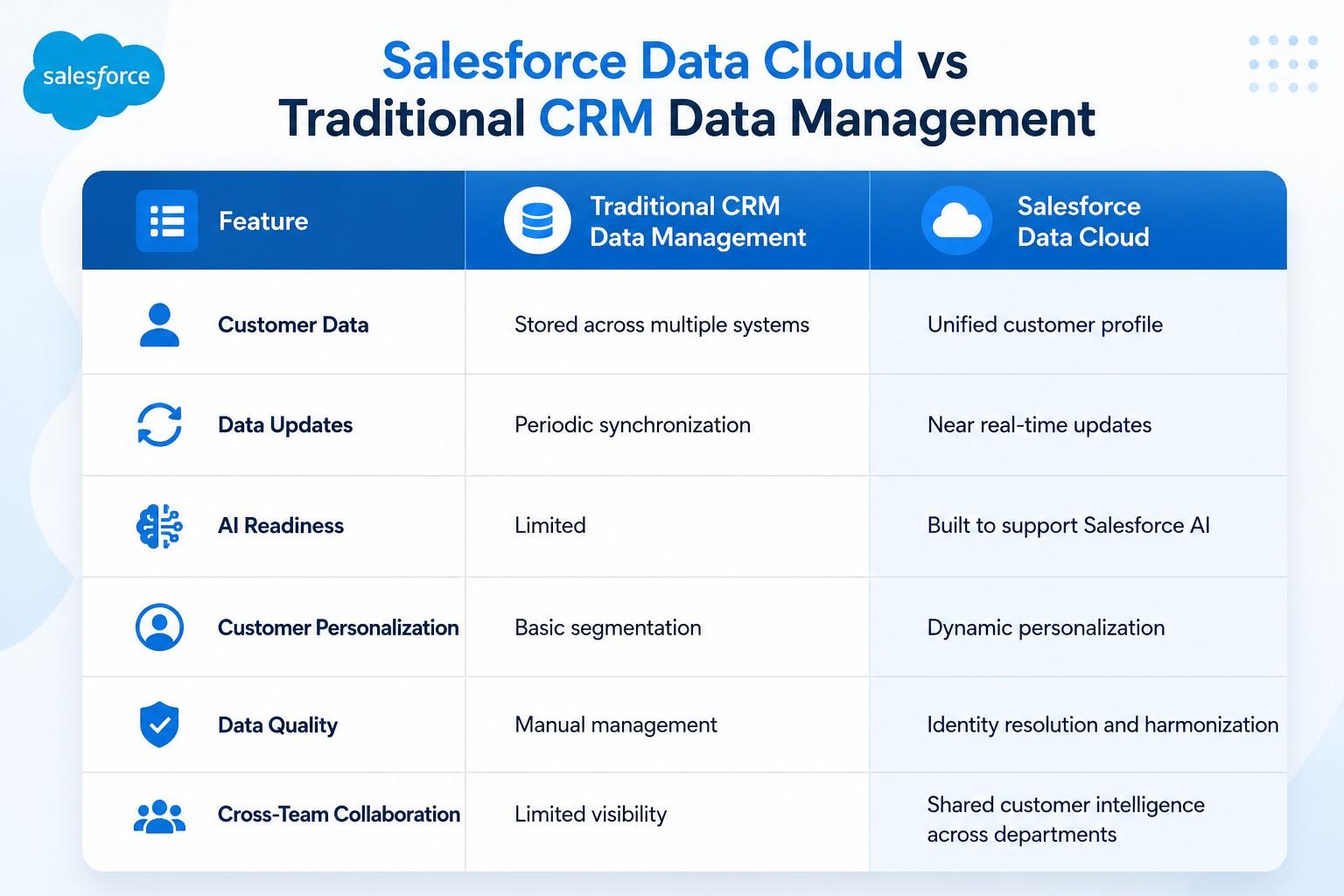
At this point in their digital transformation experience, several organisations turn to seasoned Salesforce practitioners for assistance. Dean Infotech guides its clients to strategise and implement Salesforce Data Cloud projects that highlight their CRM and AI adoption aspirations with a smooth integration into current enterprise applications.
Salesforce Data Cloud Implementation: Key Considerations
Implementing Salesforce Data Cloud is not just about connecting data sources. There is a systematic process that needs to be followed to make sure data is accurate, complete, and fit for the purpose of driving business activities and AI applications.
The initial stage is to determine the various customer data sources throughout the organisation. This can encompass Salesforce CRM, marketing automation technology, ERP solutions, eCommerce applications, customer support tools, and external repositories. Combining all of these sources forms the basis for a comprehensive customer view.
Thirdly, it‘s crucial for businesses to ensure data quality. Align formats, eliminate duplicates, and resolve customer identities to create reliable unified profiles. High-quality data enables more efficient reporting, personalisation, and AI-based recommendations.
Another key consideration is how the cross-cloud data will be utilised. Sales, marketing, service, and commerce teams frequently have divergent goals, so companies need to determine potential use cases such as refining customer segmentation or service experiences, or generating predictive insights ahead of time. Understanding how to focus the utilisation of the Data Cloud investment will maximise its value.
Security and governance should also be monitored during implementation. The implementation team (and other impacted teams) must define the necessary data access controls and governance policies to comply, yet still enable teams to access trusted customer information.
Implementation activities touch several systems and business processes. Working with seasoned experts can make the process smoother and faster. Dean Infotech provides organisations with Salesforce Data Cloud consulting to assist in developing a strong implementation plan that is scalable and aligns with the organisation‘s long-term CRM and digital transformation goals.
Choosing the Right Salesforce Data Cloud Partner
The needs of the organisation and the capabilities of the technology can influence the success of a Data Cloud initiative. Choosing the right Salesforce Data Cloud partner allows companies to leverage the power of the platform and steer clear of typical implementation pitfalls.
When assessing a partner, don’t check the surface details. The right partner is one who is fluent in Salesforce technology as well as in your business processes, and can recommend solutions that produce results. Some important factors to consider include:
Experience implementing in the Salesforce ecosystem.
Familiarity with customer data integration and identity resolution.
Knowledge of automation and AI features in Salesforce.
End-to-end data architecture, Ability to design scalable data architectures.
Continuous support, enhancement and user adoption.
A ready implementation partner will also help ensure the correct use case choices are made, existing systems are integrated as smoothly as possible, and that Data Cloud is of the right architecture to support future AI plans as the business evolves. When strategic direction is coupled with technical expertise, enterprises can shorten implementation times and enhance user adoption and ultimate ROI.
Conclusion
As customer expectations keep changing, isolated data is emerging as a hurdle in providing a customised experience and making better business decisions. Businesses require a centralised data platform which empowers each department for customer-centric activities with accurate data.
Salesforce Data Cloud meets this challenge by aggregating data from various sources, developing unified profiles of our customers, and enabling AI-driven insights all over the Salesforce platform. If we are looking to better personalise experiences for our customers, better enable collaboration internally, or leverage the latest in AI capabilities, Data Cloud offers the infrastructure to get it done.
A well-designed Salesforce Data Cloud implementation, managed by a well-seasoned Salesforce Data Cloud consultant, enables businesses to harness the value of their CRM investments and create a scalable platform for growth.






Comments