Artificial intelligence isn’t strictly confined to chatbots and workflow automation. Companies are now seeking new ways to streamline complete processes, cut operational expenses, enhance customer satisfaction, and speed up decision-making. This transition has brought about hyperautomation, one of the most significant business technology trends of 2026.
Research by Gartner suggests that organizations based around hyperautomation initiatives are seeing a major boost to operational efficiency and reduced manual work within business operations. As digital transformation speeds up, hyperautomation is being seen as a key strategic factor for sustainable growth in the future.
What sets it apart from conventional automation, which emphasizes automating one single task at a time, is that hyperautomation integrates numerous technologies. This is done to automate entire business processes.
So, whether it's automating customer onboarding and invoice processing or delivering intelligent customer support and predicting the next best action, hyperautomation helps to enable companies. This further results in being faster, smarter, and more productive than ever before.
Let's look at what hyperautomation is and how it compares to automation, the technology behind hyperautomation, the advantages it provides, and the leading uses for hyperautomation by businesses in 2026.
What is Hyperautomation?
Hyperautomation is a business-centric method integrating various advanced technologies meant for automating complex processes throughout an enterprise.
Rather than working on only one task or a workflow, hyperautomation is intended to automate business processes through the integration of:
- Artificial Intelligence (AI)
- Robotic Process Automation (RPA)
- Machine Learning (ML)
- Process Mining
- Intelligent Document Processing
- Business Process Management (BPM)
- AI Agents
- Low-Code and No-Code Platforms
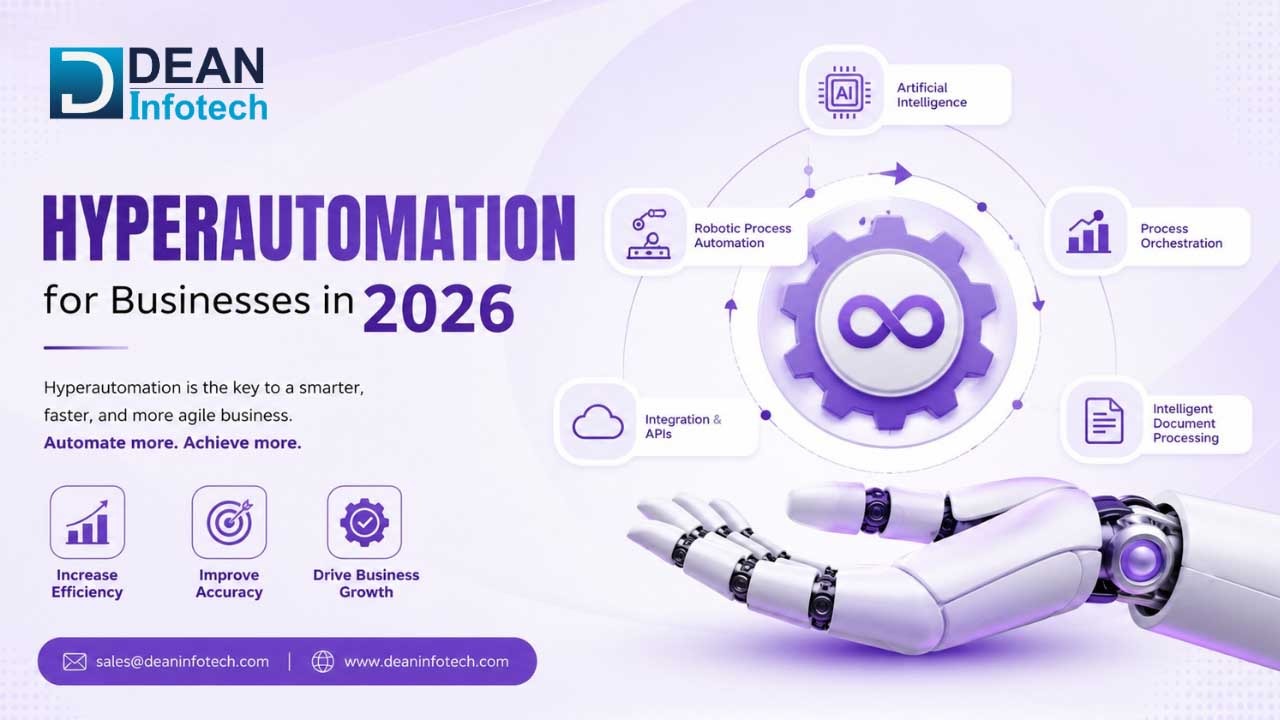
The aim is to find opportunities for automation, to analyze the workflow and to design intelligent systems that can automate the business processes as much as possible. Because hyperautomation enables them to provide more than point solutions for a single, siloed automation project, organizations are investing more heavily in AI automation services.
Why Hyperautomation Matters in 2026
Businesses face growing pressure to:
- To reduce operating costs
- Increase employee output
- Improve customer experiences
- Driving acceleration in digital transformation
- Scale-up operations
Automation that is used traditionally helps automate repetitive work; however, the use of modern automation is required nowadays, which is integrated across departments and systems and drives workflow.
Hyperautomation fulfills these requirements by building intelligent automation ecosystems that enable ongoing adjustments of the company's processes.
Most of the Dean Infotech enterprise learners we work with try to utilize hyperautomation approaches. To break through operational bottlenecks and build scalable digital workflows to enable sustainable growth is among their objectives.
What is the Difference Between Hyperautomation and Automation?
Despite being used synonymously, however, automation and hyperautomation are not the same.
Factor | Traditional Automation | Hyperautomation |
| Scope | Individual tasks | End-to-end processes |
| Technology | Single tool | Multiple technologies |
| Intelligence | Rule-based | AI-driven |
| Scalability | Moderate | High |
| Decision-Making | Limited | Advanced |
| Learning Capability | No | Yes |
| Cross-System Integration | Limited | Extensive |
| Business Impact | Incremental | Transformational |
An example using a conventional automation workflow might create an invoice. With hyperautomation, the solution is able to create the invoice, validate customer details, check for irregularities, approve the transaction, trigger notifications and update ERP systems.
Businesses that implement Workflow automation services continue to see Hyperautomation as the next stage of business process redesign.
Core Technologies Behind Hyperautomation
Hyperautomation is a combination of various technologies.
Artificial Intelligence (AI)
Artificial intelligence is the ability of a computer program or a machine to think, learn and solve problems. It gives a system the capabilities to reason, to mimic human skills and even more. It involves decision-making, identifying objects and their recognition, understanding natural language and creating new knowledge.
It is fundamental to the intelligent automation enterprise.
Robotic Process Automation (RPA)
RPA ( Robotic Process Automation). RPA works on rules for repetitive jobs.
Examples include:
- Data entry
- Form processing
- System updates
- Generation of report
- Machine Learning (ML)
- Process Mining
It shows that the processes in the business are not being utilized efficiently. List all inefficiencies and bottlenecks in the business.
Organizations also use it to find automation opportunities and improve their workflows.
Intelligent Document Processing (IDP)
IDP enables the business to extract data or information from invoices, contracts, forms, etc.
AI Agents
Self-autonomous AI agents are increasingly more relevant in the hyperautomation ecosystem.
Most of the organizations researching intelligent business processes deploy advanced AI agent workflows to speed up decision-making and streamline business workflows.
Key Benefits of Hyperautomation
Increased Operational Efficiency
Hyperautomation takes care of ongoing manual chores and automates workflows among functions.
This result allows employees to work on strategic and customer-facing activities.
Reduced Operating Costs
Reduced operator needs and enhanced resource recovery can also help in reducing operational costs.
Faster Decision-Making
AI insights enable organizations to make data-driven decisions in near real time.
Improved Customer Experience
Automated workflows allow for faster responses and customized and proactive customer interactions.
Better Scalability
Can disproportionately increase load capacity without a proportional need for additional staff.
Enhanced Accuracy
Automation improves the accuracy and reduces human errors in business processes.
Greater Visibility
These systems allow reporting from a central point and operational visibility.
Many types of corporations associate hyperautomation endeavours with their Intelligent workflow automation policies to develop more flexible and scalable business processes.
Uses of Hyperautomation by Businesses in 2026
1. Customer Onboarding Automation
Companies are automating the customer onboarding process that involves the registration of a new account, validation of documents, welcome communication and updates to the CRM.
This enhances customer experience and minimizes onboarding durations.
2. Intelligent Customer Support
Automated systems using Artificial Intelligence are capable of handling support requests, solving frequently occurring problems, routing tickets, and escalating difficult issues.
Service hyperautomation, together with AI automation, is increasingly used in organizations to enhance service quality and provide quicker responses.
3. Lead Qualification and Sales Automation
Sales teams use hyperautomation to:
- Score leaders
- Schedule meetings
- Trigger follow-up campaigns
- Update CRM records
As this improves productivity. It enhances the conversion rate.
4. Invoice Processing and Accounts Payable
Finance departments automate tasks around invoice validation, approval, payment and reporting workflows.
This alleviates some administrative burden and increases the completeness of data entry.
5. Employee Onboarding
Human resources teams automate:
- Collecting documents
- Checks for CPSS utilization
- Training assignments
- Requests for access to systems
6. Marketing Campaign Automation
Marketing teams use hyperautomation to:
- Segment audiences
- Use customized communications
- Optimize campaigns
- Analyze performance
These aim to be integrated with other initiatives, along with the use of marketing strategies enabled by AI, to enhance participation and ROI.
7. Supply Chain Optimization
Hyperautomation enables companies to keep track of their inventory levels, forecast demand, handle suppliers, and automate the purchasing processes.
Enhances operational resilience and minimizes disruption.
8. Fraud Detection and Compliance Monitoring
The AI platform constantly monitors transactions and highlights any suspicious activity that could lead to fraud and compliance issues.
9. IT Service Management
IT automation of incident handling, ticket routing, user provisioning, and system monitoring.
Which promotes the quality of service that reduces the time response.
10. Revenue Operations and CRM Management
Customer Life Cycle Management, Forecasting, Reporting, and Revenue Operations are also becoming more and more automated by Businesses.
When a company wants to go from a managed I/O Elico structured HubSpot AI implementation strategy to an enterprise-hyperautomation initiative, they often start with the initial I/O Elico structured HubSpot AI implementation strategy.
Challenges of Hyperautomation Implementation
Implementing hyperautomation is not just about adopting new technology. Businesses also need the right processes, quality data, and a clear implementation plan to get the best results. Without proper planning, organizations may face delays, higher costs, and lower adoption.
Understanding the common challenges in advance helps organizations prepare for implementation, minimize risks, and maximize the value of their automation investments and with the right strategy, businesses can ensure that hyperautomation delivers measurable improvements. This is mainly done for efficiency, productivity, and customer experience.
Integrating with Existing Systems
Many businesses use multiple software applications and legacy systems that have been built over several years. Connecting these systems with a hyperautomation platform can be challenging, especially if they use different technologies or data formats. Proper integration planning helps ensure smooth data flow between applications, reduces disruptions, and allows automation to work seamlessly across departments.
Governance and Compliance
As businesses use automation in more areas, they need clear rules to manage it properly. These rules help control who can access the system, keep customer and business data safe, and make sure the company follows industry regulations. It is also important to track automated processes and keep accurate records. Setting these rules from the beginning helps avoid future problems. It also makes automation more secure, easier to manage, and more reliable as the business continues to grow.
Choosing the Right Processes
Not every business process is suitable for hyperautomation and automating highly repetitive, rule-based, and time-consuming tasks usually delivers the greatest return on investment. Organizations should first evaluate their workflows. This primarily helps to identify areas where automation can reduce manual effort. It also helps in improving accuracy and increasing productivity before expanding to more complex business processes.
Scaling Automation
Many businesses begin their hyperautomation journey with a small pilot project before expanding automation across multiple departments. While this approach reduces implementation risks, scaling automation successfully requires standardized processes, continuous monitoring, and a clear long-term roadmap and a structured implementation strategy that helps businesses expand automation efficiently while maintaining consistency, and governance across the organization.
Conclusion
How hyperautomation is evolving fast and changing the way businesses operate in 2026.
Companies are now integrating AI and RPA, with machine learning, process mining and intelligent workflows, so they are able to fully automate how their business works and not just pick off individual processes to automate. This leads to improved efficiencies, a reduction in operating costs and enhanced customer experiences while ensuring stronger, scalable growth.
Moreover, worldwide competition is escalating, and the expectations of customers are to keep getting better. The companies that take full advantage of hyperautomation will have the opportunity to keep on innovating and excel in operations.
No matter if it is via AI automation services, workflow automation services, automation consulting services, hyperautomation implementation services or AI agent development services, those who and organizations that devote themselves to intelligent automation today will be the builders of growth in the future.
Need expert help with your next project?
Get expert guidance across Salesforce, HubSpot, GoHighLevel (GHL), AI, and web development — tailored to your business.









Comments