Companies today are throwing serious money at AI and automation , trying to cut repetitive work, make customer experiences smoother, and just run leaner overall. But buying new tech doesn't guarantee it'll actually work out for you. Without a real strategy behind it, businesses can end up spending a fortune on tools that patch one small issue while leaving the bigger problems untouched.
A smart AI and automation strategy doesn't start with the technology; it starts with the business itself. That means figuring out where time is slipping away, which processes are quietly costing more than they should, and where making faster decisions could actually move the needle.
And the point isn't to automate everything you possibly can. It's to be selective, to zero in on the automation projects that will genuinely move metrics that matter: productivity, service quality, costs, revenue, or how happy your customers are.
AI Automation Strategy: Where to Start
Before you go shopping for automation tools, take a step back and ask a more basic question: what does your business actually need to improve? Take some time to pin down three to five priorities that would genuinely make a difference, things like:
Cutting operational costs
Making your team more productive
Responding to customers faster
Closing more deals
Delivering better customer service
Reducing errors
Staying on top of compliance
Getting a clearer picture of how your processes actually work
Once you've got a handle on what matters most, go looking for automation opportunities that fit those priorities. Say one of yours is bringing down customer service costs — look at what's actually chewing up your team's time: sorting through tickets, tracking down information, following up with customers, sending status updates. These are the repetitive, predictable tasks automation handles well.
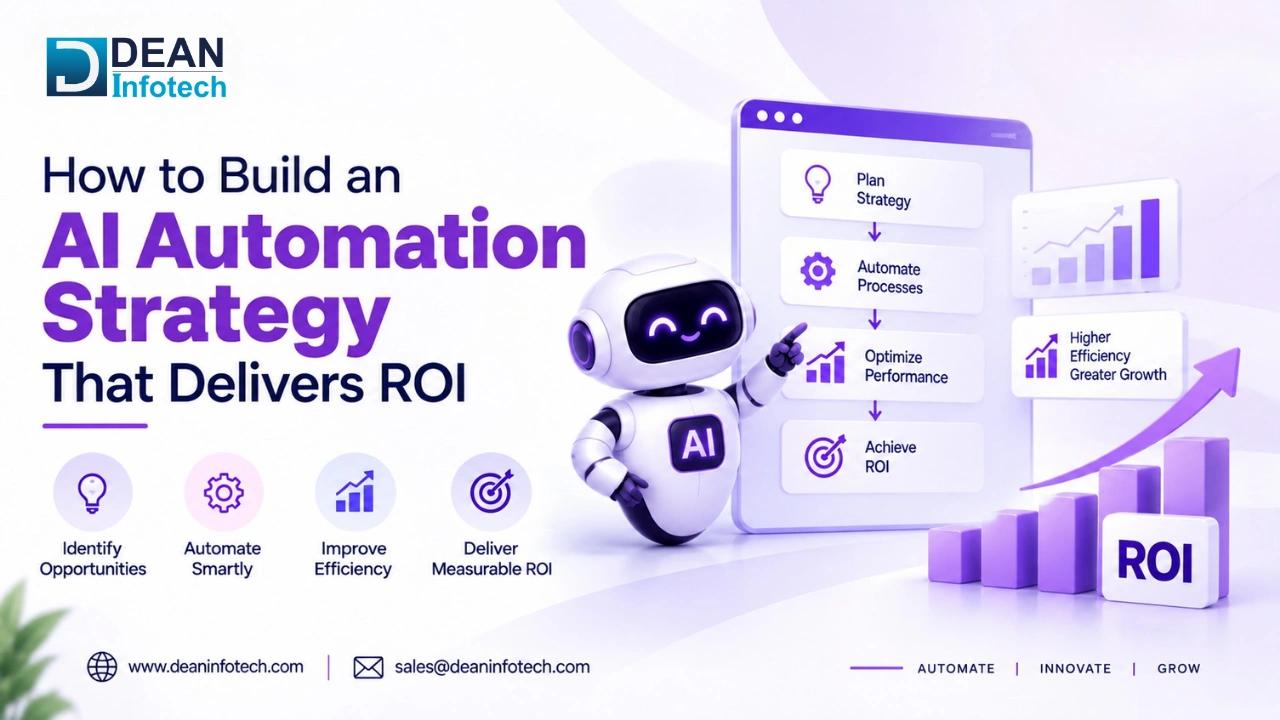
But identifying opportunities isn't enough on its own. A solid strategy also needs to spell out who owns what, what data you'll need, how you'll govern the system, what tech has to be in place, and how you'll measure ROI, all before you start building anything.
Identifying Processes Ready for Automation
Automation isn't the right call for every process. The ones worth automating usually check a few boxes: they happen a lot, follow rules that don't really change, and you can point to a clear result once they're done.
So where do you start? Take a look at what's eating up your team's time. Common culprits:
Copying data from one system into another
Typing in or double-checking information by hand
Answering the same customer questions on repeat
Putting together the same reports week after week
Combing through piles of documents
Booking appointments and chasing follow-ups
Sorting incoming requests into categories
Firing off reminders
Running the same checks on data, again and again
Once you've got that list, ask two questions for each item: how much impact would fixing this have, and how much work would it take? The best place to start is usually where the impact is high, but the effort is low; those wins come fast, and they give your team a real feel for what automation can actually do before you tackle the bigger stuff.
Setting Clear AI ROI Goals
You need to know what ROI looks like before you start building, not after the thing's already live.
That starts with a baseline. Before you touch anything, write down where things currently stand:
Processing time
Employee hours
Operational cost
Error rate
Customer response time
Conversion rate
Resolution rate
Revenue per transaction
From there, set a target. Maybe you want to cut invoice processing from two days down to four hours. Maybe it's getting customer response time from ten minutes to under one. Whatever it is, put a number on it.
But don't just chase the dollar figure. Quicker decisions, happier customers, fewer mistakes, employees freed up to do higher-value work; these matter too, even if they're harder to put on a spreadsheet.
Choosing the Right AI Agent
An AI agent does what you tell it to, working off a set of rules, whatever data it has access to, and the systems it's plugged into. Which type of agent you need really comes down to how complicated the workflow is.
For simple stuff, a basic task-focused agent will usually get the job done. Think sorting incoming customer requests or pulling info from a knowledge base — nothing fancy required.
But for more complicated use cases, you need an agent that can actually work through a process, not just execute a single step. That means it needs to be able to:
Understand what's being asked
Go gather the relevant information
Weigh the options in front of it
Take action
Check whether that action actually worked
Know when to hand things off to a human
When you're picking between agents, don't just look at one thing. Factor in accuracy, what it takes to integrate, how it accesses data, security, whether it can scale, how well you can monitor it, and how much human oversight the process actually needs.
And here's the thing to keep in mind: the goal isn't to pick the fanciest, most advanced agent on the market. It's to pick the one that'll actually get the job done, reliably, every time.
Building Agentic AI Solutions
Agentic AI really isn't meant for handling a single task in isolation; it's built for workflows where multiple steps and decisions all have to happen in sequence, one leading into the next.
Take procurement, for example. Instead of an agent that just pulls information off a purchase request and stops there, imagine one that actually works the whole process:
Reads the request
Checks what's in stock
Looks into supplier details
Weighs the available options
Confirms it meets approval requirements
Updates the procurement system
Let's let the right person know it's done
That's the difference: you're not automating a single step; you're connecting an entire process.
That said, picking a good model is only part of the equation. Whether this actually works in production comes down to things like data quality, who has access to what, how business terms are defined, how everything's integrated, and how well you're evaluating and monitoring it along the way. Alation's take on this lines up: data quality, governance, and integration are foundational requirements for building AI agents that can operate reliably at enterprise scale.
Automating End-to-End Workflows
One of the biggest mistakes companies make is automating individual tasks without considering the complete workflow.
Suppose an employee spends time receiving a customer request, checking a CRM, searching internal documents, preparing a response, updating records, and sending a follow-up.
Automating only the response-writing step may save a few minutes. Automating the complete sequence can create a much larger operational benefit.
This approach allows businesses to focus on the outcome rather than individual tasks.
For example, a sales workflow could automatically identify new leads, enrich lead information, assign a priority, update the CRM, schedule follow-ups, and notify the sales representative.
This is where AI Workflow Automation Services can help businesses redesign processes rather than simply automate existing manual steps. It's about rethinking the whole thing from the ground up.
Using AI Workflow Automation Services
Putting together an automation strategy on your own is hard, especially if your team hasn't spent much time on things like process mapping, integrations, agent architecture, security, or figuring out how to measure ROI. That's where AI automation services really earn their keep. A good provider can guide you through the whole journey:
Process discovery
Automation opportunity assessment
Solution architecture
Agent development
Workflow design
API integration
Testing
Deployment
Monitoring
Optimization
If your needs don't fit neatly into a standard package, custom AI development gives you a lot more flexibility than off-the-shelf tools ever could.
But technical chops aren't the whole story. What actually matters is finding a partner who gets your business, not just your tech stack. The best automation projects don't start with a cool tool; they start with a real problem, and they end with results you can actually see.
Measuring AI Performance and ROI
Organizations should keep an eye on important metrics such as cost savings, productivity,accuracy, processing time ,time taken for the task, and the revenue effect, so they can see whether automation is actually creating measurable business value. Operational measures might cover processing time, automation rate , error rate, response time , resolution time, employee productivity , and task completion rate. Business measures can include cost savings, revenue growth, conversion rate, customer retention, customer satisfaction, revenue per employee, and the payback period. And it can help to split things into leading and lagging indicators: adoption, usage, and workflow completion can show whether the solution is being used effectively, whereas cost savings and revenue impact show the later business consequences.
Optimizing AI Automation for Long-Term Growth
Automation should not be viewed as some sort of one time project, because business processes, data, customer expectations, and technology kind of keep moving, evolving continually. Regular reviews will help surface where workflows need to be adjusted, and organizations should put in a feedback loop to check accuracy,cost, adoption, processing speed, exceptions, escalations, plus customer outcomes. If a workflow is starting to underperform, teams need to decide whether to modify it, retrain, redesign it, or just discontinue it entirely. SAP also suggests maintaining an ongoing feedback loop, to keep refining solutions, uncover additional use cases, and sustain business value as time goes on.
Conclusion
If you want automation to really deliver business value, then technology and business goals have to start moving in the same direction , not like two separate trains. Instead of automating just because a process can be automated, look harder at workflows that can make a measurable impact. That could mean making things faster, trimming costs, boosting productivity, upgrading customer experience, or pushing revenue higher.
Want to turn automation into measurable business value? Team up with Dean Infotech to spot high-impact opportunities, map out the correct automation strategy, and deploy scalable AI and automation solutions that fit your business needs and take the next step toward smarter operations, more efficient work, and better outcomes.
Need expert help with your next project?
Get expert guidance across Salesforce, HubSpot, GoHighLevel (GHL), AI, and web development — tailored to your business.









Comments