Most marketing agencies hit a ceiling around the same point. You've got a handful of retainer clients, decent margins, and a team that's stretched thin trading hours for dollars. Scaling past that usually means hiring more people or raising prices, and both come with limits.
GoHighLevel white label is how a lot of agencies get past that ceiling without either option. Instead of just using GoHighLevel to deliver services, you rebrand the entire platform as your own software, your logo, your domain, your pricing and sell it directly to clients as a product they pay you for every month. GoHighLevel disappears from view entirely; clients only ever see your brand.
This isn't a repackaged reseller trick. GoHighLevel built the white labeling and SaaS infrastructure directly into the platform, which is part of why so many agencies have shifted from pure service delivery toward a hybrid or fully software-based revenue model over the past few years. If you're already running GoHighLevel for client development work, white labeling is often the next logical step rather than a separate decision.
In this guide, we'll break down what GoHighLevel white labeling actually includes, what agencies can customize, the exact steps to set it up, mistakes to avoid, and how the economics compare to running a traditional agency model.
Understanding GoHighLevel White Labeling
People often use "white label" and "SaaS Mode" interchangeably when talking about GoHighLevel, but they're not quite the same thing, and mixing them up is where a lot of agencies get confused before they've even started.
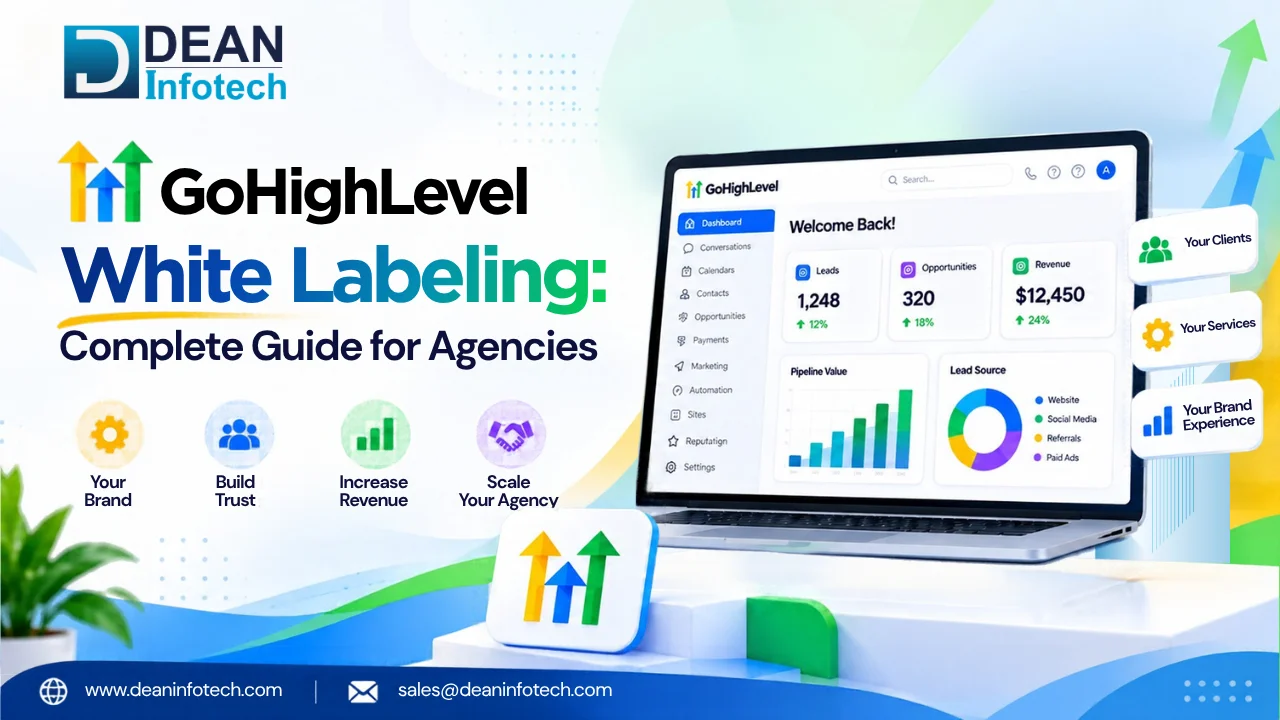
At its core, white labeling means stripping every visible trace of GoHighLevel from the platform and replacing it with your own agency's identity. Your logo instead of theirs. Your custom domain instead of app.gohighlevel.com. Your brand colors, your platform name in the browser tab, your name on outbound emails. Clients log in and see software that looks like it was built in-house by your agency, not a rebranded product.
This visual layer is available once you move up from GoHighLevel's entry-level plan. It covers the desktop experience, custom domain setup, and branded login screens.
Where it gets more interesting is SaaS Mode, which sits on top of white labeling rather than replacing it. SaaS Mode adds the business infrastructure: automated client billing through a connected Stripe account, custom pricing tiers you set yourself, self-service client signup flows, and a branded mobile app clients can download under your name. This is the layer that turns white labeling from a cosmetic upgrade into an actual software business, where you're not just hiding GoHighLevel's branding but actively reselling access to it as your own recurring-revenue product.
The distinction matters because you can run white labeling on its own useful if you just want client-facing polish for your existing service work but you can't run SaaS Mode without white labeling underneath it. One is the coat of paint. The other is the storefront built on top of that paint.
Each client still operates inside their own isolated sub-account, with separate contacts, pipelines, and automations, regardless of which layer you've activated. White labeling just changes what they see when they log in, not how the underlying system is structured.
GoHighLevel White Label Features: What Can Agencies Customize?
The white label toolkit reaches further than most agencies expect once they actually dig into the settings panel. Here's what's actually customizable.
A. Custom Domain and Branded Login Page
This is the foundation everything else sits on. You point a subdomain, something like app.youragency.com, to GoHighLevel's servers through a CNAME record set up with your domain registrar. Once DNS propagates, clients log in through your URL, not GoHighLevel's. The login page itself picks up your branding automatically once the domain is connected, so there's no separate step for that part.
B. Custom Logo, Brand Name, and Platform Identity
Inside the agency branding settings, you upload your logo (a transparent PNG tends to render cleanest across light and dark themes), set your primary and accent colors, and define what the platform calls itself in the browser tab, page titles, and system-generated notifications. Get this step wrong and it shows up everywhere downstream, so it's worth double-checking before you move on to domain or app configuration.
C. Branded Desktop Application
Agencies can offer clients a desktop app that carries their own name and icon rather than GoHighLevel's. Functionally it's the same platform underneath, but visually it behaves like standalone software your agency built. This tends to matter more for clients who spend hours a day inside the platform and want something that feels native rather than browser-based.
D. Custom Email Domain and Email Branding
Every automated email the platform sends, appointment reminders, campaign emails, notification alerts, can go out from your domain instead of GoHighLevel's default sending infrastructure. This usually means setting up SPF, DKIM, and sometimes a dedicated sending IP, which also happens to help deliverability since authenticated domains land in inboxes more reliably than shared ones.
E. Branded Mobile App Options
Clients can get a version of the mobile app under your agency's name, downloadable from the App Store or Google Play rather than as "HighLevel." This is generally the most involved white label feature to set up since it touches app store submission and review, and it's usually reserved for agencies running SaaS Mode at scale rather than something a smaller agency configures on day one.
F. Customizing Client-Facing Communication
Beyond email, this covers support links, help documentation URLs, and in-platform messaging. When a client hits a snag and clicks "Support," they should land on your help resources, not GoHighLevel's. Agencies that skip this step often end up with confused clients who reach out to GoHighLevel directly instead of coming back to the agency, which defeats a good chunk of the point of white labeling in the first place.
G. SaaS Plans and Subscription Management
Through the SaaS Configurator, agencies build their own pricing tiers, deciding what features sit in each plan and how much to charge monthly. This connects to a Stripe account so billing runs automatically. Clients see your pricing page and your checkout, not GoHighLevel's.
H. Customizing the Client Onboarding Experience
Snapshots let agencies pre-build a complete sub-account setup, pipelines, workflows, funnels, tagged and ready to deploy, so new clients get a fully configured system the moment they sign up instead of a blank account. This is what makes onboarding at any real scale possible without manually rebuilding the same structure for every new client by hand.
Also Read: Integrating GoHighLevel With Enterprise Tools (Slack, Salesforce, and More)
Strategic Benefits of GoHighLevel White Labeling for Agencies
The features themselves are just mechanics. The real reason agencies bother with any of this comes down to what it does to the business model underneath.
- Recurring revenue, not billable hours. A retainer gets renegotiated or paused the moment a client's budget tightens. A $297/month platform subscription tends to be stickier, since leaving means rebuilding their entire operational setup elsewhere, not just switching vendors.
- Higher client retention. A client running their pipeline, bookings, and follow-ups through your branded CRM has a real switching cost. They're not walking away from a service provider, they're walking away from the system running their day-to-day operations.
- Better business valuation. Service agencies get valued on a modest multiple of profit, since revenue depends on the people delivering it. Software revenue, even resold software, tends to get valued closer to recurring-revenue multiples, which matters for agencies planning an exit or raise.
- Real differentiation in a crowded market. A prospect comparing three agencies all pitching "social media management and lead gen" can't easily tell them apart. An agency selling its own branded software looks like a different category of vendor, even with identical tech underneath.
- Margin expansion at scale. Service delivery scales roughly linearly, more clients means more staff hours means more cost. Reselling software doesn't. Once the platform, snapshots, and onboarding flow are built, the fiftieth client costs a fraction of what the fifth one did.
None of this kicks in automatically just because white labeling is switched on. It depends on pricing it right, onboarding smoothly, and treating support seriously, which is exactly where a lot of agencies stumble.
How to White Label GoHighLevel in 5 Steps
Step 1: Pick the right plan for what you actually need
Before touching any settings, confirm your plan covers what you're trying to do. Visual white labeling, custom domain, logo, colors, branded login, is available on GoHighLevel's Unlimited plan at $297/month. If you want to actually resell the platform with automated client billing through SaaS Mode, that requires the top-tier plan at $497/month. The Starter plan doesn't support white labeling at all, so agencies still on that tier need to upgrade first.
Step 2: Configure your custom domain
Head into your agency settings and locate the white label domain section (it typically sits under Settings > Company or Agency Settings, depending on the account version you're on). Enter the subdomain you want clients to use, something like app.youragency.com, then log into your domain registrar and add a CNAME record pointing that subdomain to the target GoHighLevel provides. DNS propagation usually takes 15 to 60 minutes, though it can stretch to 24 hours in some cases, so this isn't a step to rush right before a client demo. Once it resolves, GoHighLevel issues an SSL certificate for the domain automatically and your login page starts showing your branding instead of theirs.
Step 3: Upload your branding
With the domain live, move to the branding section and upload your logo, transparent PNG works best across light and dark interface modes, set your primary and accent colors, and define the platform name that shows up in the browser tab and system notifications. This step also covers where support links and help documentation point, worth updating so clients land on your resources rather than getting routed to GoHighLevel's support directly.
Step 4: Set up a custom email sending domain
This step gets skipped more often than it should, and it's usually the reason a white label setup looks polished everywhere except the inbox. Configure a transactional email provider (GoHighLevel supports options like Mailgun) with your own domain and set the necessary SPF and DKIM records. Without this, password resets, appointment reminders, and notification emails still arrive from a generic GoHighLevel sending address, which breaks the illusion for anyone paying attention.
Step 5: Enable SaaS Mode and configure billing
If you're on the SaaS Pro plan, this is where the platform turns into an actual resold product. Connect a Stripe account, build your pricing tiers through the SaaS Configurator, deciding what features sit in each tier and what to charge, and set up snapshots so new clients get a fully pre-built sub-account the moment they sign up rather than a blank workspace. Agencies also running the branded mobile app handle that submission separately, since it goes through app store review and typically takes longer than the rest of the setup combined.
Realistic total setup time runs anywhere from a couple of hours for the basic branding layer to a few days once you factor in DNS propagation, email domain verification, and app store review for the mobile piece.
Common Mistakes to Avoid
- Skipping the email sending domain. Notifications still arrive from a generic GoHighLevel address, which breaks the white label illusion instantly.
- Sending clients the wrong login link. Sharing app.gohighlevel.com instead of your branded domain exposes the platform underneath.
- Ignoring the mobile app branding. Clients using the default app see GoHighLevel's splash screen, even if everything else is white labeled.
- Pricing too low to cover support costs. Underpricing SaaS tiers looks good on paper until support hours eat the margin.
- Launching without a snapshot. Manually rebuilding pipelines and workflows for every new client kills the scalability white labeling is supposed to deliver.
- Rushing DNS setup right before a demo. Propagation can take up to 24 hours, so last-minute domain changes are a common self-inflicted failure.
Also Read: Common Challenges During GoHighLevel Migration and How Experts Solve Them
Conclusion
White labeling GoHighLevel isn't a magic switch that turns a service agency into a software company overnight. It's a genuine shift in how the business runs, from trading hours for retainers to building a platform clients pay to use every month. The mechanics aren't complicated once you've been through them: pick the right plan, set up your domain and email properly, brand it, and if you're going all in, layer SaaS Mode on top with real pricing tiers and a Stripe connection.
Where agencies actually stumble isn't the setup itself. It's the details that get rushed, an unbranded email domain, a missing snapshot, pricing that doesn't account for support time down the line. Get those right from the start and the model does what it's supposed to: recurring revenue that doesn't scale linearly with headcount.
If you're weighing whether to handle this in-house or want it configured correctly the first time, Dean Infotech's GoHighLevel development services cover white label setup, SaaS Mode configuration, and snapshot builds for agencies moving into this model. You can also hire a GoHighLevel consultant if you'd rather get a second opinion on your pricing and rollout plan before launching to clients.
Either way, the sooner the foundation is set up properly, the sooner it starts paying for itself.
Need expert help with your next project?
Get expert guidance across Salesforce, HubSpot, GoHighLevel (GHL), AI, and web development — tailored to your business.






Comments