Blockchain is no longer just about cryptocurrency. It is now about the industry providing a new way to securely, transparently, and in a decentralised manner create, record, authenticate, and share information. Banks, insurers, health care providers, manufacturers, and governments are all looking to blockchain for greater efficiency, greater trust, and reduced fraud.
The Deloitte Global Blockchain Survey indicates that 86% of business executives believe blockchain will increase in scalability and be widely adopted. This paves the way for the digital transformation of business, where blockchain is widely used to enable secure data sharing and automation.
There are benefits to Blockchain in appropriate circumstances. Still, once those benefits are established, additional challenges can arise when selecting Blockchain as a solution, such as scalability, implementation costs, and compliance.
What is Blockchain?
Blockchain is a distributed ledger technology. It is an open system that stores transaction records across multiple computers rather than in a central database. A transaction is a step added to a 'block', with each block being linked to the prior block.
Unlike most conventional databases, where data is stored in one place and owned by one entity, Blockchain is distributed across all the nodes, and all the nodes will have a copy of the ledger and data changes only if there is a consensus,
Because older blocks cannot be altered or erased without network approval, blockchain has unique transparency, traceability, and data integrity. Therefore, it has been applied in many jobs far beyond the cryptocurrency industry, including healthcare, finance, logistics, manufacturing, and identity.
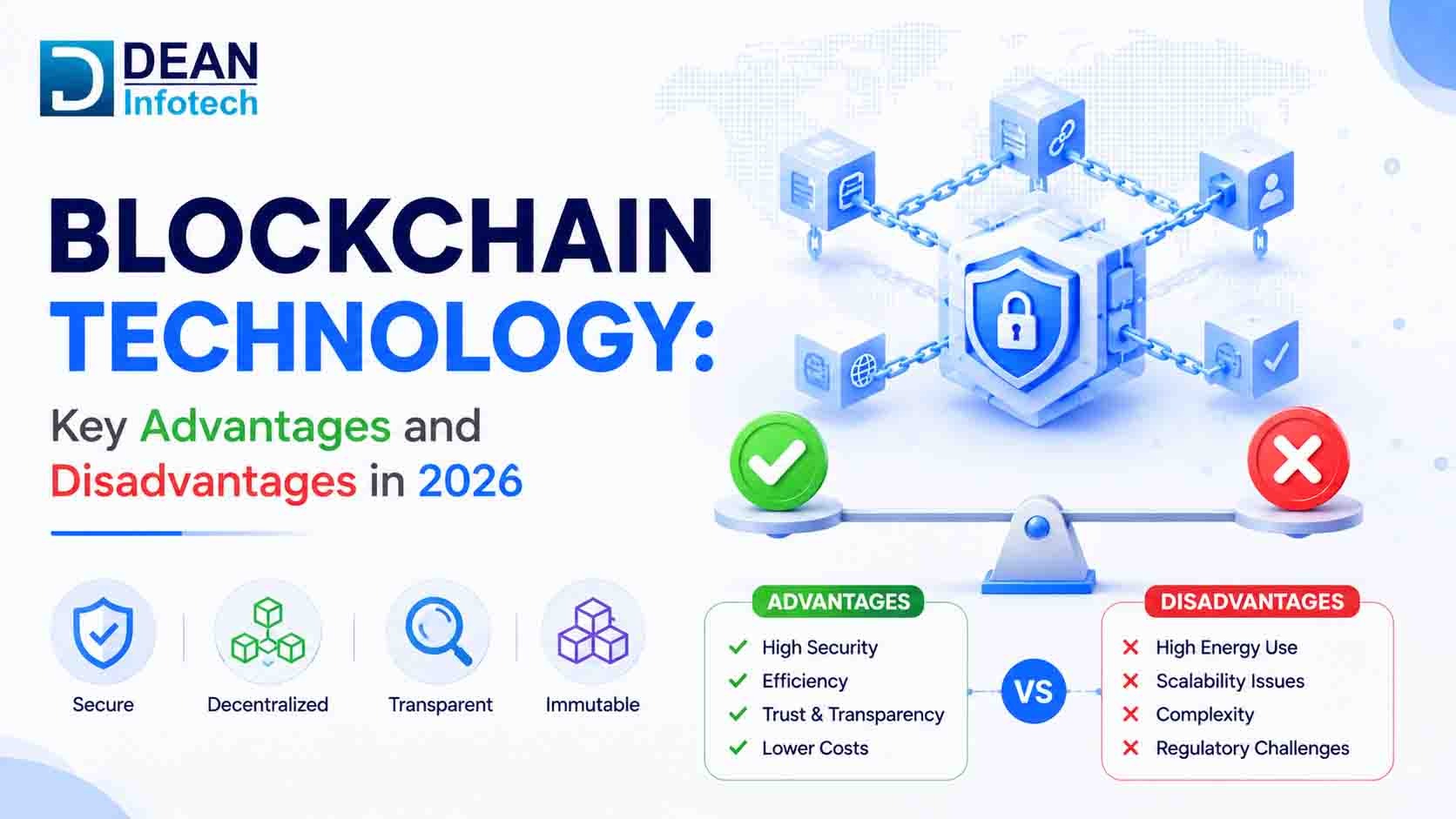
Key Advantages of Blockchain
Many of the advantages are relevant to corporations seeking to improve their systems and create a more transparent, efficient, and trustworthy digital environment.
Improved Security
One of the biggest strengths of the technology is security. The cryptographic layer and the decentralised validation make it so hard to change the service. All the information is saved forever, making fraud or data manipulation very hard.
Greater Transparency
Authorised participant access to an equal copy of the ledger by all participants. As transaction records are genuine and publicly available, the system is more accountable and transparent, which reduces conflict.
Better Traceability
Blockchain can be used to trace the location of products, transactions, or assets at any point in their lifecycle. Visibility into the supply chain and proof of product claims are currently used across both the food manufacturing and pharmaceutical sectors.
Reduced Operational Costs
The realisation of blockchains' potential to reduce transaction and management costs by removing intermediaries and enabling automated verification is complemented by the use of Smart Contracts to enforce predetermined business rules.
Faster Transactions
Normal cross-border transfers require several procedures across financial institutions and thus take days to complete. On the contrary, with blockchain enabled, transfers can be completed in near-instant time.
Businesses rolling out enterprise digital transformation are gravitating toward blockchain initiatives that leverage Custom Software Development Services to craft secure enterprise apps that meet their needs.
Blockchain Applications Across Industries
The true promise of blockchain is to solve real problems businesses face. The greater the adoption, the greater the potential of this decentralised technology. In financial services, blockchain could enable secure payments, digital identity, fraud detection, and faster settlement. In healthcare organisations, patients' records can be tightly controlled and regulatory compliance ensured.
Supply chain companies use blockchain to improve real-time shipment monitoring and increase transparency, allowing them to authenticate product origins and curb counterfeit sales. The public sector, including government agencies, is piloting blockchain for digital identity applications, land registration, and verified document authenticity. On the private side, firms are leveraging the technology for inventory visibility, warranty management and buyer/supplier collaboration.
Enterprises deploying enterprise innovation are looking at blockchain as a partner in Hyperautomation to build smarter, more secure digital operations.
Blockchain vs Traditional Databases
Feature | Blockchain | Traditional Database |
| Data Storage | Distributed | Centralized |
| Transparency | High | Limited |
| Security | Cryptographically Secured | Access-Controlled |
| Data Modification | Extremely Difficult | Easy with Permissions |
| Intermediaries | Minimal | Usually Required |
| Audit Trail | Permanent | Can Be Modified |
| Best For | Multi-party Collaboration | Internal Business Operations |
Key Disadvantages of Blockchain
Nonetheless, blockchain has both advantages and shortfalls; a business has to think carefully before deciding whether the technology is really something they need.
Scalability Challenges
Blockchains tend to be slower, on average, than relational database management systems, where users can connect to the database and view all information. However, private blockchain systems tend to be faster than public ones, though they still need to be secure. Validation time on the public blockchain network increases with the number of transactions.
High Implementation Costs
Developing blockchain applications requires a high level of skill, specialised infrastructure, integration and ongoing maintenance. For most organisations with simple operational needs, it may not be justified today:
Energy Consumption
Some blockchains (especially those based on PoW) depend on increasing computational power. However, newer consensus algorithms (such as Proof of Stake) are helping address this; it is an ongoing research area.
Regulatory Uncertainty
Regulations on blockchain use are still in flux worldwide. International corporations diversifying should meet the legal, financial, and data privacy compliance requirements when releasing their blockchain services.
Integration Complexity
Many organisations use legacy software and hardware. For organisations introducing blockchain into their business workflows, this will require additional time to customise existing ERP, CRM, and other business systems, and to migrate and integrate new solutions. Organisations pursuing enterprise modernisation can tie their blockchain initiatives to AI Business Automation to improve efficiency and accelerate the integration of future innovations into current processes.
Best Practices Before Adopting Blockchain
A genuine business problem to address with a blockchain should be identified well before implementation, not just the latest "hot" technology. The organisation must investigate beforehand if there is a good business reason for using the features offered by decentralisation, transparency and tamper-proof records. If that problem can be solved on a normal database at a lower cost, then it isn't very interesting.
Equally important is choosing the appropriate blockchain architecture. Various blockchains (public, private, consortium, hybrid) are available at different levels and have different governance and scalability. The selection of a specific model depends on business requirements, security, and regulations.
Certain organisations engaged Dean Infotech to test the practicality of blockchain, design for scalability, integrate conventional enterprise applications, and reduce delivery challenges.
Blockchain in 2026
The momentum of technology, outside of crypto, has been growing and provides ballast for the digital transformation tools used at the enterprise level. With advances in interoperability, optimisation of energy-efficient consensus techniques, smart contracts, and enterprise infrastructure, blockchain platform adoption is becoming more accessible even for smaller companies.
The integration of blockchain with artificial intelligence, the Internet of Things, cloud computing, and automation will enable new capabilities for sharing secure data and for automated, intelligent business processes.
While several Tier 1 companies are investing in new technologies and their early adoption, they are also venturing into Agentic AI, in addition to blockchain, to integrate decision-making and smartly automate workflows.
Conclusion
Without a doubt, blockchain is one of the most important and innovative technological inventions of the new digital era. By leveraging transparency, security, traceability, and distributed data management, blockchain is widely used across many fields, including finance, healthcare, manufacturing, and supply chain.
However, Blockchain is not a wonder solution. Organisations should clarify operational costs, scalability issues, compatibility with current IT systems, and potential legal challenges before investing.
If applied to the right business requirements, Blockchain could deliver long-term value to a company in several ways, including operational efficiencies, trust-building, and the enablement of new services. Organisations evaluating the benefits of Blockchain or enterprise Blockchain Applications should follow a strategic approach that aligns business needs with technology benefits.
Need expert help with your next project?
Get expert guidance across Salesforce, HubSpot, GoHighLevel (GHL), AI, and web development — tailored to your business.







Comments