Small businesses begin by investing in software that will be able to assist them in their day-to-day running of the business. Accounting packages, CRM software, project management software and communication software will be a helpful tool for a small business. It will be a helpful tool for a small business that will allow them to work efficiently and effectively.
Most small businesses will reach a point where the inadequacies of a miscellaneous collection of disconnected applications and automated procedures, enabled by limited software, begin to impact their daily operation. And so begins the point at which a custom application enters.
According to Gartner, organizations can reduce operational costs by as much as 30% by combining automation technologies with redesigned operational processes. Custom software is a substantial factor in the transformation of businesses.
Custom solutions take the opposite approach, specifically tailored to how a company's business works.
The article explains what custom software development is, how you know if your business needs it, the benefits it offers, its price and how it compares to off-the-shelf software.
What is Custom Software Development?
Custom software development deals with the creation, design, implementation, deployment and maintenance of software applications specific to a company's individual business needs.
Custom solutions are very different from commercial software products. While commercial products are designed for the masses with many potential users, custom solutions have just one enterprise as their sole user.
A business may require custom software for:
- Customer relationship management
- Department of sales, marketing and distribution.
- Inventory management.
- Workflow automation
- Internal communication
- Reporting and analytics
- Customer portals
- The project management
- Custom Software Development Services
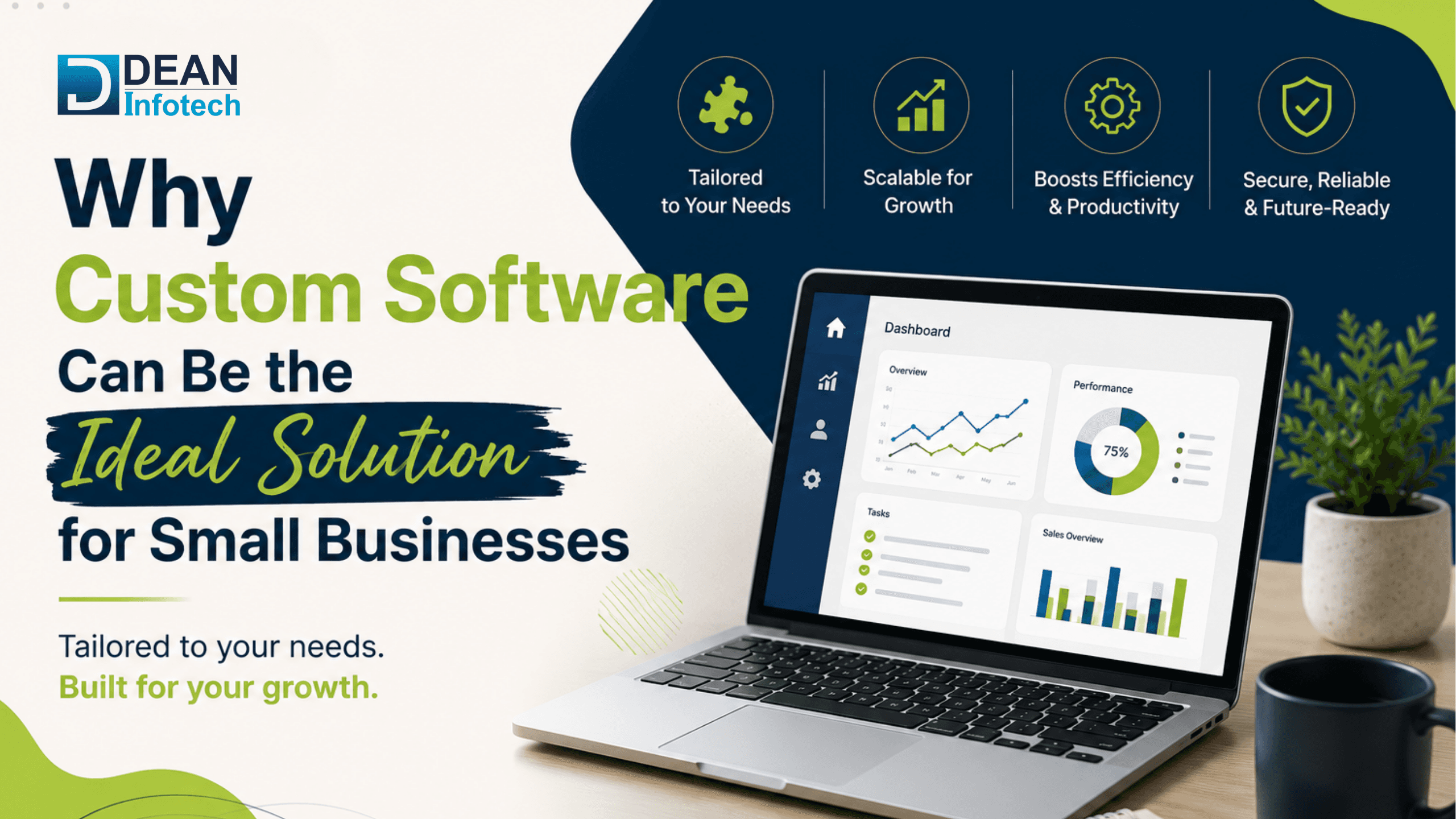
Why Small Businesses Are Considering Custom Software
The idea that a custom program is only practical for a huge corporation is a common misconception. Small companies are beginning to understand that a customized system may be just the edge they need to get ahead.
Today's small businesses face challenges such as:
- Resource constraints, increasing customer expectations
- Escalate competition
- Manual procedures
- Siloed data
- Scalability issues
Using a custom program, you can solve these problems and, at the same time, set the stage for growth.
Organizations that have already shown the willingness to automate and streamline their processes may find that a tailor-made solution offers more flexibility than an off-the-shelf software package.
Organizations interested in digital transformation usually start by assessing Business Software Development approaches, which reflect the use of technology to match operational objectives.
Signs Your Small Business Needs Custom Software
Not all companies need a software upgrade straight away. However, there are signs that the time has come for customized software.
Your Team Relies on Multiple Disconnected Tools
Several small businesses run the following applications separately: sales applications, marketing applications, customer care applications, stock applications and accounting applications.
Staff's under-using different applications all the time leads to less productivity and dispersed data.
Custom software can combine these tasks onto one platform.
Manual Processes Are Slowing Growth
If it involves hours of entering data, updating spreadsheets, or filling in the same bits of information over and over again, there is probably an automation opportunity.
Applications of software decrease manual work and increase flow.
Off-the-Shelf Software Lacks Important Features
Generic software solutions put that pressure on your business.
You may find yourself:
- Using workarounds
- Buying several add-ons
- Keeping duplicate records
- Unfocusing the decision-making process
Custom software can be designed to meet only the requirements of the business without unintended features and restrictions.
If your internal team is unable to produce actionable reports or combine data from various systems, proprietary software can offer central reporting and analytics.
Your Business Is Growing Rapidly
Growth can lay bare operational weaknesses. Bottlenecking at higher volumes- what works on smaller volumes doesn't necessarily do so on large ones.
The bespoke application is designed with the future in mind, allowing the application's growth with the business while adding functionality to support future growth.
Benefits of Custom Software for Small Businesses
The benefit of custom software goes well beyond solving short-term problems.
Improved Efficiency
Custom software is built to fit around existing processes and enables employees to work faster and more efficiently.
Automating repetitive activities can help a business augment productivity and decide to cut back operating costs.
Greater Scalability
One of the biggest benefits of custom software is that it can adapt to grow with the company.
Custom applications can adapt as the user's needs change, unlike many pre-existing software programs, which need costly upgrades and migrations.
Better Integration
Also, be sure to ask if the software will need to be integrated with existing business systems, because custom software can be integrated with existing business systems.
Integrated where necessary: if various CRM, accounting or marketing applications or internal systems are linked, this will make the accuracy of data and clearer operation easier.
In addition to the above, the long-term relationship with Dean Infotech allows many organizations working with Dean Infotech to build connected technology ecosystems with custom development projects.
Enhanced Security
Popular software products tend to be targeted by cybercriminals.
Custom Software helps develop better security measures that suit your business in order to meet the compliance standards.
Competitive Advantage
No two businesses are the same; they are always unique.
Custom Software allows enterprises to develop specialized abilities to separate them from the rest.
Such benefits would support enhanced customer experiences, efficiency, and profitability.
Long-Term Cost Efficiency
Custom software indeed has a larger initial investment, but it generally offers reduced costs over the long term, such as:
- Various software subscriptions
- Licensing fees
- Third-party add-ons
- Unnecessary processes.
While these points cover all you need to do, there are some processes that are unnecessary and cause waste.
Period by period, it becomes cost-effective to overlap development expenses with resulting savings.
Most of the businesses that focus on automation have implemented a combination of custom development projects with built-in automation to deliver maximum benefit and efficiency.
Custom Software vs Off-the-Shelf Software
A decision about whether to use custom or commercial software will depend upon business needs, budget and growth strategy.
Factor | Custom Software | Off-the-Shelf Software |
Customization | Fully tailored | Limited |
Scalability | High | Depends on vendor |
Initial Cost | Higher | Lower |
Long-Term Value | High | Varies |
Integration Flexibility | Extensive | Limited |
Feature Relevance | Business-specific | Generic |
Competitive Advantage | Strong | Limited |
Ownership | Full control | Vendor-controlled |
When Custom Software Makes Sense
Custom solutions become valuable when:
- Workflows are individual tasks.
- Indeed, growth appears to be very rapid.
- Integrating requirements is complicated.
- Differentiation between competitors is critical.
Most expanding businesses normally move away from off-the-shelf applications to custom-made systems due to their growing needs.
Companies seeking to optimize business efficiency come to a custom software development company for an assessment of automation options and a review of opportunities for system optimization.
Cost of Custom Software Development for Small Businesses
One of the most popular questions small business owners have is: “How much will I be paying for custom software?”
The answer depends on several factors, including:
- Project Complexity: Simple internal usages demand less effort from a developer than a world-class platform, which has many features.
- Features and Functionality: The number of features has a direct effect on the schedule and cost.
- Integrations: Integrating the application with third-party systems can add complexity to the project.
- Security Requirements: Development costs could increase due to additional security and compliance requirements.
- Ongoing Maintenance: The software will have to be upgraded and maintained in the future.
When searching for software development experts, organizations often look for outsourcing options that will enable them to cut development costs.
Outsourcing can provide:
- Proven, experienced development team
- The ability to deliver projects more quickly
- Decreased recruitment cost
Final Thoughts
Custom software is, of course, no longer just for the masses.
Increasing efficiency, scale, and competitive differentiation become crucial needs for small businesses, and special and customized software solutions are in demand now.
Regardless of whether you're facing disconnected systems, paper-based processes, reporting difficulties or constraints on your growth, there's a good chance that custom software could offer the adaptability and features that will meet the needs of your company.
Customized Software Development Services enable organizations to tailor solutions to their unique needs, in line with their workflow and help grow with the business in the long term, providing tangible value.
The key is selecting the appropriate development strategy, implementation approach and technology partner.
Dean Infotech has assisted businesses from various industry verticals in designing, developing and optimizing software solutions to increase efficiency, automate processes and scale sustainably.
Need expert help with your next project?
Get expert guidance across Salesforce, HubSpot, GoHighLevel (GHL), AI, and web development — tailored to your business.









Comments