Contemporary organizations depend on various software solutions to handle sales, marketing, customer support, financial, and operational duties. These tools may facilitate the work of the company‘s staff members, but they frequently cause data silos to be formed when they function separately from each other.
This is where Salesforce Integration Services are crucial. Organizations can link Salesforce with other business systems, bring all Customer data into a single source, streamline business processes, ensure the accuracy of reports and provide customers with a consistent experience.
From managing marketing campaigns, web stores, customer service, finance or other business functions, Salesforce integrations work to give access to the latest and correct information for every staff member.
In this guide, we look at 25+ Salesforce integrations your business should be aware of, and how they can improve productivity, collaboration, and performance.
What are Salesforce Integrations?
Salesforce integrations link with our Salesforce CRM and allow for data to flow between the systems.
Instead of editing records in different systems, integrations include the latest information automatically, enabling your team to be more productive and informed.
Key benefits include:
Increased data accuracy
Less manual data entry
Better customer visibility
Teamwork is much easier to work in
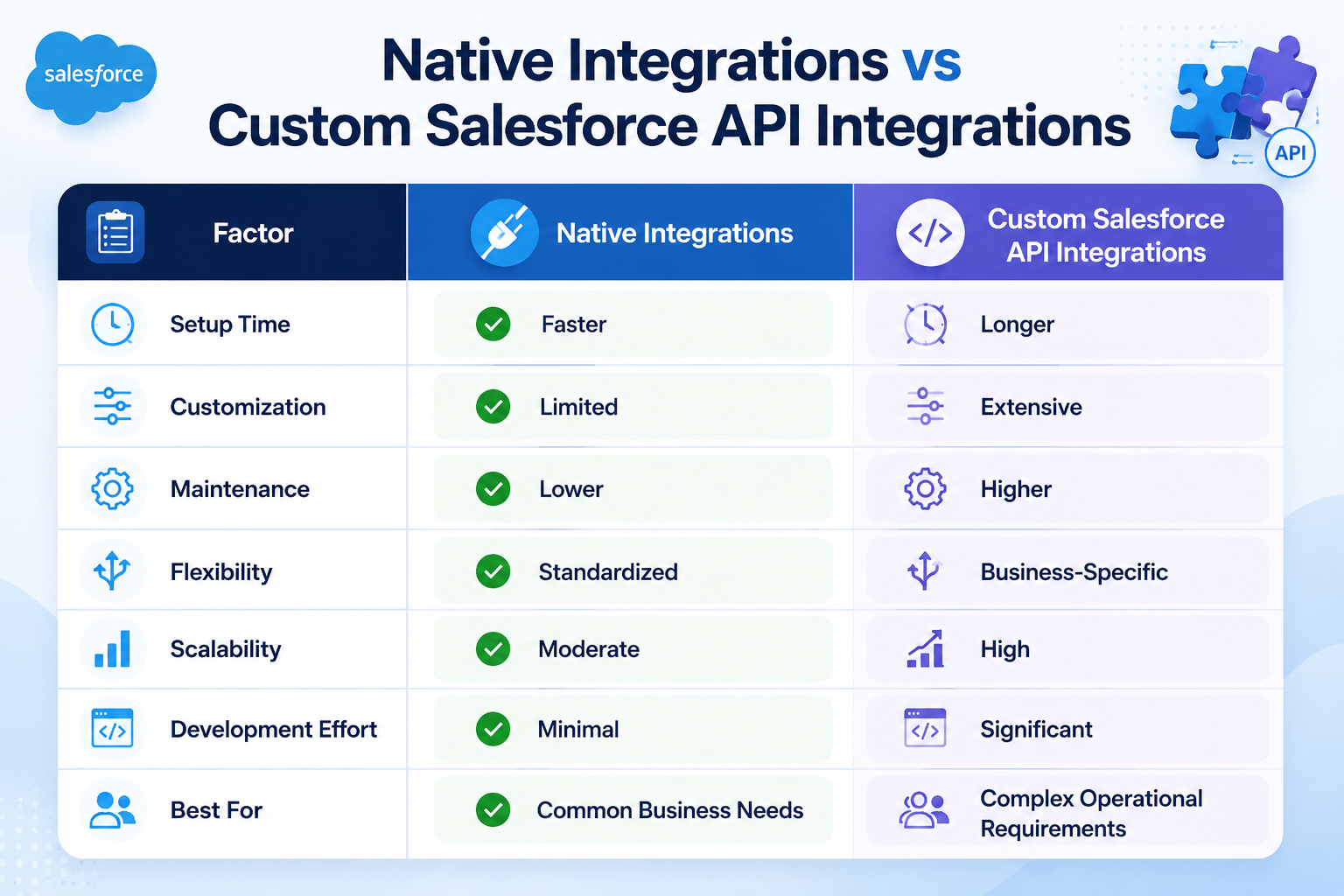
Unique business processes mean more customizations to integrate with enterprise applications through Salesforce API integration Services.
Why Businesses Invest in Salesforce Integration Services
Businesses invest in Salesforce Integration Services to connect critical systems, streamline operations, and improve data flow across departments.
Effective integrations reduce manual tasks, enhance customer experiences, provide better business insights, and create a scalable foundation that supports long-term growth and operational efficiency.
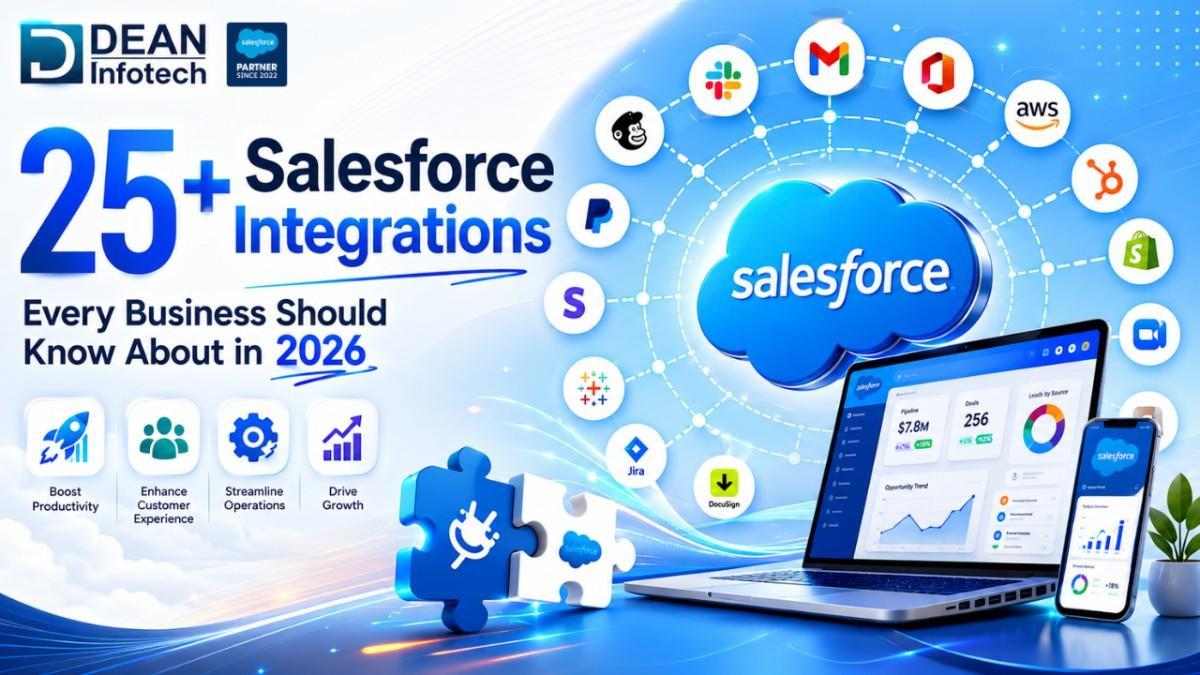
List of Top Salesforce Integrations Every Business Should Know About
Marketing Integrations
Engagements are a critical part of marketing teams. These integrations help organizations with campaign, customer and lead management activities. These integrations contribute to better lead nurturing, campaign efficiency and customer engagement.
HubSpot
HubSpot. It is one of the most popular Salesforce marketing integrations, as it integrates marketing and sales in a single customer journey.
Key benefits include:
Automatic lead synchronization.
Greater insight into how campaigns are performing.
Better lead qualification. Stronger marketing and sales alignment.
Less need for manual data entry.
For example, an organization that utilizes Salesforce Marketing Cloud can connect the marketing data, customer journey, and engagement data to the Salesforce CRM in order to personalize customer interactions.
Mailchimp
Mailchimp integration enables businesses to integrate their email marketing campaigns with Salesforce customer data. Users can monitor subscriber engagement, enhance segmentation, and obtain more visibility into campaign results.
Key benefits include:
Scheduling the campaign operation.
Enhanced audience targeting.
Improved customer segmentation.
Improved reporting.
Better performances in email marketing.
Marketo
As a B2B product, Marketo can be most useful for automating lead nurturing and for increasing the efficiency of the B2B marketing efforts.
Key benefits include:
Improved lead scoring.
Better campaign attribution.
Better visibility into the customer journey.
Enhanced conversion tracking.
Other Popular Marketing Integrations
Additional marketing integrations businesses frequently use include:
Pardot
ActiveCampaign
Constant Contact
Campaign Monitor
These provide an opportunity for firms to strengthen their marketing automation and customer engagement.
Communication And Collaboration Integrations
Communication tools allow your team to stay connected. An integration with Salesforce will increase your team‘s overall productivity by reducing the need to switch back and forth between all of your applications.
Salesforce and Slack Integration
Salesforce and Slack integration. Teams can work around customer data in the dedicated Slack channels.
Key benefits include:
Instant CRM alerts
Better collaboration across departments
Enhanced customer response times
More transparency about opportunities
Less context switching
For companies that buy into the speed and collaboration game, the integration of Salesforce and Slack might be the most helpful productivity boost out there.
Microsoft Teams
Microsoft Teams integration gives users the ability to view data within the application while working with teammates.
Key benefits include:
Enhanced communication.
A means of sharing information more quickly.
Improved meeting efficiency.
Getting access to customers' records more easily.
Better team alignment.
Zoom
Using Zoom makes communicating with the customer and in the sales process easier.
Key benefits include:
Auto-scheduling meetings.
Improved customer engagement tracking.
Much better sales collaboration.
Centralized communication logs.
A high increase in labor productivity.
Google Workspace & Outlook
The integrations enable companies to integrate their calendars, email, contacts, and customer activity to Salesforce.
Benefits include:
Improved productivity.
Enhanced customer insights.
Better communication tracking.
Simplified scheduling.
More robust workflow management.
ECommerce Integrations
Salesforce integration is very useful for an eCommerce business as they for unified view of customer, product and order data. These integrations offer a complete and comprehensive view of how customers behave and the effectiveness of marketing and sales efforts.
Salesforce and Shopify Integration
Integrating a Salesforce and Shopify platform is one of the most important integrations for an online business. It allows companies to merge information on customers, orders, product information, and shopping habits between the two.
Key benefits include:
Names, addresses, dates, and customer data are merged together.
Better visibility of orders.
Improved sales forecast.
More granular customer segmentation.
Targeted marketing campaigns.
Connecting Salesforce and Shopify allows companies to have complete insight into customers and track their complete purchasing process.
WooCommerce
WooCommerce integration enables users to integrate their WooCommerce store data into Salesforce for better customer management and reporting purposes.
Key benefits include:
Customer synchronization.
Order tracking transparency.
Improved inventory visibility.
Improved documentation.
Reach customers more effectively.
Magento
Magento still has a lot of affection, especially as more large eCommerce sites are looking to remain flexible and scale.
Key benefits include:
Revisions of customer data in real time.
More efficient order processing.
More targeted marketing.
Better reporting.
Improved customer experience.
Other Popular eCommerce Integrations
Additional eCommerce integrations include:
BigCommerce
Adobe Commerce
OpenCart
They are points of interaction that allow businesses to operate more efficiently and deliver maximum customer exposure through channels.
Customer Support Integrations
Customer service teams find Salesforce integrations especially useful as they provide a full history of a customer, making services more efficient.
Zendesk
Build Zendesk into your support system. Agents will have instant access to customer info without even leaving the support platform. Customers will notice and gladly wait even less for solutions.
Key benefits include:
A single, consolidated view of the customer.
Faster problem solving.
Better ticket management.
Reporting can be improved.
A number of companies that have implemented a customer support platform also tend to implement a structured Salesforce Service Cloud deployment as a packaged option, looking to enhance their case management and service operations.
Freshdesk
Freshdesk integration links customer records between support tickets and Salesforce. This allows for better visibility across teams.
Key benefits include:
Automated ticket synchronization.
Better customer monitoring.
Improve service flows.
Improving teamwork.
Support productivity reached.
Intercom
Intercom provides a way for companies to merge conversations with customers and CRM data so that support and sales teams can communicate more effectively with individual customers.
Key benefits include:
Improved customer engagement.
Greater Communication history.
Improved lead qualification.
Quick replies.
Improves customer relationships.
ServiceNow
ServiceNow integration is suitable for enterprise organizations with complicated service processes.
Key benefits include:
Improved incidence management.
Enhanced workflow automation.
Greater visibility of operations.
Three new and/or expanded services.
Streamlining efficiency further.
Finance And ERP Integrations
Financial and ERP integrations - Integrations with business systems, such as financial and enterprise resource planning (ERP), enable restaurants to access operational and customer data for improved reporting and analysis.
QuickBooks
QuickBooks integration enables users to export and import invoices, payments and customers between the two systems.
Key benefits include:
Reduced manual input.
More financial insight.
Enhanced management of customer information.
Improved response to the report.
Faster billing practices.
NetSuite
The NetSuite integrations link the ERP and CRM systems providing a single view of the customer and the business.
Key benefits include:
Greater visibility into operations.
Enhanced reporting.
Better financial management.
Improved knowledge of clients.
SAP
SAP integration assists large enterprise business organizations attain the target of growing operational efficiency and unified business intelligence.
Key benefits include:
Business data in a centralized location.
Better reporting.
Enhanced automation of processes.
Improved decision-making.
Improved scalability.
Other ERP Integrations
Businesses also commonly integrate:
Oracle ERP
Xero
Microsoft Dynamics ERP
The integrations increase operating efficiencies and financial transparency.
Productivity And Project Management Integrations
Project management tools enable an organization to deliver its customer projects, specific tasks or internal processes more efficiently.
Jira
Jira integration is particularly useful to companies that need collaboration between technical teams and their customer facing teams.
Key benefits include:
Better issue tracking.
Greater exposure of the project.
Reduces the negative consequences of weak problem-solving.
Enhanced team work.
The brand engagement of customers is higher.
Asana
Asana allows teams to track customer projects, such as case or deployment projects, while still offering visibility in Salesforce.
Key benefits include:
Synchronizing tasks.
Better accountability.
Better project management.
Improved workflow.
Stronger collaboration.
Trello
Trello integration allows users a visual method of project management while keeping it in line with Salesforce customer information.
Key benefits include:
Better monitoring of tasks.
Collaborating more effectively.
Replicated the increased visibility of workflow.
Making project management easier.
Other Productivity Integrations
Popular productivity integrations include:
Monday.com
ClickUp
Smartsheet
These tools enable teams to manage projects better while keeping the customer in the loop.
How Salesforce API Integration Services Enable Custom Integrations
Although the majority of the integrations are provided using pre-built connectors, some organizations might need extremely customized options. Here is where the Salesforce API integration Services are very crucial.
APIs allow businesses to:
Integrate existing and published legacy systems.
Ensure that data syncs in real-time.
Create custom workflows.
Automate complex business processes.
Combine private applications.
Organizations with unique operational needs use Salesforce API integration Services as a means to develop scalable solutions that will support digital transformation initiatives and future expansion.
Final Thoughts
Once attached to the other tools your business depends on every single day, Salesforce becomes much more powerful.
Connect your sales, marketing, and collaboration tools to your ERP, eCommerce applications, and other integrated solutions. The right integrations will link everything into a seamless environment that boosts productivity, customer satisfaction, and overall business success.
Regardless of whether you are managing a Salesforce and Slack integration, a Salesforce and Shopify integration or sophisticated custom workflows through Salesforce API integration Services, an effective integration approach can generate enormous value and pave the way to sustainable growth.
Bringing in a Salesforce consulting professional can assist many companies in getting integrations right, ensuring they meet realistic business and operations needs.
Connect Salesforce Smarter with Dean Infotech
The right experts and instructors alone will not lead to successful integrations. Having strategic plans, business processes re-engineering, and rollout strategies are must-have prerequisites.
Dean Infotech assists businesses in harnessing Salesforce Integration Services, customized API development, workflow automation and platform optimization to provide intelligent systems that produce results.
No matter whether you are integrating marketing solutions, support products, ecommerce applications or enterprise solutions, our Salesforce-specific consultants will help you get the most out of every implementation.
Need expert help with your next project?
Get expert guidance across Salesforce, HubSpot, GoHighLevel (GHL), AI, and web development — tailored to your business.


Comments