Your Salesforce roadmap keeps growing. Your team doesn't. Maybe an ERP integration is stuck because one developer is also answering every admin request. Maybe a Marketing Cloud rollout landed on your desk and nobody in-house has run one before. Sooner or later, you need outside help.
The harder question is what kind of help. Do you add specialists to your own team, or hand the whole job to an outside firm? Those are two different models: Salesforce staff augmentation and Salesforce outsourcing services. Pick the wrong one and you'll feel it later, through slipped deadlines, a manager buried in oversight, or a bill bigger than the work justified.
This guide covers how each model works, what each one costs, and how to decide. If you're comparing an IT staff augmentation service with a full project handoff, you'll have a clear answer by the end.
What Is Salesforce Staff Augmentation?
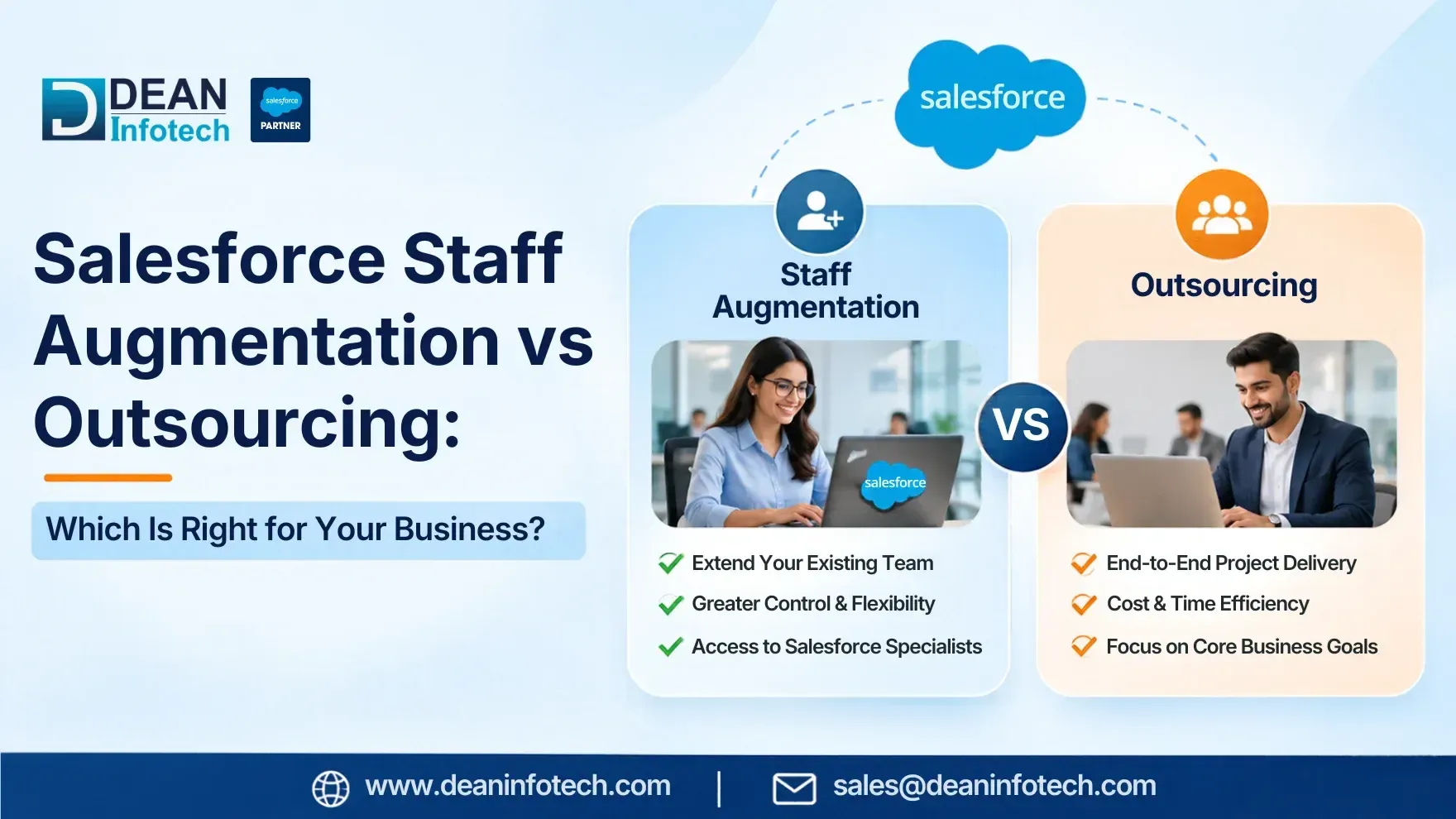
Short Answer: Salesforce staff augmentation is a model where external Salesforce professionals join your existing team for a set period. They work under your direction, follow your processes, and fill skill or capacity gaps without the wait of permanent hiring.
A provider of Salesforce staff augmentation services handles sourcing, technical screening, contracts, and replacements. You handle the work itself: setting priorities, reviewing code, running sprints, and approving releases.
Picture a finance company with one admin and two developers. Leadership wants a loan management system connected to Salesforce before year-end, but both developers are booked solid, and recruiting would take three or four months. So the company decides to hire Salesforce developers on contract. They join daily stand-ups, work in the company's sandboxes, and follow its release process. Once the integration goes live, the engagement shrinks or ends.
The roles you can add usually include:
Salesforce developers (Apex, Lightning Web Components, Flow)
Administrators
Solution or technical architects
Integration specialists
QA engineers and business analysts
Staff augmentation works best when someone on your side can lead, like an architect or an experienced product owner. It won't fix fuzzy requirements. More hands on unclear work only gives you more activity, not better results.
What Is Salesforce Outsourcing?
Short Answer: Salesforce outsourcing means contracting an external provider to deliver a defined project or run an ongoing service. The provider manages its own team and day-to-day execution. You stay responsible for business requirements, key decisions, and final acceptance.
You're buying an outcome, not hours: a working implementation, a finished integration, a migrated org, or a support desk measured against agreed response times.
Take a manufacturer that wants Salesforce to manage dealers and distributors, with live order data flowing in from its ERP. It has no Salesforce team at all. Rather than hiring an architect, developers, a tester, and a project manager one by one, it hands the project to a Salesforce development company that supplies the full crew and runs everything from discovery to deployment.
Typical Salesforce outsourcing services cover implementation, custom development, integrations, data migration, org consolidation, and managed support.
Outsourcing isn't hands-off, though. The provider needs quick decisions, access to the right people, and clear acceptance criteria from you. Without those, even a strong partner stalls.
Salesforce Staff Augmentation vs Outsourcing: Key Differences
The core difference is who manages the work and who answers for the result. Location and hourly rate matter far less than most buyers expect.
Factor | Staff Augmentation | Outsourcing |
What you're buying | Skilled people and capacity | A finished project or service |
Day-to-day management | You | The provider |
Accountability for results | Mostly you | The provider, as set out in the contract |
Technical control | High | Shared through milestones and reviews |
Pricing | Hourly or monthly per person | Fixed price, time and materials, or retainer |
Biggest risk | Too little internal supervision | Vague scope and weak oversight |
Best for | Skill gaps and backlogs | New builds, migrations, managed support |
Accountability is the gap that bites hardest. With staff augmentation, if a design is wrong or a release slips, that's mostly on you, because you directed the work. With outsourcing, the provider answers for the deliverables and service levels written into the contract.
Knowledge retention works differently too. Augmented specialists sit inside your team, so what they learn tends to stay close. Outsourced teams hold more of the know-how, which makes documentation and a proper handover essential.
As for security, some vendors claim one model is safer. It isn't that simple. Risk comes from how access is granted, not from the engagement model. Least-privilege permissions, multi-factor authentication, and sandbox-first development matter either way.
Cost Comparison: Staff Augmentation vs Outsourcing
Staff augmentation is billed per person, usually hourly or monthly. Outsourcing is billed per project, milestone, or service level. Augmentation tends to cost less when you already cover architecture, project management, and testing internally. Outsourcing often wins when you'd otherwise have to build and manage that whole structure yourself.
Here's a simple illustration. Say you add two offshore developers for three months at $60 an hour, 160 hours a month each. That's 2 × 160 × 3 × $60, or $57,600. It looks tidy, but it covers developer time only. Architecture, code review, testing, and release management still come from your own payroll.
A fixed-price quote for comparable work may look similar or higher on paper. But it usually bundles discovery, testing, documentation, and accountability for delivery. Rates vary a lot by region, seniority, and specialization, so treat any figure as indicative, not a quote.
So compare total cost, not hourly rates:
Total cost = provider fees + your internal management time + onboarding + expected rework
Ask every provider about minimum commitments, notice periods, replacement timelines, what's included, and who pays to fix defects found after delivery. A short paid assessment from a team offering Salesforce consulting services can also pin down scope before you commit to either model. A lower rate is only cheaper if the work is right the first time.
Which Model Is Right for Your Salesforce Project?
Staff augmentation fits when:
You already have a Salesforce lead or architect
You're clearing a backlog of enhancements
You need a specialist, say for Marketing Cloud or CPQ, for a few months
You want full control over standards and releases
Outsourcing fits when:
It's your first Salesforce implementation
You're migrating from another CRM or merging several orgs
A complex integration needs several specialists working together
You want ongoing support under defined service levels
Many mid-sized and enterprise companies end up with a hybrid. Internal admins handle daily requests, augmented developers work through the backlog, and an outsourced team delivers a major integration. One caution: hybrid setups fail when nobody owns the shared pieces. Decide in writing who owns architecture, sandboxes, releases, access, and incident response.
How to Choose Between Salesforce Staff Augmentation and Outsourcing
Start with three questions:
Do we have someone internally who can lead and review the work? If not, lean toward outsourcing.
Do we need one party accountable for the outcome? If yes, outsource.
Is this a skill or capacity gap inside work we already manage? If yes, go with staff augmentation.
Next, vet the provider. Whichever model you choose, check these:
Can you interview and technically assess people before they start?
Do they have certified talent and relevant Salesforce project examples?
How many working hours overlap with yours, and who is your named contact?
What are the replacement, notice, and knowledge-transfer terms?
How do they protect your data and intellectual property?
Watch for red flags: resumes you can't verify, vague answers about who does the work, and rates so low that testing and documentation quietly disappear. And if your needs stretch beyond Salesforce into support or operations roles, non-IT staffing services can cover that side without a second vendor search.
Conclusion or key Takeaway
It comes down to one question: do you need more Salesforce people, or do you need someone to own the result? If you have leadership and just need capacity or a specific skill, staff augmentation gives you speed and control. If you need a build, a migration, or support that someone else is accountable for, outsourcing is usually the safer bet. And if you're juggling several initiatives, a hybrid can give each piece the structure it needs.
Dean Infotech works with businesses on both models, from placing certified talent to advising on the right fit. If staff augmentation sounds like your route, hire Salesforce developers who can start inside your workflow and move your roadmap forward.
Enjoyed this article?
Follow Dean Infotech on Google for practical CRM, technology and AI insights, fresh updates and expert guides.
- Expert-led insights
- Practical guides
- Fresh updates
Need expert help with your next project?
Get expert guidance across Salesforce, HubSpot, GoHighLevel (GHL), AI, and web development — tailored to your business.









Comments