A successful implementation of Salesforce involves more than merely purchasing user licenses and setting up a CRM system. Companies frequently seek strategic advice, technical support, industry expertise and ongoing assistance to reap the full benefits of Salesforce.
In fact, customer experience has become a major business differentiator. According to Forbes, companies with the strongest omnichannel customer experiences retain 89% of their customers on average, compared to just 33% for those with weaker customer experience strategies.
This is also where a Salesforce Partner comes into it.
Implement Sales Cloud, Service Cloud, Experience Cloud, or Marketing Cloud with the assistance of a Salesforce Partner. Salesforce Partners help companies build, launch, customize, integrate, and optimize their Salesforce environments.
But not all Salesforce Partners are the same. The Salesforce Partners are distinguished by different tiers and levels, depending on their level of expertise, certifications, and number of successful deployments.
In this guide, you will understand what Salesforce Partner levels are, what consulting partner levels and managed services are, and what businesses should be aiming for when choosing a Salesforce Partner in 2026.
What Is a Salesforce Partner?
A Salesforce Partner is an organization that has been officially recognized by Salesforce and is authorized to deliver services such as implementation, customization, consulting, training, integration and support with respect to all Salesforce products.
Partners work with organizations to:
Implement Salesforce solutions
Customize CRM environments
Develop integrations.
Streamline workflows
Offer training to the user
Provide user instructions
Provide continuous support
Manage Salesforce environments
These partners act as trusted advisors to your business across the customer lifecycle, helping clients gain the maximum return on investment from their DX investment.
Why Salesforce Partners Matter
Salesforce is one of the most powerful business systems in the world, but with that also come complications.
Organizations often struggle with:
Implementation planning
Data migration
Workflow design
System integrations
User adoption
Report setup
Continuous improvement of optimization
A qualified Salesforce Consulting Partner like Dean Infotech enables organizations to decrease time to implementation and adoption by eliminating common pitfalls.
Benefits include:
Quicker time-to-market
Reduced implementation risk
User adoption improved
Enhancement of system performance
More successful business results
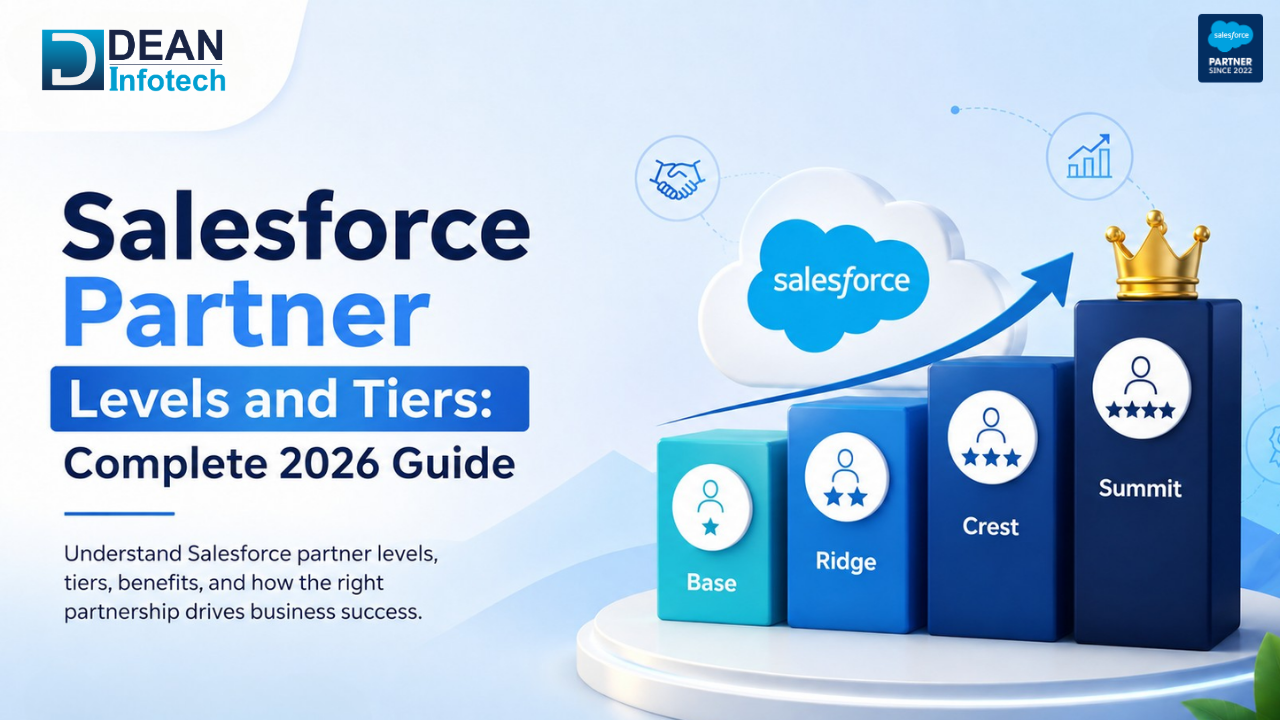
Salesforce Partner Levels Explained
Salesforce Partner Levels Explained
Salesforce has changed its partner program over time.
Earlier, Salesforce had four partner levels:
Registered Partner
Ridge Partner
Crest Partner
Summit Partner
Now, Salesforce uses only two partner levels:
Crest Partner
Summit Partner
These levels help businesses understand a partner's experience, expertise, and success with Salesforce projects. In general, partners at higher levels have more certified professionals, stronger customer success records, and deeper Salesforce knowledge.
Salesforce Partner Tier Comparison
Factor | Crest Partner | Summit Partner |
Salesforce Certifications | Strong certification base | Extensive certifications across multiple Salesforce products |
Implementation Experience | Experienced in delivering Salesforce projects | Proven success with large and complex implementations |
Customer Success | Strong customer satisfaction record | Outstanding track record of customer success |
Product Expertise | Expertise across key Salesforce solutions | Deep expertise across multiple Salesforce clouds and technologies |
Industry Knowledge | Experience in specific industries | Advanced industry specialization and consulting capabilities |
Managed Services | Ongoing support and optimization services | Comprehensive managed services and strategic guidance |
Enterprise Experience | Capable of handling mid-to-large projects | Extensive experience with enterprise-scale transformations |
Global Delivery Capability | Regional or multi-market delivery capabilities | Mature global delivery and support capabilities |
Key Factors That Determine Salesforce Partner Status
Some of the most common factors that determine Salesforce partner status include:
Certifications
Salesforce certifications are among the single most significant indicators of partner competence.
Certified professionals may hold credentials in:
Sales Cloud
Service Cloud
Experience Cloud
Data Cloud
AI solutions
Development of a platform
Marketing automations
Companies with more extensive certification portfolios tend to have more robust technical capabilities.
Customer Success
There are many reasons for this. Not least because of the enormous importance that Salesforce has placed upon customer outcomes.
Partners are evaluated based on:
Customer satisfaction
Adoption measures
The long-term client relationship
A good history of successful implementations
Product Expertise
Billions of dollars worth of work is available from partners who focus on specific products within the Salesforce space.
Examples include:
Sales Cloud
Service Cloud
Commerce Cloud
Revenue Cloud
Marketing Cloud
Businesses should select partners that have relevant technologies to their needs.
What Is a Salesforce Consulting Partner?
What does a Salesforce Consulting Partner do? A Salesforce Consulting Partner is an expert in planning, executing, customizing and maximizing your Salesforce solution, so that your business works better.
Consulting partners typically provide:
Business process analysis
Salesforce implementation
Integration services
User training
Change management
Ongoing optimization
Their main objective is to make sure Salesforce is aligned with the business objectives and is creating real value.
Many organizations using complex CRM environments seek the help of a consulting partner to broaden the resource capabilities and speed up the deployment at a lower risk.
The Role of Managed Service Providers in Salesforce
The implementation is only the beginning of the journey. Ongoing care of the post-implementation environment. This is where Managed Service Providers come in.
Managed service providers offer ongoing support services such as:
System administration
User support
Monitoring the platforms
Workflow optimization
Security management takes into consideration different issues associated with the technology, such as IPR, rights over data and confidentiality. It concerns measures to retain control over data held in the repository and between the various organizations.
Organizations often opt for managed services if they need to access Salesforce knowledge but do not have the resources in-house.
Benefits of Managed Service Providers
An alliance between a business and an Managed Service Providers can help reduce costs that come with running the business while ensuring that the IT infrastructure is optimized for effectiveness and security. With the assistance of an MSP, a business will be able to enjoy proactive monitoring, fast problem-solving and highly skilled technical professionals without having to employ many people internally.
Key advantages include:
Operational burden is decreased
Quicker issue resolution
Continuous optimization
Support costs can be considered predictable
Enhanced functionality of the system
More of an additional benefit for companies that deploy multiple Salesforce editions
How to Choose the Right Salesforce Partner
Choosing the right Salesforce partner can make a big difference to your project's success. While partner levels and certifications are important, they should not be the only factors you consider. The ideal partner should understand your business goals, have relevant experience, and be able to support you both during and after implementation.
Business Requirements
Before selecting a partner, identify what you want to achieve with Salesforce. Some businesses need a basic CRM setup, while others require custom development, integrations, or automation. Having clear requirements will help you find a partner with the right expertise and ensure the project stays on track from the start.
Industry Experience
A partner with experience in your industry can add significant value. They are more likely to understand your business processes, common challenges, and customer expectations. This knowledge helps them recommend solutions that work well for your industry and reduces the time spent learning about your business.
Technical Expertise
Technical expertise is one of the most important factors when choosing a Salesforce partner. Check whether the partner has certified Salesforce professionals, experience with custom development, and the ability to integrate Salesforce with other business systems.
They should also be skilled in automation and process optimization. For example, Dean Infotech is a Salesforce Crest Partner, demonstrating its strong Salesforce capabilities, proven project experience, and dedication to delivering successful outcomes for clients.
Support Model
Salesforce projects do not end after implementation. Many businesses need ongoing support, maintenance, training, and system improvements. Before making a decision, understand what services the partner offers after launch. A partner that provides long-term support can help you get more value from your Salesforce investment.
Cultural Fit
A successful partnership depends on more than technical skills. The partner should communicate clearly, respond promptly, and work well with your team. Good collaboration makes projects run more smoothly and helps avoid misunderstandings. Choosing a partner whose working style matches your organization can lead to better long-term results.
Salesforce's Future Collaborations in 2026
In the context of ongoing ecosystem expansion with AI, automation, Data Cloud and industry-focused offerings, the growing role of the partner becomes more and more important.
Organizations now require support across:
Transformation of CRM
Improving customer experience
Automated marketing
Revenue operations
Data management
The most successful Salesforce Partners are moving away from being simply ‘implementation partners’ to becoming ‘business advisors’.
Companies that form strong partner-based networks are much more innovative and efficient and have better business performance.
Final Thoughts
The Salesforce Partner ecosystem offers organizations access to expertise, implementation services, and ongoing optimization services. So, whether you're searching for a Salesforce Consulting Partner or Managed Service Providers, or need someone who can do specific things with Marketing Cloud, knowing partner levels and what companies are capable of will give you a much wider perspective.
Businesses should look at other factors besides partner tier, including their certification, industry experience, service available and ability to provide long-term support.
The right Salesforce Partner can turn the Salesforce IT investment into a strategic business advantage.
Grow with Dean Infotech
In order to be successful, Salesforce projects require the proper blend of both strategic and technical skills to ensure that customers are not left unattended after the implementation.
Dean Infotech is a provider of consulting, customization, integration, managed services and CRM transformation programs that help companies leverage, grow and extend Salesforce solutions.
Be it the right Salesforce Partner for you, implementation of your new environment or maturity of your existing environment, our certified experts will bring the best value for your investment.
Connect with our experts today!
Need expert help with your next project?
Get expert guidance across Salesforce, HubSpot, GoHighLevel (GHL), AI, and web development — tailored to your business.







Comments