Introduction
Salesforce doesn’t make sense as a value platform over the long haul. It requires continual administration, configuration, fine-tuning, security fixes and assistance for users to deal with changing business needs. That’s where Salesforce Managed Services can help.
Reliable Salesforce Managed Services Providers help organizations manage and improve their Salesforce environment without the cost of building a large in-house team. Managed services proactively monitor systems and support users, automate, integrate, and optimize performance to ensure your CRM keeps supporting your business growth.
In the below-given guide, we are going to discuss Salesforce Managed Services 2026, their definition, expected advantages, different pricing strategies, the onboarding process, performance measurements, and finding the right provider for your business. Regardless of whether you are a beginner or wish to maximize the value of the already made investment in Salesforce, the guide is going to be beneficial for you.
What are Salesforce Managed Services?
Salesforce Managed Services refers to the process of outsourcing company functions or processes to improve operations and reduce costs. This approach allows the company to leverage external support to manage a specific department or area or a process.
In most cases basic Salesforce CRM Managed Service consists of managing services like administration, development, customization, user support, automation, integration management, security updates, and performance optimization. In case the need arises, the Salesforce Provider keeps updating your workflows, permissions, and reports to ensure that Salesforce continues to work effectively.
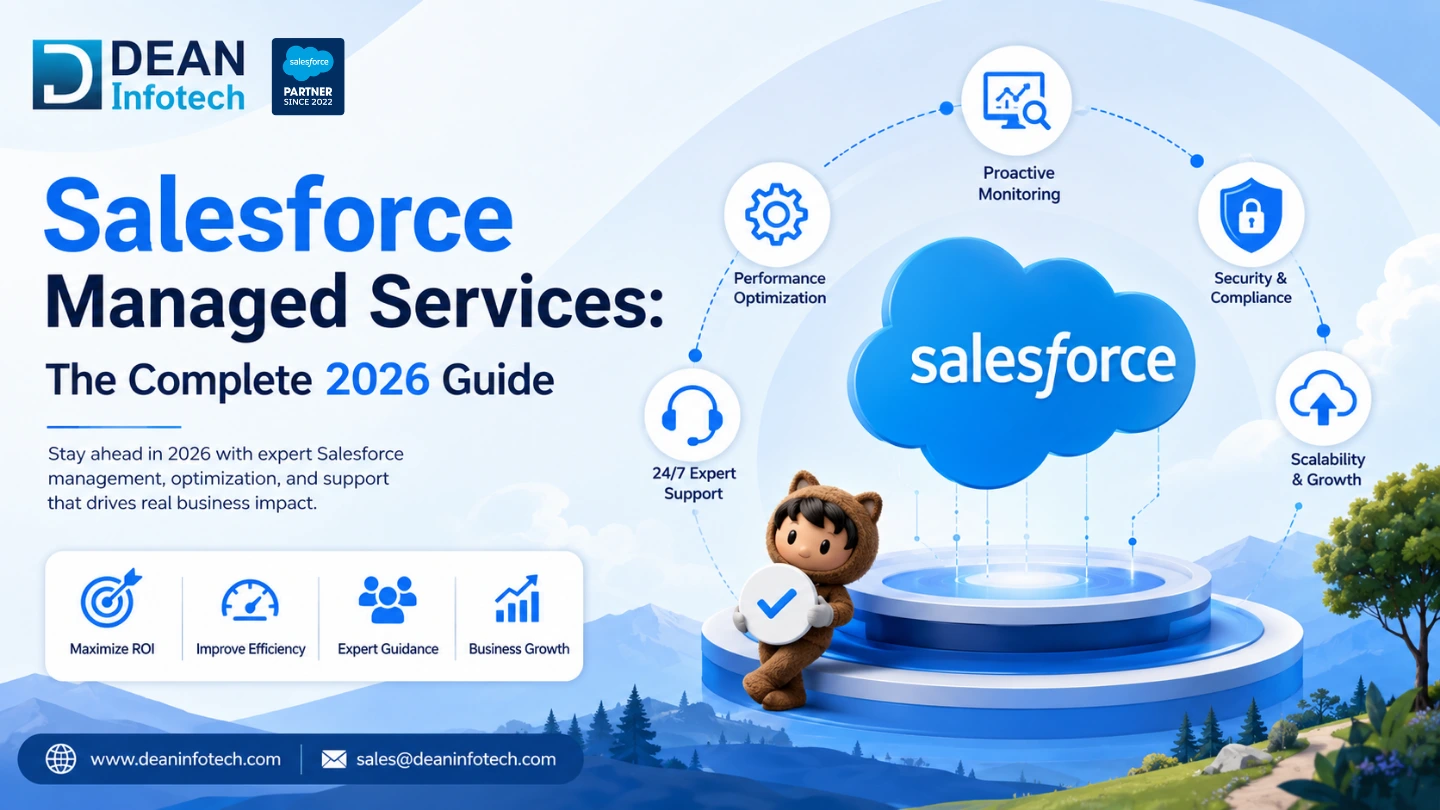
In simple words, Salesforce Managed Services assist businesses in maintaining the security and efficiency of their CRM.
Core Components of Salesforce Managed Services
Salesforce Managed Services consists of various ongoing processes that help ensure the development, security, optimization, and proper alignment of your CRM with your business objectives. Unlike the traditional focus on implementation only, managed services guarantee the continued efficiency of your Salesforce environment as your business grows. Whether it comes to user management, custom application development, integration management, data management, security and system updates, every part is essential for ensuring an efficient CRM environment.
Salesforce Administration
Salesforce Administration Someone has to do the day-to-day maintenance, managing users, defining roles and permissions, developing reports and dashboards, and performing the routine tasks that keep your CRM humming along without hiccups.
Development and Customization
Your company is dynamic and your Salesforce solution should reflect that, through creating new functionalities, automating long-winded processes for your staff, developing Lightning components, and adjusting based on your changing requirements.
Integration Support
Salesforce rarely works in a vacuum, it’s almost always integrated with a handful of other tools in your stack. That means maintaining those integrations, and monitoring them so that data flows between systems in a reliable manner without unexpected breakdowns.
Data Quality Management
Good data makes everything else better. That means regularly removing duplicates, validating records and making sure your customer information stays accurate and consistent instead of quietly getting messier over time.
Release and Change Management
Every update and new feature is tested extensively before going live. With a good release management you can make changes without surprising your team or interrupting the day to day work.
Security and Governance
Ensuring your Salesforce environment remains protected requires vigilance over user access rights, security reviews, compliance checkups, and audits, nothing goes unchecked!
Why Do B2B Companies Invest in Managed Services? (Key Benefits)
Salesforce Managed Services can be crucial for B2B organizations to keep their CRM system safe, functioning optimally, and up-to-date with dynamic business needs. Through dependable support from reliable specialists, companies can minimize operating expenses, maximize productivity and scale up Salesforce solutions with minimal internal resources.
Key Benefits
Reduce operational cost - By Choosing Salesforce managed services companies can easily save money by not hiring a Salesforce team but getting the expert support on-demand as per their requirement.
Access to expertise - With Salesforce managed services, companies can gain on-demand access to Salesforce certified administrators, developers and business analysts without worrying about the search of these expertise
Optimise system performance - Regular Salesforce maintenance and tuning keep your systems running at peak performance without interrupting the naturally and set speed of the working of the organisation
Improve response times - Companies can get quick fixes for technical problems, minimise system downtime and avoid disrupting team productivity
Increase user adoption - Salesforce managed services offer continuous support, training and system enhancements to encourage effective Salesforce usage
Scalability - Easy support and systems grow and adapt as your company does, when adding users or expanding your operations.
Protect your business - One of the biggest reasons is to maintain strong security protocols and compliance measures and securing the vital data of your business.
Pricing and Engagement Models
Price is the factor that really adds up with Salesforce Managed Services, this comes down to the amount of work that is needed, the complexity of your existing system and the degree to which your company needs support. Service providers usually come with a range of options so you can find a plan that works for your budget and your business.
Monthly Retainer
We offer fixed price, monthly fee options that give you a certain number of support hours a month, with clear SLAs. This is perfect if your business needs long-term, continued support to enhance your use of Salesforce.
On-Demand Support
Pay only for what you actually use. A good fit if your support needs are occasional or your workload tends to shift from month to month.
Hybrid Engagement
A mix of dedicated monthly support plus extra hours for bigger enhancements or things that come up unexpectedly. Works well for teams whose project demands aren't always predictable.
Outcome-Based Model
Here, pricing is tied to specific milestones or business goals rather than hours worked, a solid option when the deliverables are already clearly defined.
What Affects Pricing
A few things tend to move the cost up or down:
The Salesforce products and clouds you use
The number of users and how complex your permission set is
The number of third-party tools or integrations you use
The amount of data, including migration
Your security and compliance needs
The level of support you require and how quickly you need it according to your SLA
30‑60‑90 Day Onboarding Plan [example]
| Phase | Objectives | Key Deliverables | Primary Owners | Notes |
| Days 0–30 | Discovery of business requirements, assessing Salesforce health, implementing quick wins, establishing SLAs, and reviewing security. | Salesforce health check report, prioritized backlog, user access matrix, quick fixes. | Engagement Lead, Salesforce Admin, Solution Architect | Focus on quick improvements and setting a strong foundation. |
| Days 31–60 | Establish support processes, monitor integrations, manage changes, and train users. | Sprint plan, test cases, release documentation, user training sessions. | Solution Architect, Salesforce Developer, QA Engineer, Trainer | Standardize processes and improve platform stability. |
| Days 61–90 | Measure performance, align Salesforce with business goals, and plan continuous improvements. | KPI dashboard, quarterly roadmap, risk register, optimization plan. | Engagement Lead, Business Analyst | Transition to long-term optimization and proactive support. |
KPIs to Track with Managed Services
With careful selection, relevant KPIs allow the businesses to gauge the impact of Salesforce Managed Services and allow Salesforce CRM to continue providing them value and improve the business processes. Close and constant watching of relevant KPIs ensure business process improvement and maximize the benefits of the organization’s investment.
KPI | What It Measures |
| User Adoption Rate | Here companies need to measure the level of active engagement by their staff members with Salesforce and its adoption. |
| Case Resolution Time | It basically reflects the time taken to resolve any support cases or issues raised by the client. |
| System Uptime | Companies need to monitor the availability and overall reliability of the Salesforce system by their service provider. |
| Data Quality Score | One needs to determine quality, accuracy and duplication of the data stored in the salesforce system. |
| Workflow Automation Rate | Companies need to check the number of manual processes that can be automated. |
| Report & Dashboard Usage | Good Reporting and dashboard setup can track how often business users view reports to make decisions. |
| Release Success Rate | In short this offers metrics on successful deployments with low errors / rollbacks. |
| Business Impact | Overall measurement comes to the point of improvement in productivity, customer satisfaction, and return on Salesforce investment gains. |
Why Dean Infotech for Salesforce Managed Services ?
Your selection of a suitable Salesforce Managed Services provider will have an enormous impact on the long term security, reliability, and scalability of your CRM. We at Dean Infotech are committed to continuous optimization and proactive support and have Salesforce expert consultation services for businesses, in order to utilize their Salesforce platform effectively.
Certified Salesforce Experts
Our certified professionals take care of everything, administration, customization, integrations, automation, and the technical support that keeps your Salesforce environment running smoothly day to day.
End-to-End Salesforce Services
Managed services, implementation, custom development, third-party integrations, whatever stage you're at, we handle it all in-house instead of sending you elsewhere.
Proactive Support & Continuous Optimization
But that does not stop with fixing the problem, when it happened. We are watching over your Salesforce, optimizing when necessary, to make sure the experience for the users is always optimized.
Flexible Support Options
No two businesses need the same thing, so we keep our engagement models flexible, monthly managed services, dedicated Salesforce resources, or project-based support, depending on what actually makes sense for you.
Security & Best Practices
User access, data governance, security, release management, we follow Salesforce best practices across the board to keep your CRM secure, compliant, and current.
Proven Results
Because we've operated in different sectors, we know how to enable companies like yours to operate simply, increase productivity and achieve more value from Salesforce investment.
Conclusion
Working with the right Salesforce Managed Services Provider helps keep your Salesforce environment secure, scalable, and set up for long-term success. Between proactive support, ongoing improvements, dependable Salesforce Integration Services, and continuous Salesforce CRM Service, the right managed services partner makes sure your CRM grows alongside your business instead of turning into just another thing to maintain.
Whatever your company is aiming for, better system performance, smoother business processes, or stronger ROI from Salesforce, partnering with an experienced Salesforce managed service provider gives you the exact required expertise and flexibility to achieve the goals you want. With the right support behind it, Salesforce stops being just a tool and becomes a real driver of productivity, better customer experiences, and long-term growth.
Need expert help with your next project?
Get expert guidance across Salesforce, HubSpot, GoHighLevel (GHL), AI, and web development — tailored to your business.







Comments