Real estate is a far more competitive industry, where buyers and sellers want even quicker responses, personalized service, and top-notch, seamless communication throughout their property transactions. Conversely, agencies and developers are handling more leads, more channels, more clients, and bigger transactions than ever before. The traditional spreadsheets and disconnected systems just don't cut it.
This is where Salesforce for Real Estate Business provides real benefits. Being a cloud-hosted CRM, Salesforce provides real estate Business organizations with the ability to consolidate customer information, make redundant processes more efficient, and tailor personalized, seamless interaction points at every step, from capturing prospect leads to handling property inquiries and after-sales service, thus enhancing organizational efficiency.
Across the industry, there is a clear indication of the value placed on technology adoption. 32% of respondents in the NAR 2024 Technology Survey said CRM systems are one of the top three technologies used to generate the most quality leads for their business.
For property developers, agents, commercial real estate companies, and property management companies, Salesforce is evolving from a CRM platform to a platform that fosters sales, marketing, customer support, analytics, and AI-driven decision-making.
Why Salesforce Is Well-Suited for Real Estate Businesses
Real estate is about more than just the buying and selling of properties. Companies have to track prospects diligently, schedule appointments at the home site, manage paperwork, hold on to long sales cycles, and stay connected with the customer long after the sale is completed.
What Salesforce does to eliminate this is to offer customers and reps a single source of truth.
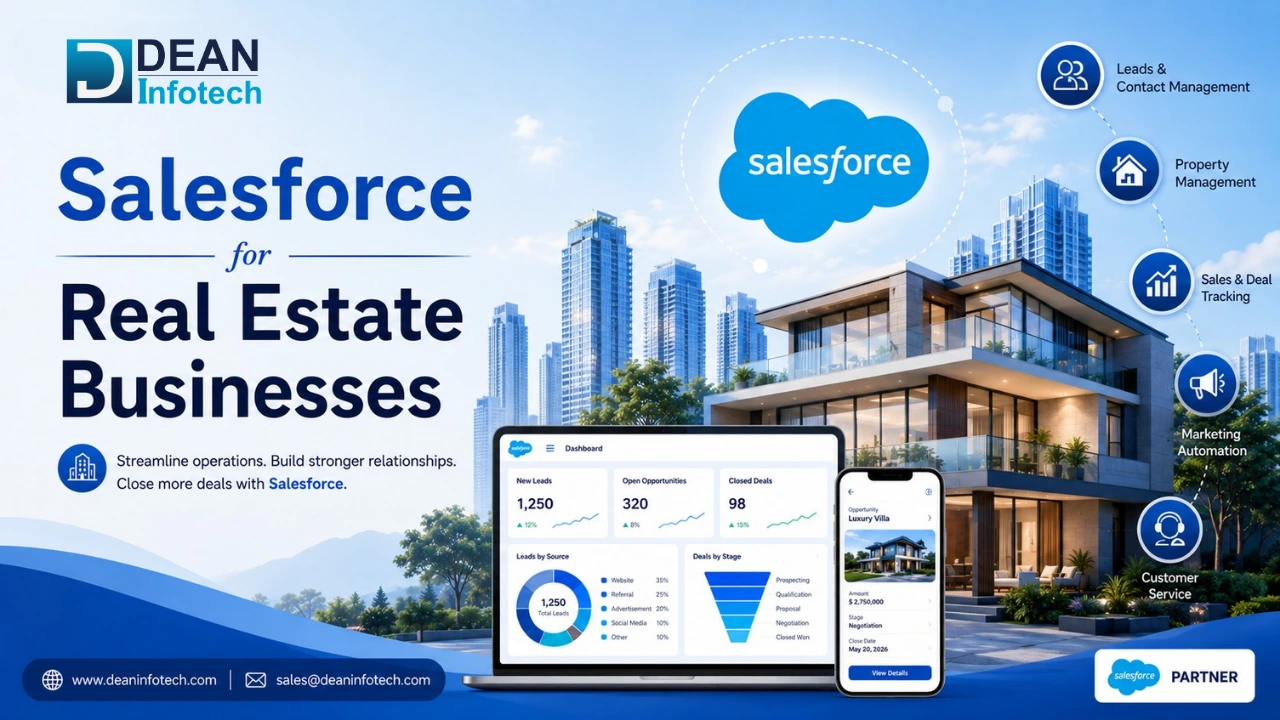
There is no stopping and starting between emailing spreadsheets and messaging programs because every communication is stored on the platform. When they call, they now have access to their preferences, communication history, what properties they are interested in, and the status of their transaction.
Facilitates interdepartmental coordination between sales, marketing, customer service, finance, and operations divisions. This is because each division has access to sound information.
Key Benefits of Salesforce for Real Estate Businesses
Centralized Lead Management
Real estate lead generation is received from numerous channels: websites, property portals, Facebook campaigns, referrals, and offline events. Handling them manually is more likely to result in forgetting or delaying the follow-up and losing them.
References
Automates the capture of leads by sources, projects, assigned to agents, and tracked along the sales pipeline of each lead. Tells the sales team to follow up with automatic reminders and workflows, thus improving the chances of increasing sales conversions.
Personalized Customer Engagement
A property purchase is driven by emotion and money, so the buyer needs to be spoken to on a personal level and not advertised to.
Customer segmentation according to preference, value range, region, property types, and the stage of the buyer's acquisition can be provided by Salesforce so that institutions can tailor campaigns, property, itinerary alerts, and follow-up calls.
Sales Process Automation
Daily routines usually consume most of an agent's time. With the help of Salesforce, the above tasks can be automated to achieve:
Lead assignment
Reminders for future appointments
Approve documents
Take an appointment
Automation can afford to give agents more time to build relationships and negotiate deals on the one hand, and less time on paperwork.
360-Degree Customer View
Salesforce has identified the number one benefit as being the profiles of the entire customer.
Agents can view:
Property questions
Communication history
Site visits were held at the following locations and with the following people:
Received offers
Documents to share
Purchased items.
Request for services.
Improving Sales Performance with Data and AI
A modern real estate venture generates tremendous quantities of data on clients and activities. But the information is meaningless unless it can be transformed into actionable knowledge.
Salesforce provides customizable dashboards and reporting capabilities that help businesses monitor:
Conversion rates
Sales pipeline performance.
Agent productivity
Customer engagement metrics
Automate sales tasks and optimize conversion by leveraging AI-enabled automation such as predictive lead scoring and opportunity insights so sales reps know which customers require their immediate attention.
Enhancing Customer Service After the Sale
Customer relationships don't end when the property deal is completed. Ongoing contact ensures word-of-mouth, repeat business, and customer loyalty.
Salesforce supports post-sale services through:
Case management ( Handling self-service cases)
Follow-up requests.
Warranty management
Collecting customer feedback
Custom tutorials
Regular communication helps to foster trust and enhance customer satisfaction through each stage of ownership.
Supporting Marketing and Lead Nurturing
As a key ingredient, marketing is used to attract potential customers and investors to enterprises. Salesforce is also proficient in integrating CRM data with marketing automation, so that businesses can target highly specialized campaigns.
Marketing teams can:
Segment the crowd
Create customized email journeys
Track Campaign Performance
Score the marketing-qualified leads
Return on Investment
These characteristics should help to make sure the marketing and sales teams are working towards the same business objectives.
Scalability for Growing Real Estate Businesses
Growing and expanding into new markets or rolling out additional initiatives makes the operations more complex. Salesforce has an enterprise IT platform that scales along with the company. When the counts are at a few hundred or a few hundred thousand, it enables the business to introduce and register clients and users, add applications, and adapt workflows without dismantling the technology backbone.
Additionally, it has a wide integration network that is compatible with linking to ERP systems, accounting solutions, document management systems, property management systems, and communication tools.
Read Full Blog Here: What are the Pros and Cons of Maximizing Real Estate Sales with Salesforce Automation
Real Estate Trends Driving CRM Adoption
Technology now has a strong presence across the whole real estate sector. CRM solutions like Salesforce give companies the agility to deliver a quicker, more personalized experience as well as make more informed business decisions throughout the customer journey.
Conclusion
The future of real estate belongs to those businesses that combine knowledge of markets and intelligent technology. With Salesforce, real estate companies can automate repetitive tasks, reduce operating costs, increase customer insight, and enhance business decisions through integrated data and data-driven insights.
Salesforce is not just another CRM but an “end-to-end customer lifecycle management tool,” which manages the customer lifecycle from lead capture and sales to customer support to customer relationship management.
Need expert help with your next project?
Get expert guidance across Salesforce, HubSpot, GoHighLevel (GHL), AI, and web development — tailored to your business.








Comments