Mobile apps are just part of doing business now, whether it's reaching customers or offering services online. Want to check your bank balance, order groceries, or book a doctor's appointment? Chances are there's an app for it, and honestly, people expect nothing less.
That said, users don't have much patience for apps that fall short. The ones that actually succeed load quickly, keep data safe, feel easy to use, and hold up as the business grows. Getting mobile app development right from the start makes all the difference; it leads to happier customers and a business built to last. In this guide, we'll walk through the basics of mobile app development, the benefits it brings, how the process plays out, what's trending, smart practices to follow, and how to pick a development partner worth trusting.
What Is Mobile App Development?
Short Answer: Mobile app development is about designing, building, testing, and maintaining the apps we use on our phones and tablets. Developers dig into platforms like Android and iOS, figuring out the right languages, frameworks, APIs, databases, and tools for the job.
But writing code is really just one piece of the puzzle. There's a whole lot more involved: figuring out what the business actually needs, shaping an interface that just makes sense to use, building out the features that matter, putting everything through its paces for performance and security, getting it launched, and then sticking with it through updates as time goes on.
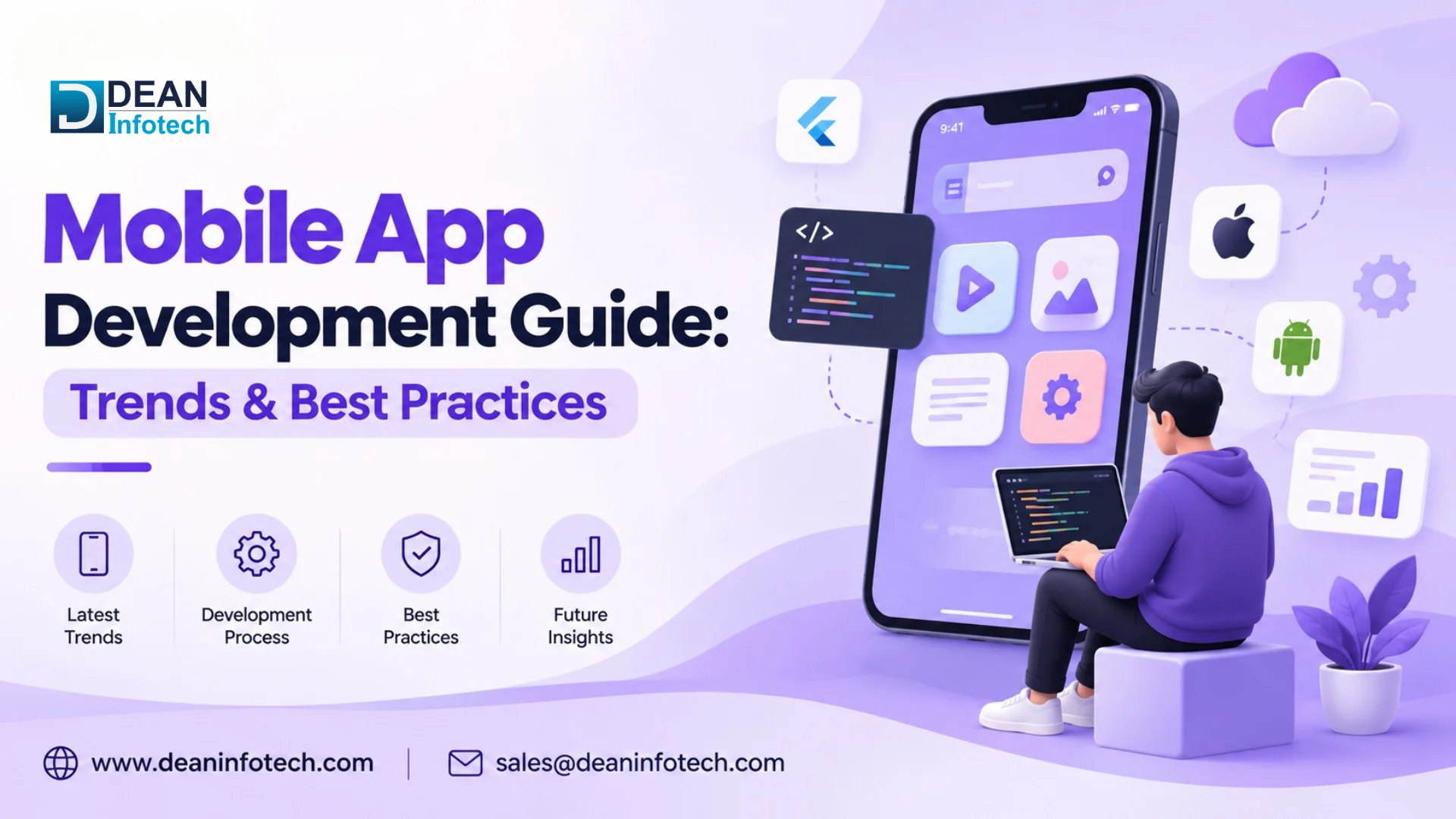
As for platforms, businesses aren't locked into one path. They can go native and zero in on a single platform, or take the cross-platform approach and build once so the app runs smoothly across different operating systems.
Types of Mobile App Development
Businesses usually pick from four approaches. Which one fits depends on your budget, timeline, and how much the app needs to do with the phone itself.
Native app development
A native app is built for one platform only, either iOS or Android. Developers use that platform's own tools, which means Swift for iOS and Kotlin for Android. The result is usually faster and smoother, and it gets full access to device features like the camera, GPS, push notifications, and Face ID or fingerprint login. The trade-off is cost. If you want both platforms, you're building and maintaining two separate apps.
Cross-platform app development
Here developers write the code once and ship it on both iOS and Android, using frameworks such as Flutter or React Native. You get one codebase to build and update, so development is quicker and maintenance is cheaper. Performance is close to native for most business apps. Very graphics-heavy apps or ones that lean hard on newer device features can still run into limits.
Hybrid app development
A hybrid app is essentially a web app wrapped in a native shell. The interface is built with HTML, CSS, and JavaScript, then packaged so it can be installed from an app store. Tools like Ionic and Capacitor work this way. It's a fast, low-cost route to multiple platforms, but the app can feel less polished than a native or cross-platform one, particularly with animations and complex screens.
Progressive web apps (PWAs)
A PWA is a website that behaves like an app. Users open it in the browser, can add it to their home screen, and it keeps working with a weak or dropped connection. There's nothing to download from an app store, which lowers the barrier for new users. The catch is that PWAs get less access to device features than installed apps, and support varies by platform, especially on iOS.
Benefits of Mobile App Development
A well-built app can pay off in several ways:
Direct line to customers. Push notifications and in-app messages reach people without relying on email open rates or social algorithms. Personalized offers and reminders are easier too.
Easier access. Customers can book, order, pay, or check an account from their phone in a few taps.
Less manual work. Internal apps can automate approvals, field reports, and inventory checks that used to live in spreadsheets and email threads.
More ways to earn. Subscriptions, in-app purchases, e-commerce, and paid upgrades all become options.
Better data. Usage patterns show which features people rely on, where they drop off, and what to build next. That beats guessing.
A good app also makes a business easier to deal with than a competitor who's still asking customers to call during office hours. But that only holds if the app is actually good. A slow, clunky one does more harm than having none.
Mobile App Development Process
A structured development process helps reduce risks and create a reliable application.
1. Idea and Requirements Analysis
Firstly, it is necessary to identify the idea of the application, its target audience, features, goals, and the desired results.
2. Planning and UI/UX Prototyping
Designers and developers are working on user flows, mockups, and prototypes. Great emphasis is placed on intuitive navigation and interactive elements.
3. Development
Development of Front-end and Back-end is taking place. APIs, databases, authentication system, payment system, and other components are implemented at this stage.
4. Testing
Testing detects all minor or major bugs, issues related to functionality and usability, security problems, and performance issues. It is necessary to conduct compatibility tests for various devices and OS versions.
5. Deployment
Deployment of the product and preparation for launching on the Apple App Store and Google Play Store take place.
6. Maintenance and Updates
The process of development of the application does not end with the deployment; in fact, this step serves only as the start of the process of regular maintenance and updates.
New security measures, performance optimizations, housekeeping updates, and other feature updates are released on a regular basis.
Latest Mobile App Development Trends
Technology continues to influence how mobile applications are designed and developed. Some important trends include:
Mobile Apps Using AI Technology
AI technology is becoming increasingly prevalent in mobile applications due to personalization, recommendations, chatbots, predictive analysis, automation, and search capabilities when proper data and privacy policies are used.
Cross-Platform Application Development
Due to the availability of common code for developing Android and iOS applications, the usage of cross-platform development frameworks is increasingly prevalent.
Voice Integration into the App
Voice integration into the app enhances user experience in terms of accessibility and convenience through the use of voice search, commands, and conversation capabilities in various kinds of applications.
Augmented Reality Technology and Immersive Experiences
Augmented reality opens new horizons in such industries as retail, education, entertainment, real estate, and product visualization.
Security
As mobile applications store more private information than they used to before, security remains one of the major aspects that should be considered during the development process.
Mobile App Development Best Practices
Following established practices can improve an application's quality and long-term performance.
User-oriented: Design features that will meet users’ needs without any extra functionality.
Maintain simplicity: Easy navigation and proper design lead to intuitive applications.
Prioritize security: Protect critical data by utilizing secure authentication, encryption, and API.
Conserve resources: Avoid unnecessary use of loading, memory, and power.
Proper scaling: Design the application’s architecture so it is ready for future integration.
Test regularly: Regular testing is required rather than a one-time test before launching an application.
Data analysis: Analyze the engagement, crashes, conversions, and any other data that would help improve your application.
Maintain compatibility: Ensure that your application remains compatible with new versions of operating systems.
Read Full Blog Here: A Comprehensive Guide to Mobile App Development for Businesses
Common Mobile App Development Mistakes
A few common missteps can really hold an app back. Diving into development without nailing down clear requirements, packing the first version with too many features, tuning out user feedback, brushing off security, or skipping tests across different devices, these are some of the biggest culprits that trip businesses up.
Users don't have much patience for poor performance either, so it's usually smarter to get the core functionality right first, then build from there based on real feedback and how people are actually using the app.
Another trap is choosing a tech stack just because it's cheap in the short run. The technology behind an app should do more than save money upfront; it needs to hold up when it comes to performance, scalability, and whatever comes next.
How to Choose a Mobile App Development Company
Picking the right mobile app development company can honestly make or break your project. Sure, technical skills matter, but it's worth digging deeper: look at their experience, the work they've done before, how they communicate, how seriously they take security, and what kind of support sticks around after launch.
What you're really after is a team that understands your business goals, not just one that knows how to churn out code. Go through their past projects and see if they've tackled similar apps or worked in your industry already.
Before you sign on with anyone, sit down and talk through the details, their process, timeline, tech stack, how they handle testing, what maintenance looks like, and how often you'll hear from them along the way. The right partner won't disappear after the initial build. They'll stay with you from planning and design all the way through development, testing, and support once the app is out in the world.
Salesforce Mobile App Development
Short Answer: Salesforce mobile app development is really about putting CRM data, workflows, and customer info directly into your team's hands, no matter where they're working from. Sales reps closing deals on the go, support teams responding to customers, field staff needing quick answers, a good mobile solution keeps them all connected without chaining anyone to a desk.
The trick is getting the mobile experience to actually mesh well with your existing CRM setup, so things feel just as natural on a phone as they do sitting at a computer. If your business needs something built around your specific Salesforce environment, it's worth checking out dedicated Salesforce mobile app development services.
Dean Infotech brings solid experience in software and technology solutions, and can help businesses figure out what their digital development needs actually look like. You can check out more about their services over at Dean Infotech.
Conclusion
Mobile app development sits at the center of any real digital strategy these days. Doing it well takes attention at every stage, the right development approach, solid security, a UX that feels effortless, architecture built to scale, and consistent maintenance over time.
It also helps to keep an eye on what's next, AI, voice interfaces, AR, cross-platform development, without losing sight of what customers actually need today. That's usually where the right mobile app development partner makes all the difference, taking a rough idea and shaping it into something secure, scalable, and easy to use.
When it's time to build out your mobile or enterprise solution, Dean Infotech brings the kind of experience that gets it done right.
Need expert help with your next project?
Get expert guidance across Salesforce, HubSpot, GoHighLevel (GHL), AI, and web development — tailored to your business.








Comments