Salespeople today also have the same common dilemma: too many leads and not enough time.
The proliferation of digital marketing has made lead generation more convenient, but determining which prospects are ‘sales-ready’ is still a challenge. This results in wasted time and low sales productivity as reps chase after the wrong leads.
This is where artificial intelligence comes into play. Rather than doing manual research, manually scoring and identifying leads, companies can now use artificial intelligence to analyze customer behavior, look for buying signals, and give greater priority to those opportunities most likely to close.
Organizations are increasingly combining AI-powered qualification with CRM platforms like HubSpot. In such a platform, tools such as HubSpot Breeze AI help sales teams identify high-intent leads. They also help automate repetitive tasks, and improve conversion outcomes.
What Is the Sales Qualification Process?
Sales qualification is a process where a sales rep assess a potential client, (leads and prospects) known as a lead or prospect, to understand if they are a good fit for your product/service and if they will be a purchasing customer. Qualification helps sales reps weed out those opportunities that will waste their time and resources, and allow them to concentrate on those that they can close.
In simple terms: not every lead is meant to have a sales conversation. A well defined sales qualification process helps to ensure your conversations are with those prospects who have a need, budget, authority, and timeframe to purchase your offering.
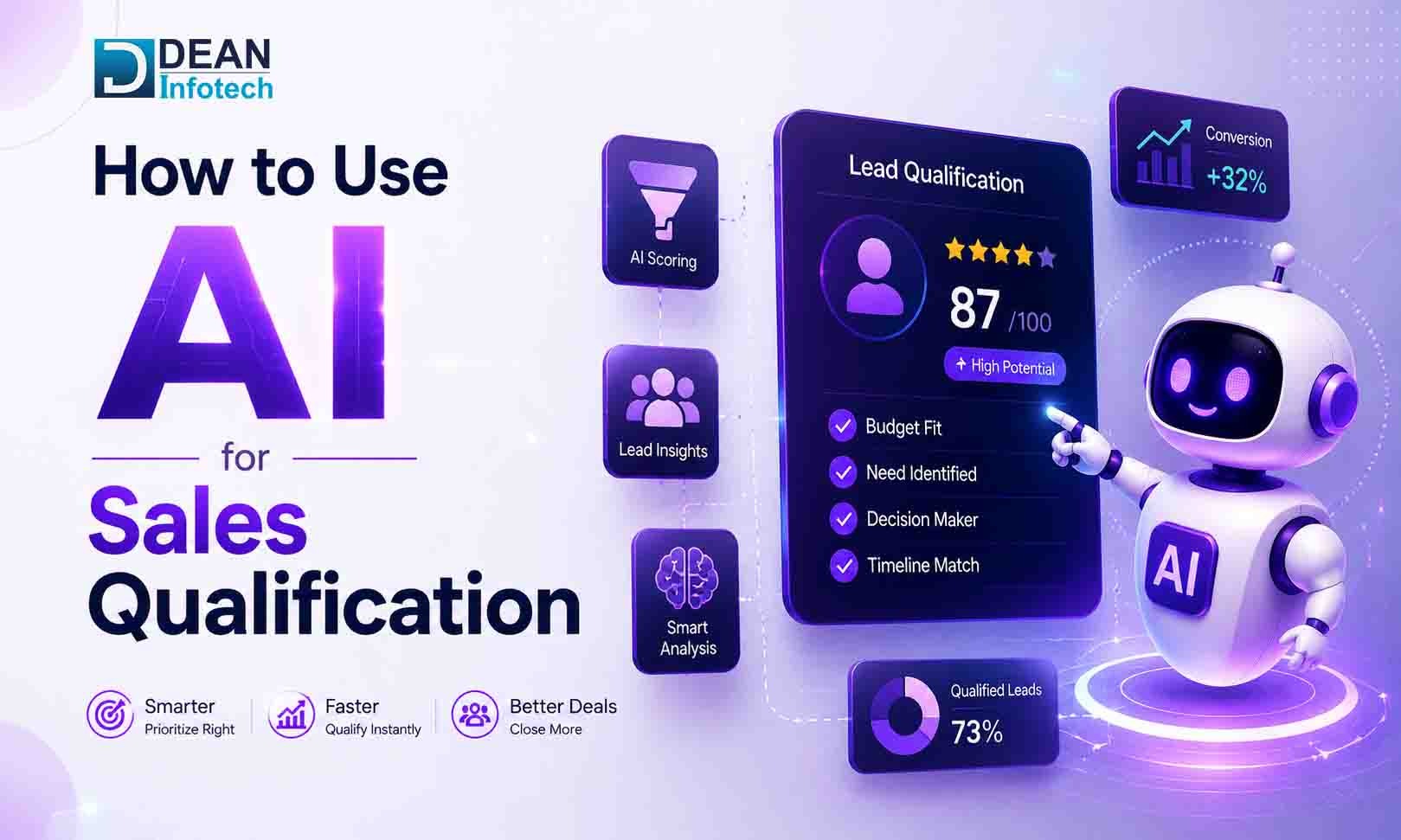
What is AI Sales Qualification?
Using artificial intelligence and machine learning, AI sales qualification involves analyzing data from leads and finding the ones that are most likely to turn into sales.
Rather than applying hardcoded rules, AI considers all the data from robotics, computers, sensors, and numerous other sources:
CRM records
Web activity
Email engagement
Interactions(others)
Form submissions
History of purchases
Sales conversations
Modern CRM platforms such as HubSpot further enhance this process through HubSpot Breeze AI, helping sales teams uncover buyer intent and prioritize prospects based on real-time insights.
Our teams at Dean Infotech help businesses leverage these AI-powered capabilities to build smarter and more efficient sales qualification processes and by recognizing patterns and trends, AI enables sales teams to focus on the most promising opportunities.
MQL vs SQL vs SAL vs SQO (Clarifying the Terms)
One of the most common sources of confusion in sales and marketing alignment is the terminology around lead stages. The acronyms MQL, SAL, and SQL (sometimes extended to SQO) represent progressive stages in the lead qualification journey. Understanding these distinctions is crucial because they define handoffs between teams, influence pipeline reporting, and directly impact how AI tools score and route leads.
Stage | Meaning | Owned By | Description |
| MQL | Marketing Qualified Lead | Marketing | Lead shows interest through content engagement and matches the target criteria. |
| SAL | Sales Accepted Lead | Marketing + Sales | Sales reviews and accepts the lead for follow-up. |
| SQL | Sales Qualified Lead | Sales | Lead has been contacted and meets qualification requirements. |
| SQO | Sales Qualified Opportunity | Sales | Qualified prospect becomes an active sales opportunity. |
Here’s a detailed breakdown:
1. MQL - Marketing Qualified Lead
Definition: A lead that marketing has identified as promising based on predefined criteria such as engagement level, demographic/firmographic fit, and behavior (e.g., downloaded an ebook, attended a webinar, visited the pricing page multiple times, or achieved a certain lead score).
Ownership: Primarily Marketing.
Intent Level: Moderate interest. They’ve shown curiosity but haven’t been validated for buying readiness.
Next Step: Passed over to sales for review (often via automated handoff).
Example: A marketing manager at a mid-sized SaaS company downloads your “Ultimate Guide to Sales AI” and signs up for a newsletter. They match your ICP but haven’t requested a demo yet.
MQLs are the fuel for the top of the funnel. The goal here is volume + relevance through nurturing.
2. SAL - Sales Accepted Lead
Definition: An MQL that the sales team has reviewed and formally accepted as worthy of their time and effort. This acts as a quality gate between marketing and sales.
Ownership: Joint (Marketing → Sales handoff).
Intent Level: Medium to High. The lead meets basic sales criteria (reachable, correct account, not junk/spam, fits SLA timelines).
Purpose: Ensures sales only works on leads they agree are viable, preventing friction and enforcing Service Level Agreements (SLAs) — e.g., “Sales will review and accept/reject within 24-48 hours.”
Example: The sales rep checks the MQL, confirms the contact is valid, the company size is appropriate, and there are no red flags. They accept it in the CRM.
SAL is an important buffer stage that improves alignment and accountability between teams.
3. SQL - Sales Qualified Lead
Definition: A lead (usually from SAL) that sales has actively engaged with and determined is a genuine sales opportunity. The rep has validated core qualification criteria (Need/Pain, Budget, Authority, Timeline, etc.).
Ownership: Sales.
Intent Level: High. The prospect has demonstrated clear buying intent.
Next Step: Converted into a sales opportunity in the CRM and moved into the active pipeline.
Example: After a discovery call, the prospect confirms they have budget allocated, pain points your solution solves, decision-making power, and a timeline to purchase within the next quarter.
This is where the real selling begins.
4. SQO - Sales Qualified Opportunity (Optional but increasingly used)
Some organizations add this stage to distinguish a fully qualified SQL that has become a formal Opportunity in the pipeline (with assigned deal value, close date, and stage).
It marks the transition from qualification to active deal management.
Why Businesses Are Adopting AI for Sales Qualification
Companies are willing to spend more on AI, as they recognize that traditional qualification methods frequently lag behind the evolution of modern customer behavior.
Common Challenges with Manual Qualification
Increased lead loads
Inconsistent scoring methods
Human bias
Time-consuming research
Automating data analysis and recommendations helps solve these problems using AI.
Benefits of AI Sales Qualification
Improved Lead Prioritization: AI ranks potential clients based on which are the most probable to close the deals.
Faster Response Times: Automated qualification allows for faster follow-up, which can greatly enhance conversion.
Increased Sales Productivity: Sales representatives spend less time researching leads and more time dealing with qualified prospects.
Business intelligence: It also helps business projects anticipate future sales opportunities on the basis of customer behavior and business history.
Consistent Qualification Processes: An AI algorithm applies the same set of rules to all the leads and eliminates a lot of subjective decision-making.
Traditional Sales Qualification vs AI Sales Qualification
Capability | Traditional Sales Qualification | AI-Powered Sales Qualification |
Lead Evaluation | Based on predefined rules and rep judgment | Analyzes historical data, behavior, and intent signals to identify high-potential leads |
Prospect Research | Sales reps manually gather company and contact information | AI automatically enriches lead profiles with relevant firmographic and behavioral data |
Lead Prioritization | Reps decide which leads to pursue first | Predictive models rank leads based on the likelihood to convert |
Qualification Speed | Can take hours or days per lead | Evaluates and qualifies leads in real time |
Follow-Up Management | Reps manually schedule and track outreach | AI triggers personalized follow-ups based on prospect actions |
Lead Routing | Fixed assignment rules with limited flexibility | Dynamically routes leads to the most suitable sales representative |
CRM Data Management | Manual data entry and updates | Automatically captures, updates, and syncs customer information |
Personalization | Depends on individual rep effort and available time | Generates tailored messaging at scale using customer insights |
Sales Productivity | Significant time spent on administrative tasks | Allows reps to focus more on selling and relationship building |
Scalability | Requires additional headcount to handle growth | Easily scales qualification efforts without proportional team expansion |
How AI Qualifies Leads
AI considers several signals when using an AI engine to rate leads.
Behavioral Signals
An indicator of how the opportunities interact with your brand.
Examples include:
How often are visitors to the site actually opening the site?
Time spent on pages
Content downloads
Webinar attendance
Opening of the email
Clicks on emails
A prospect who visits pricing pages consecutively or downloads multiple pieces of product material will score higher in qualification criteria than a prospect who accesses a single blog article.
Demographic and Firmographic Data
AI also assesses the personality of the prospect. Factors may include:
Designation
Industry
Number of employees
The following factors are important considerations when choosing a location for a business:
Geographic location
Revenue
Department
This will also give you information to help decide if the lead is a good match for your ideal customer profile.
Intent Signals
Intent data can be used to give insight into those prospects that are actively researching for a solution.
Examples include:
All comparisons of products
Visits to Pricing page
Requests for demo
Content of the message box, submitted through the contact form.
Competitor research
Indicates a higher probability of purchase
AI-Powered Lead Scoring
They include (but are not limited to): -lead scoring, which is one of the most common applications of AI in sales qualification.
Traditional Lead Scoring
Standard scoring is rule-based.
For example:
Open an emailed= 5 points
Form submission = 10 points
Demo request = 20 points
These techniques are easy, but their static nature constrains them and is not subject to change due to shifting customer preferences.
AI Lead Scoring
AI extracts knowledge from historical conversion data. (To identify characteristic features of customers who convert successfully.)
It bases scores on those factors that really do determine purchasing.
Benefits include:
Greater precision
Conjugate Search
Improved prioritization
Less manual work
This allows sales teams to concentrate on leads that are more likely to convert.
Using AI to Automate Lead Qualification
One of the key benefits of AI sales automation is that it can automate many of the qualification tasks that currently take up so much of our time.
Lead Research
AI tools can automatically collect and analyze data from various sources.
This may include:
Information about the company
Data of the Industry
From the news, the most recent information
Use of technology
Business growth signals
Lead Segmentation
AI can group leads based on:
Industry
Purchase intention
Level of engagement
Product interest
Customer journey step
Enhances targeting and personalization.
Lead Routing
When qualified, each lead can be automatically routed to the sales rep(s) who are deemed responsible for the reporting account.
Benefits include:
Faster follow-up
Reduction in response times
Efficiently managed territories
Follow-Up Recommendations
AI can also predict the next best action, taking into account customer behavior.
Examples include:
Requesting a demonstration.
Cash for a case study
Providing a free trial
Sharing pricing information
These suggestions give sales teams information to reach prospects.
Best AI Tools for Sales Qualification
There are also a few companies providing AI qualification functionality.
HubSpot
HubSpot uses AI to support:
Lead scoring
Prospect research
Sales forecasting
Automating workflows
Its integrated CRM facilitates the management of qualification and follow-up activities within a single platform.
Salesforce Einstein
Salesforce Einstein provides:
Predictive lead scoring
Opportunity insights
Forecasting revenues
Automated recommendations
It is especially convenient for organizations that already have Salesforce.
Apollo.io
Apollo.io combines prospecting and qualification capabilities through:
AI-driven lead prioritization
Prospect data enrichment
Buyer intent insights
Automated outreach sequences
Sales engagement automation
It helps sales teams identify, qualify, and engage prospects more efficiently.
ZoomInfo
ZoomInfo enhances sales qualification with:
Intent-based lead identification
Company and contact intelligence
Automated lead enrichment
Predictive buyer insights
Workflow automation
Its extensive B2B database helps teams qualify prospects using accurate and up-to-date information.
6sense
6sense uses AI and predictive analytics to provide:
Account-based lead qualification
Buying intent detection
Predictive lead scoring
Opportunity identification
Revenue intelligence
It is especially effective for B2B organizations targeting high-value accounts.
Demandbase
Demandbase helps sales teams qualify accounts through:
AI-powered account scoring
Buyer intent analysis
Account prioritization
Predictive opportunity insights
Account-based marketing and sales alignment
Also read:- How to Use AI to Build Scalable HubSpot Workflows
Best Practices for AI Sales Qualification
Start with Clean Data
Successful AI CRM automation depends on accurate, complete, and well-structured customer data that supports reliable qualification and forecasting.
Businesses should:
Remove duplicates
Keep all records up-to-date
Standardize CRM fields
Define Your Ideal Customer Profile
An AI qualification is more useful when businesses know their target groups.
Document factors such as:
Industry
Company size
Range revenue
Roles of the buyer
Combine AI with Human Expertise
AI is giving us recommendations, but in sales teams, we still need to make a judgment on what to act on.
The best organizations integrate the learning from data with the ability of people to relate to each other.
Monitor Performance Regularly
Track metrics such as:
Conversion rate for certain product leads
Qualification accuracy
Length of sales cycle
Resource velocity
Ongoing monitoring supports the evolution of qualification strategies.
Common Mistakes to Avoid
Relying Solely on AI: AI must be an enabler of decision-making and interaction rather than a substitute for human interaction.
Ignoring Data Quality: Inadequate data results in wrong recommendations and weaker results.
Overcomplicating Qualification Models: Too many variables can lead to a decrease in clarity and generate confusion. Concentrate on the signals that most matter.
Failing to Review Results: It is important to monitor and optimize the AI system processes regularly.
The Future of AI Sales Qualification
AI will become more and more an integral part of sales operations.
Future developments are expected to include:
More precise predictive analytics
Real-time buyer intent analysis
Automation of sales coaching
Advanced conversational intelligence
Hyper-personalized outreach recommendations
As these tools develop and mature, sales teams will have a deeper window into overall customer behavior and buying intentions.
Early adopters of AI within their organization will be in a much stronger position to optimize efficiency, drive higher conversions and scale revenue growth.
Final Thoughts
AI is revolutionizing sales qualification and enabling firms to find high-value prospects more quickly and accurately.
AI reduces time spent on administrative tasks for sales teams, providing everything from predictive lead scoring and automated research to intelligent segmentation and follow-up recommendations.
Platforms such as HubSpot are enhanced by HubSpot Breeze AI and are making advanced sales qualification accessible to businesses of all sizes. This is done by combining CRM data, automation, and predictive intelligence within a single ecosystem.
At Dean Infotech, we help businesses implement HubSpot solutions. Our experts help with CRM automation and AI-powered sales processes which improve lead qualification and accelerate growth.
Although AI cannot replace the skills of salespeople, it is now becoming vital for companies looking to enhance productivity, accelerate sales, and achieve long-term growth.
Need expert help with your next project?
Get expert guidance across Salesforce, HubSpot, GoHighLevel (GHL), AI, and web development — tailored to your business.









Comments