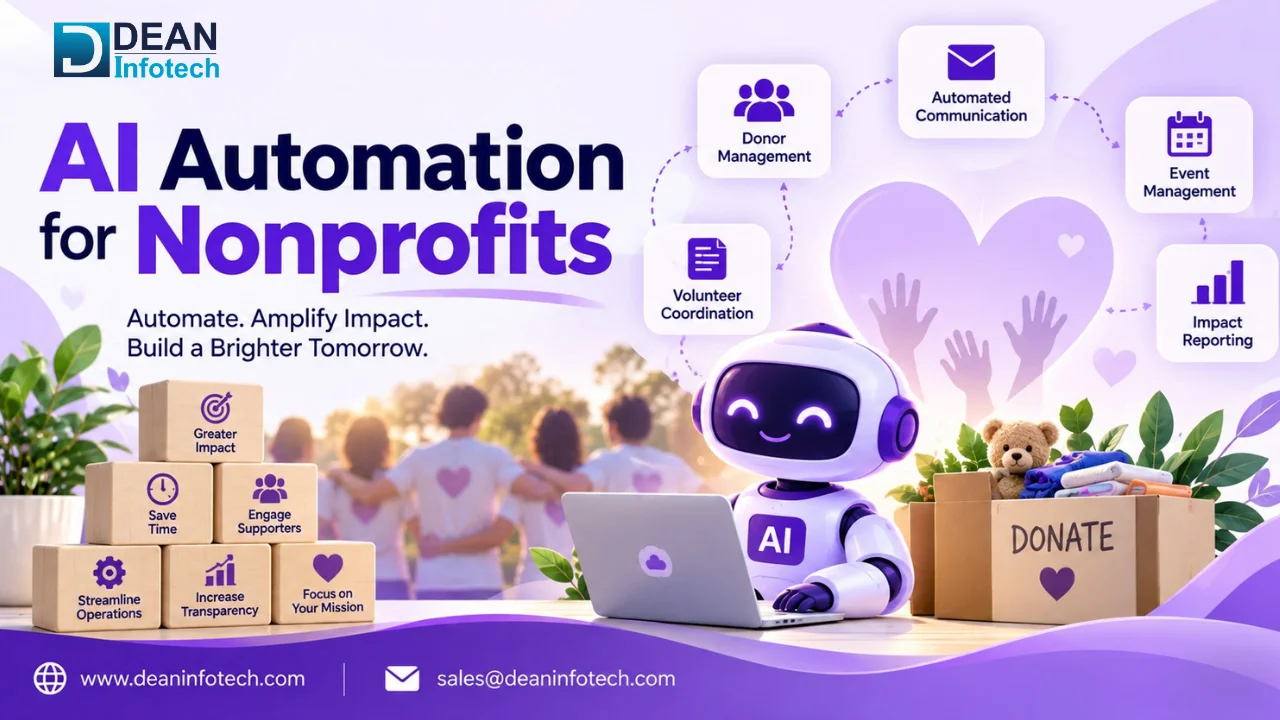
Nonprofit organizations are frequently facing the challenge of meeting an ever-increasing need from donors, volunteers, beneficiaries, and other stakeholders, and have tight budgets and limited staff. Staff time may be used to enter repetitive data, communicate with donors, report, and schedule. AI automation can help streamline these processes and give an employee the time to work on mission-critical tasks.
According to IBM, 82% of nonprofits are already leveraging some level of AI, and 76% have yet to establish an AI policy. This demonstrates the increasing utilization of AI and the importance of doing it responsibly. Dean Infotech can aid nonprofits in revolutionizing their communication, increasing their outreach potential, maximizing their limited resources, and more.
Why Nonprofits Are Turning to AI Automation
To handle more activities without a major operational cost increase, nonprofits are turning more towards AI automation. This can be very time-consuming for staff to undertake fundraising, maintain donor relationships, coordinate volunteers, report, and communicate with the community. Employees will have less time remaining to perform strategic and mission activities if they have to do a majority of these activities by hand.
AI automation can support organisations in completing repetitive tasks efficiently. It can organize and summarize documents, analyze data, generate content, and even automate standard emails. Even organizations that don't have a nonprofit vision can take advantage of generative AI to automate tedious, repetitive administrative tasks, allowing them to allocate more time for their employees to focus on more effective initiatives, such as stronger relationships.
Key Benefits of AI Automation for Nonprofits
AI can help nonprofits maximize their resources by automating time-consuming tasks, improving communication, data management, and supporter engagement. Automation can be the perfect way to boost productivity while retaining the human elements that are essential to the work of nonprofits if handled properly and intelligently.
Reduces Administrative Work
Simple data entry, processing documents, scheduling, reporting, and answering simple emails can consume a lot of staff time. Fortunately, many of these repetitive tasks can be automated with AI, allowing human employees to focus on tasks that require more human judgment, creativity, and social interaction.
Improves Donor Engagement
Sustaining donor relationships is an essential element in building long-term donor relationships. AI can review donor interactions and engagement history to inform personalized and targeted communication strategies. Other examples of emails that can be automated for nonprofits include thank-you emails, donation receipts, newsletters and re-engagement emails.
Supports Fundraising
AI can aid fundraising teams in segmenting donors, analysing fundraising campaigns, offering personalised outreach and donor follow-up. Automated workflows can also respond to some donor activities, allowing an organisation to manage more campaigns and communicate in real time with donors.
Enables Data-Driven Decisions
Valuable data can be collected by nonprofits during fundraising campaigns, at events, through volunteer programs, and as a result of donor interactions. This data can help organisations see trends and patterns, and make decisions about how well their campaigns have been working and what resources to allocate next.
Improves Volunteer Management
Co-ordination of volunteers involves recruitment, organising, communicating, and follow-up. AI can help with the sorting of volunteers, match them with the correct volunteer opportunities, remind them, and automate repetitive communications.
Reduces Operational Costs
By reducing repetitive tasks carried out by staff, the non-profit can save more time and complete more work in less time through AI consulting services. This may allow more time and resources to be dedicated to programs, services, and community projects.
Practical AI Automation Use Cases for Nonprofits
AI automation has the potential to be used in fundraising, administration, communication, volunteer management, and research. The best cases are repetitive tasks in which automation can deliver a tangible improvement to the task that isn't an important decision for the nonprofit professional.
AI-powered donor management: AI can handle donor information, donor behaviour analysis, categorisation of donors, and support donor management teams in prioritising opportunities for engaging donors.
Automated fundraising campaigns: Nonprofits can send automated thank-you messages, donation reminders, nonprofit campaign updates, newsletters, and donor re-engagement sequences.
AI chatbots: Direct simple donation, program, volunteer, and event inquiries through AI chatbots and direct more complex inquiries to staff.
Volunteer recruitment and scheduling: AI can be used to process applications, coordinate opportunities with volunteers, remind volunteers, and schedule volunteers.
Grant research: AI can assist teams in identifying relevant grants, summarizing the requirements for each grant, and organizing their grant-research process.
Automated reporting: AI can handle and summarize operational data, reducing manual reporting.
Content creation: AI can generate ideas for newsletters, social media posts, marketing campaigns, event invitations, and more.
AI Automation Tools for Nonprofits
There are an increasing number of AI and automation solutions available for nonprofits. The selection will depend on the budget, the technology available to them, and the business purpose and data requirements of the organization.
ChatGPT: Can help create text, research, brainstorm, summarise, and perform basic writing tasks.
HubSpot: Provides CRM, marketing automation, contact management, and communication application.
Salesforce Nonprofit Cloud: Offers nonprofit CRM, fundraising, program management, and data workflow functionality.
Zapier: Integrates applications and automates repetitive work.
Mailchimp: Provides email marketing, audience segmentation, and automated campaigns.
Microsoft Power Automate: Automation of processes and applications.
While it's true that AI capabilities are a key consideration, nonprofits should look at the security, integration options, scalability, usability, and overall cost of the tool before making a decision.
Best Practices for Implementing AI Automation in a Nonprofit
The successful adoption of AI is not about just purchasing and implementing a solution. For nonprofits, it's time to find real-life applications, establish policies, and ensure employees know where automation will fit into the existing processes. IBM highlights three key pillars of AI literacy, human-centric design, and responsible governance when it comes to nonprofit AI adoption.
Start with Clear Objectives
List down specific problems that are anticipated to be solved by AI. These goals could be to save time on administration, shorten donor response time, or drive greater engagement rates.
Choose Practical Use Cases
Choose simple, predictable activities such as scheduling emails, organizing data, summarizing meetings, or preparing reports. Projects that have been proven to be successful can be used to build confidence before increasing the use of automation.
Prepare Organizational Data
Reliability is key for AI systems. Before automating donor, volunteer, and operational data, clean, organize, and standardize data.
Develop Responsible AI Policies
Define policies around privacy, data security, transparency, human oversight, and using AI appropriately. This is especially significant given the misalignment of nonprofit use of AI with the creation of formal policies.
Maintain Human Oversight
In sensitive situations, the role of AI is to assist employees rather than make decisions. In making important donor, beneficiary, fundraising, and organizational decisions, human review should be provided.
Monitor and Improve
Carry out periodic performance evaluations, identify problems or errors, and monitor results; make necessary changes to procedures. Continuous monitoring makes automation relevant and useful, and helps to keep it aligned with organizations' goals.
How to Measure the ROI of AI Automation for Nonprofits
The ROI calculation will enable nonprofits to understand and assess the value of their AI investments. Organizations need to establish a baseline before implementation and compare after implementation. Staff time saved, lower admin costs, response times, campaign engagement, donor retention, and fundraising conversion rates are all helpful metrics.
Financial variables aren't the only ways to calculate ROI. Value can also be gained in the quicker turnaround of communications and better donor relationships, along with better productivity and reporting. Indeed, the advantages of becoming AI fluent are quantifiable at 10-15 per cent, demonstrating the real value that can be achieved through efficient AI development.
Common Challenges When Adopting AI Automation
While AI automation offers opportunities, there are potential risks and practicalities to consider before making the move towards AI automation in nonprofits. In addition to limited budgets, limited technical skills, and data that are often scattered, adoption is often a challenge.
Data privacy: Nonprofits may deal with sensitive information regarding donors and beneficiaries, so it is crucial to ensure that this data is kept safe.
Lack of technical expertise: Smaller organizations might not have employees who have the necessary technical knowledge for handling complex AI systems.
Implementation costs: Small software subscription, integration, and employee training costs.
AI accuracy: The information and suggestions provided by AI might be inaccurate and need to be verified by humans.
Employee adoption: There may be a need for training and support for teams to integrate AI into their current processes.
Ethical issues: There is a need for protection for bias and undesirable automated decisions.
Lack of governance: Nonprofits must have policies in place regarding privacy, transparency, accountability, and responsible use of AI. IBM research shows that this governance deficit is a problem throughout the industry.
Conclusion
With AI automation, nonprofits can enhance their efficiency, build better relationships with donors, improve fundraising efficiency, and eliminate repetitive tasks. From communication automation, volunteer management, data analysis, and reporting to more, AI can help with a variety of nonprofit tasks. But it is important to take an intelligent and responsible approach to adoption. Dean Infotech can aid nonprofits with practical AI applications in the real world, set goals, protect sensitive information, and train employees to work with AI tools properly.
Human involvement in key decision-making and supporter relationships is an integral part. When coupled with good governance and human resources, nonprofits can use automation to maximize their resources and direct time and energy towards their mission and their community.
Need expert help with your next project?
Get expert guidance across Salesforce, HubSpot, GoHighLevel (GHL), AI, and web development — tailored to your business.









Comments