Connecting Salesforce to your ERP and marketing automation tools can turn a scattered tech stack into a unified growth engine. But the partner you choose for that project determines how smoothly your data flows, how quickly your team adapts, and how much value you actually get from the integration.
This guide compares eight Salesforce integration partners that specialize in CRM-to-ERP connectivity and marketing automation. You will find evaluation criteria, feature breakdowns, and a side-by-side comparison table to help you shortlist the right fit for your business.
Dean Infotech gives you an AI-accelerated integration approach that connects Salesforce to ERPs, marketing platforms, and custom applications with measurable speed and accuracy.
Quick Guide: 8 Best Salesforce Integration Partners for CRM and ERP Projects
Dean Infotech: The best overall Salesforce integration partner for end-to-end CRM, ERP, and marketing automation connectivity
Itransition: A global IT consultancy with middleware-driven Salesforce integration for complex enterprise ecosystems
Configero: Compliance-focused Salesforce integration for regulated industries like finance and healthcare
Algoworks: API-driven Salesforce connectivity with a focus on data synchronization across platforms
Cynoteck: Process automation-focused Salesforce integration for growing mid-market businesses
360 Degree Cloud: A Salesforce consulting partner with integration capabilities for multi-cloud environments
Synebo: Customizable Salesforce integration services for startups and scaling companies
Folio3: Salesforce-to-ERP and eCommerce integration with a focus on operational data accuracy
How We Chose the Best Salesforce Integration partners for ERP and Marketing Automation
Picking a Salesforce integration partner is a high-stakes decision. You are trusting another team with your customer data, your operational workflows, and the connection points between your most critical systems. Here is how we evaluated each partner on this list.
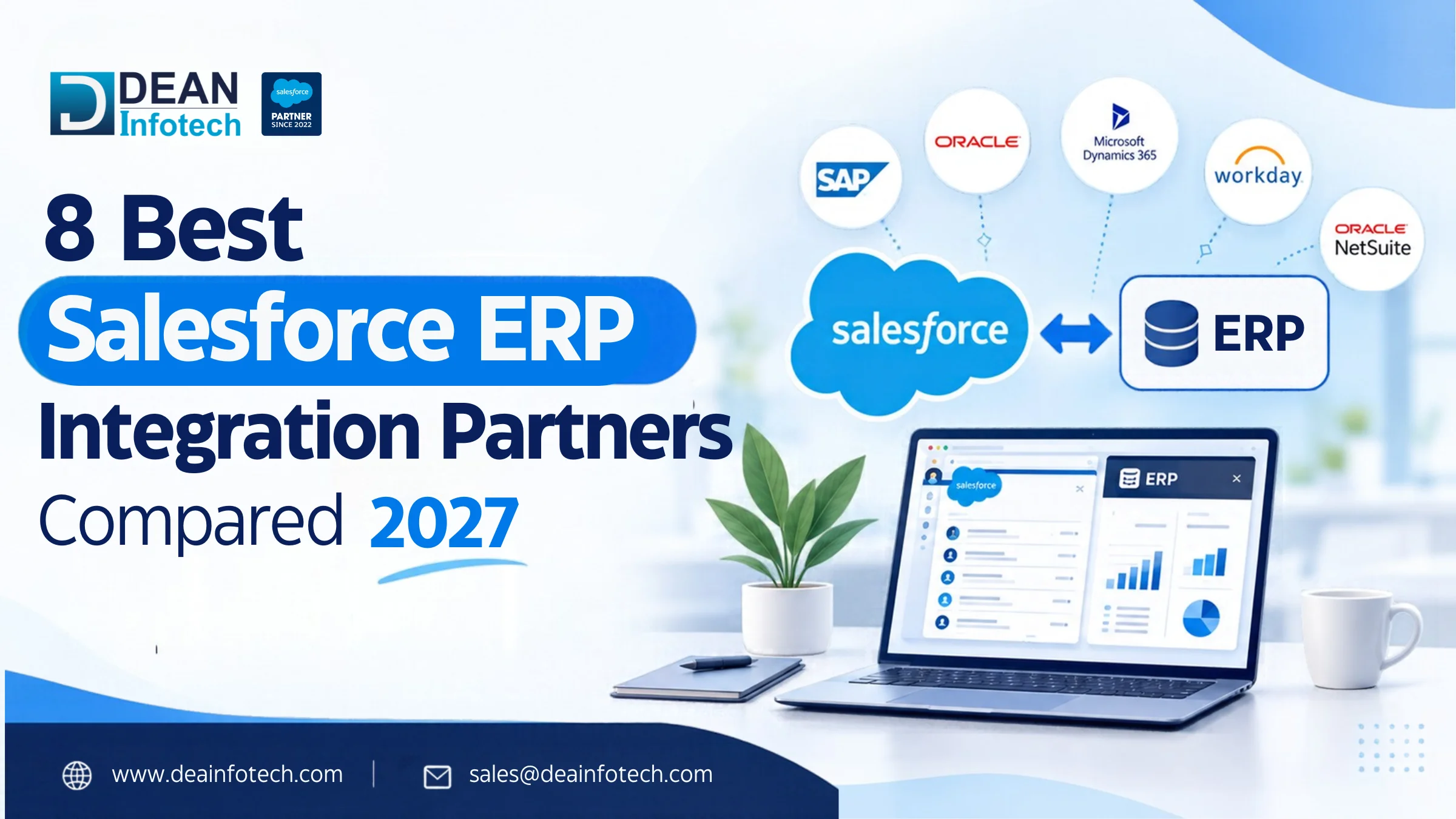
ERP integration depth: Can the partner connect Salesforce to major ERPs like SAP, NetSuite, and Microsoft Dynamics with real-time data sync? You need a partner that handles bidirectional data flows, not just one-way pushes.
Marketing automation connectivity: Does the partner integrate Salesforce with marketing tools so your lead scoring, nurture sequences, and campaign attribution stay connected to CRM data?
API and middleware expertise: Partners that work with MuleSoft, Boomi, or custom APIs give you more flexibility than those limited to pre-built connectors.
Industry and compliance experience: If you operate in healthcare, financial services, or manufacturing, your integration partner needs to understand the regulatory landscape and build with compliance in mind.
Post-launch support and monitoring: Integrations break. A reliable partner provides ongoing monitoring, error handling, and optimization after go-live so your data never falls out of sync.
Delivery speed and methodology: How quickly can the partner scope, build, and deploy an integration? Partners that use structured project management and AI-assisted development tend to reduce timelines without cutting corners.
The 8 Best Salesforce integration Partners for ERP and Marketing Automation
1. Dean Infotech: Best overall Salesforce integration partner for CRM and ERP
Dean Infotech is a Salesforce Crest Consulting Partner that delivers end-to-end Salesforce consulting and integration services across CRM, ERP, and marketing automation. The company operates from offices in the USA and India and serves B2B clients across healthcare, fintech, manufacturing, eCommerce, and professional services.
What sets Dean Infotech apart is a hybrid Human + AI development model. The team uses AI-assisted coding tools and automated testing frameworks to cut delivery timelines by up to 40%, while senior architects handle system design and governance. This approach means your integration gets built faster and tested more thoroughly.
Dean Infotech connects Salesforce to ERPs like SAP, NetSuite, and Microsoft Dynamics, as well as marketing platforms and custom internal applications. The firm also builds Dean ERP, a cloud-based ERP solution for manufacturers on Salesforce, giving the team firsthand expertise in how CRM and ERP data should interact.
For companies that also use HubSpot alongside Salesforce, Dean Infotech provides HubSpot integration services and Salesforce-to-HubSpot migration, which makes them especially useful for businesses running multi-CRM environments.
Dean Infotech features
AI-accelerated integration delivery: Uses GitHub Copilot and automated testing to compress project timelines while maintaining code quality, so your integration launches sooner.
Bidirectional ERP sync: Connects Salesforce with SAP, NetSuite, and Dynamics for real-time data exchange across orders, invoices, inventory, and customer records.
Marketing automation integration: Links Salesforce to HubSpot, Pardot, and other platforms so your lead data and campaign attribution stay unified with your CRM pipeline.
Custom API development: Builds tailored API connections and middleware configurations for systems that do not have out-of-the-box Salesforce connectors.
Dean ERP for manufacturing: Offers a native Salesforce ERP built for manufacturers, giving the team direct experience in CRM-to-ERP architecture.
Ongoing managed services: Provides post-launch monitoring, error resolution, and continuous optimization through managed services so your integrations stay healthy over time.
Dean Infotech pros and cons
Pros:
AI-enhanced development reduces integration delivery timelines by up to 40%
Multi-CRM expertise across Salesforce, HubSpot, and GoHighLevel creates flexibility for complex tech stacks
Builds and maintains its own ERP product on Salesforce, meaning the team understands CRM-ERP data flows from the inside
Cons:
Headquartered in India with a U.S. office, so time zone coordination may require scheduling adjustments for some teams
The breadth of services (CRM, ERP, web, mobile, AI) means you should confirm your project gets a dedicated integration-focused team
Smaller team size compared to large global system integrators, though this often translates to more personalized attention
2. Itransition: Global IT consultancy for middleware-heavy Salesforce integrations
Itransition is a software development and IT consulting company founded in 1998, headquartered in Denver, Colorado. With over 25 years of delivery experience, the firm handles complex Salesforce integration projects that involve connecting legacy systems with modern cloud platforms through middleware architectures.
The company focuses on enterprise-grade projects where multiple systems need to communicate through middleware layers like MuleSoft or Boomi. Itransition works with clients in financial services, manufacturing, and healthcare who require stable, long-term integration architectures.
Itransition features
Middleware-based architecture: Connects Salesforce to ERP and legacy systems through middleware platforms, which helps you manage multiple data flows from a central layer.
Legacy system modernization: Migrates and integrates aging on-premise systems with Salesforce and cloud ERPs.
Scalable project delivery: Provides full-team engagement for large integration projects with formal governance and QA processes.
Itransition pros and cons
Pros:
Over 25 years of software development experience across enterprise clients
Handles complex middleware architectures connecting multiple legacy and cloud platforms
Works across various industries including financial services and manufacturing
Cons:
Focused on large enterprise engagements, which may not suit smaller or mid-market projects
Salesforce is one of many platforms rather than a primary specialization
Published Salesforce-specific case studies are limited compared to CRM-focused boutique firms
3. Configero: Compliance-first Salesforce integration for regulated industries
Configero is a Salesforce consulting partner based in Atlanta, Georgia, founded in 2009. The firm specializes in Salesforce implementation and third-party integrations with a particular focus on data security and regulatory compliance. Configero works with clients in sectors where data governance is non-negotiable.
The team handles Salesforce integration with ERPs, data warehouses, and marketing platforms while building compliance layers into the architecture. If your industry requires strict audit trails and access controls, Configero structures integrations to meet those standards.
Configero features
Compliance-built integrations: Configures Salesforce connections with data encryption, access controls, and audit logging for regulated environments.
ERP and data warehouse connectivity: Connects Salesforce to financial systems and analytics platforms with structured data mapping.
Force.com custom development: Builds custom applications on the Salesforce platform to extend integration capabilities.
Configero pros and cons
Pros:
Deep focus on compliance and data governance for regulated industries
Over 15 years of Salesforce consulting experience
Handles multi-ERP integration projects with security at the foundation
Cons:
Smaller team compared to larger consulting firms
Industry specialization may not align with businesses outside regulated sectors
Limited public case studies on marketing automation integration specifically
4. Algoworks: API-led Salesforce integration for data synchronization
Algoworks is a Salesforce Summit Partner headquartered in Sunnyvale, California, founded in 2006. The firm reports over 800 Salesforce certifications and has delivered more than 700 Salesforce projects. Algoworks focuses on API-driven integration services that synchronize data across Salesforce and connected platforms in real time.
The company provides Salesforce migration, integration, and custom development services. Their integration work centers on API-led connectivity that keeps Salesforce data aligned with other business systems, including ERPs and marketing tools.
Algoworks features
API-led integration: Connects Salesforce to third-party platforms through structured API layers for real-time data synchronization.
Migration services: Handles CRM migrations into Salesforce from legacy systems with data mapping and validation.
Custom AppExchange development: Builds Salesforce-native applications that extend platform functionality.
Algoworks pros and cons
Pros:
Over 800 Salesforce certifications across the team
Four consecutive years as a Salesforce Summit Partner
Handles both integration and AppExchange product development
Cons:
Broad service portfolio (mobile, web, staff augmentation) means integration is one of many offerings
Published ERP-specific integration case studies are not prominently featured
Client reviews note that timelines can extend beyond initial estimates
5. Cynoteck: Process automation-focused Salesforce integration for mid-market
Cynoteck is a CRM consulting and software development firm founded in 2008, headquartered in India with offices in the USA. The company provides Salesforce implementation, customization, and integration services with a focus on automating business processes and connecting Salesforce to ERPs and Microsoft platforms.
Cynoteck works primarily with growing mid-market businesses that need to automate manual workflows between their CRM and back-office systems. The firm connects Salesforce to systems like Microsoft Dynamics and third-party ERPs.
Cynoteck features
Process automation: Automates workflows between Salesforce and connected systems to reduce manual data entry.
Microsoft ecosystem integration: Connects Salesforce to Microsoft Dynamics and other Microsoft business tools.
AI-enhanced CRM features: Implements Einstein AI and custom AI components within Salesforce workflows.
Cynoteck pros and cons
Pros:
Founded in 2008 with over 15 years of CRM consulting experience
Works across Salesforce and Microsoft platforms
Handles both Salesforce and web/mobile development under one roof
Cons:
Fewer published Salesforce-specific certifications compared to Summit-tier partners
Integration services are part of a broader development portfolio, not a standalone specialty
Limited published case studies on ERP integration specifically
6. 360 Degree Cloud: Multi-cloud Salesforce consulting with integration capabilities
360 Degree Cloud is a Salesforce Summit Partner founded in 2012, headquartered in Faridabad, India. The firm reports over 680 certifications and 271 certified professionals, with more than 3,000 completed Salesforce projects. 360 Degree Cloud provides Salesforce consulting, implementation, integration, and custom development across Sales Cloud, Service Cloud, Marketing Cloud, and industry-specific clouds.
The company's integration work connects Salesforce to third-party platforms, ERPs, and marketing tools. They serve clients across finance, healthcare, retail, manufacturing, and education sectors.
360 Degree Cloud features
Multi-cloud Salesforce expertise: Works across Sales Cloud, Service Cloud, Marketing Cloud, and Education Cloud for connected integration projects.
Custom development: Builds Lightning Web Components, Aura components, and Apex-based solutions for custom integration needs.
AppExchange products: Develops and maintains proprietary applications on the Salesforce AppExchange.
360 Degree Cloud pros and cons
Pros:
Over 680 Salesforce certifications and 3,000+ completed projects
Recognized as APAC ISV Partner of the Year in 2023
Works across multiple Salesforce clouds including industry-specific editions
Cons:
Primary operations are based in India, which may require time zone coordination for U.S. and European clients
ERP integration is not listed as a standalone service area on their website
Mixed reviews on third-party platforms suggest inconsistent experiences across project types
7. Synebo: Customizable Salesforce integration for startups and scaling companies
Synebo is a Salesforce Crest (Gold) Partner founded in 2015, with offices in the USA and Europe. The 160-person firm provides CRM consulting, custom Salesforce development, and integration services. Synebo focuses on delivering flexible integration solutions that adapt to the needs of both startups and enterprise organizations.
The company handles CRM migrations, Lightning transitions, and multi-system integrations, including ERP and data platform connectivity. Their approach emphasizes detailed project management and long-term system performance.
Synebo features
Flexible integration architecture: Designs Salesforce integrations that scale from startup-level to enterprise complexity.
CRM migration expertise: Moves organizations from legacy CRMs into Salesforce with data integrity checks.
AppExchange development: Builds custom Salesforce applications for specific workflow requirements.
Synebo pros and cons
Pros:
Maintains a 5.0 rating on Clutch based on verified client reviews
Works with both startups and enterprise clients on integration projects
Founded in 2015 with a focused team of 160 professionals
Cons:
Smaller team size compared to firms with hundreds of consultants
Fewer years of operating history than more established partners
ERP-specific integration examples are not prominently documented on their website
8. Folio3: Salesforce-to-ERP and eCommerce integration specialist
Folio3 is a software development company that specializes in connecting Salesforce to ERP and eCommerce platforms. The firm helps businesses automate order-to-cash workflows by syncing Salesforce with systems like NetSuite, SAP, and Shopify so that customer, order, and inventory data stays consistent across platforms.
Folio3 works with businesses that need to bridge their front-office CRM with back-office operational systems. Their integration work emphasizes data accuracy, automated workflows, and reducing manual reconciliation between sales and fulfillment teams.
Folio3 features
ERP-to-Salesforce connectivity: Integrates Salesforce with NetSuite, SAP, and other ERPs for order, invoice, and inventory synchronization.
eCommerce integration: Connects Salesforce to Shopify and other commerce platforms for unified customer and order management.
Data accuracy focus: Implements validation rules and automated checks to keep data consistent across integrated systems.
Folio3 pros and cons
Pros:
Focused on ERP and eCommerce integration as a core service area
Handles both Salesforce and NetSuite environments
Emphasizes operational efficiency and data accuracy in integration projects
Cons:
Less prominent Salesforce partner tier compared to Summit or Crest-level firms
Marketing automation integration is not highlighted as a specialty
Limited public information on team size and certification count
Comparison Table: The Best Salesforce Integration Partners for ERP and CRM
Partner | Native ERP Product | AI-Assisted Delivery | Multi-CRM Expertise |
| Dean Infotech | ✓ (Dean ERP) | ✓ | ✓ (Salesforce, HubSpot, GHL) |
| Itransition | ✗ | ✗ | ✗ |
| Configero | ✗ | ✗ | ✗ |
| Algoworks | ✗ | ✗ | ✗ |
| Cynoteck | ✗ | ✗ | ✓ (Salesforce, Microsoft) |
| 360 Degree Cloud | ✗ | ✗ | ✗ |
| Synebo | ✗ | ✗ | ✗ |
| Folio3 | ✗ | ✗ | ✗ |
What Should You look for in a Salesforce ERP Integration Partner?
Your integration partner needs to understand both sides of the equation: how Salesforce manages customer-facing data and how your ERP handles operational processes like order fulfillment, inventory, and financials. A partner that only knows one system will leave gaps in your data architecture.
Look for a team that maps data flows before writing a single line of code. According to the 2025 MuleSoft Connectivity Benchmark Report, the average enterprise now uses 897 applications, yet only 29% are integrated. This means most businesses are working with fragmented data that creates manual work and reporting inconsistencies.
You should also ask about error handling and monitoring. Integrations are not set-and-forget projects. Your partner should provide ongoing sync monitoring, failed-record alerts, and regular health checks to keep your connected systems running reliably.
How Does CRM-to-ERP Integration Improve Sales and Operations Alignment?
When your CRM and ERP share data in real time, your sales team sees order status, inventory levels, and invoice history directly inside Salesforce. That means fewer support tickets, faster quote-to-cash cycles, and more accurate revenue forecasting.
On the operations side, ERP teams get visibility into pipeline data and closed deals without waiting for manual handoffs. This alignment reduces fulfillment delays and helps finance teams reconcile billing data faster.
Dean Infotech builds these bidirectional data flows using Salesforce migration and integration services and custom middleware configurations. The result is a connected system where every team works from the same source of truth.
Why Dean Infotech is the Best Salesforce Integration Partner for ERP and CRM
Dean Infotech brings together Salesforce CRM expertise, ERP product knowledge, and AI-accelerated delivery in a way that most integration partners cannot match. The company does not just connect systems. It designs integration architectures that align your sales, marketing, and operations data into a single, reliable ecosystem.
With Dean ERP, the team has built its own Salesforce-native ERP for manufacturing, which means they understand CRM-to-ERP data flows at the product level, not just the consulting level. That firsthand experience with Salesforce development translates into more precise data mapping, more reliable sync configurations, and fewer surprises during your project.
If you are evaluating Salesforce implementation or integration projects and want a partner that combines technical depth with real-world ERP experience, Dean Infotech is a strong place to start. Reach out to their team to discuss your integration requirements and get a project assessment.
Need expert help with your next project?
Get expert guidance across Salesforce, HubSpot, GoHighLevel (GHL), AI, and web development — tailored to your business.




Comments