The CRM you pick determines your sales, your relationships with customers, and ultimately your revenue. Of the dozens of CRM options in the market, two stand out in nearly every conversation: HubSpot Sales Hub and Salesforce.
According to Forbes Advisor, 78% of sales professionals report that CRM systems help improve sales performance, highlighting why choosing the right platform is a critical business decision.
Both systems provide strong tools for prospect management, sales automation, pipeline management, reporting, and customer communication. But they differ in the way these tools are implemented. The biggest question on every business’s mind is a straightforward one: on which platform do I see the most conversions?
It depends on how big your business is, how sales are processed, your expansion plans, and the technology needed.
In this comprehensive HubSpot Sales Hub Comparison, we will see how the two CRM giants compare on the modern sales team's most important criteria.
What is HubSpot Sales Hub?
HubSpot Sales Hub is a sales enablement platform designed to enable companies to manage their leads, automate the boring repetitive tasks, monitor sales activity and increase pipeline visibility.
Created within the integrated CRM platform of HubSpot, which includes sales automation, reports, artificial intelligence, and sales tools. It is a sales centre that offers contact management, deal tracking, and automation tools in one easy-to-use UI.
Key features include:
Management of contact and deal
Track an email
Sales automation
Scheduling meetings
Human conversation intelligence
Pipeline management
Reporting dashboards
Models for assisting in sales using AI
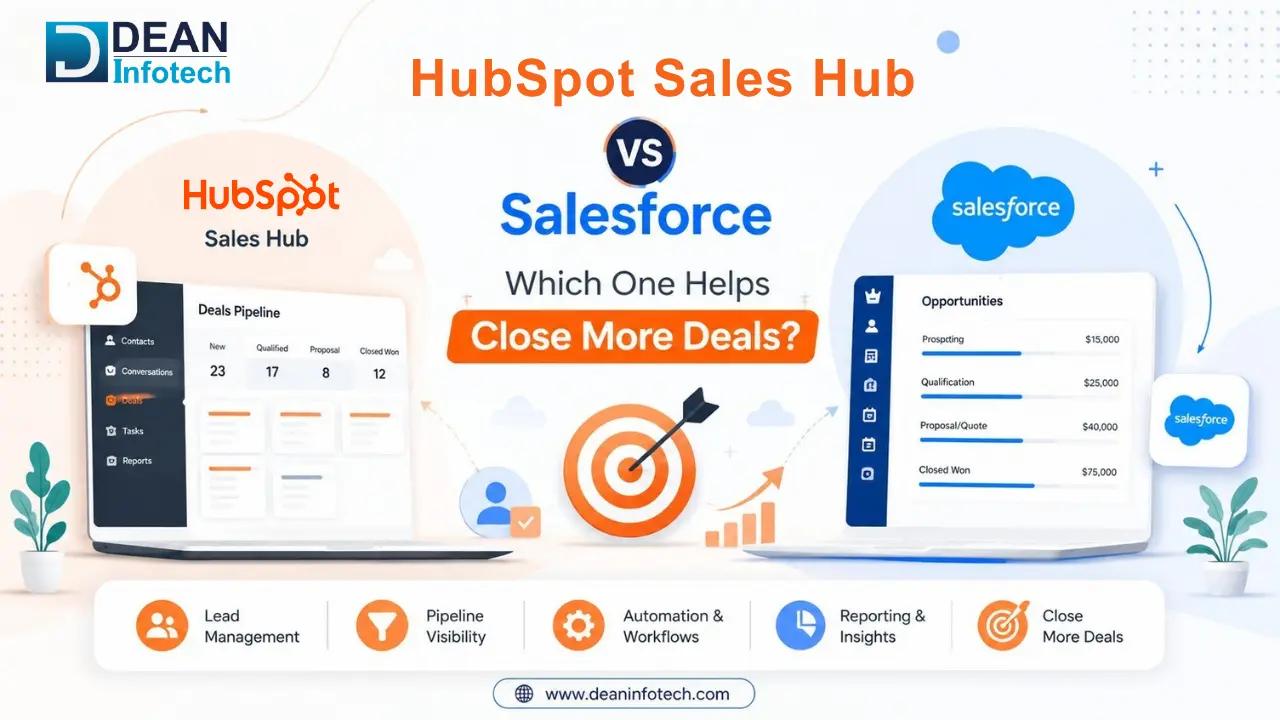
Another one of HubSpot's biggest selling points is how user-friendly the platform is. Companies are able to deploy the platform quickly and receive value with little technical experience.
Most organizations with a new CRM start by learning the basics of HubSpot CRM Implementation and how it enables sales process standardization and growth. Businesses looking to accelerate adoption often work with implementation partners such as Dean Infotech to streamline HubSpot setup.
What Is Salesforce CRM?
Salesforce is one of the world's most popular CRM tools, with organizations as big as the biggest to far smaller startups using it and the platform offers extensive capabilities for:
Customer relationship management
Automated sales
Service management
Market automation
Analytics
AI insights
Customization of workflows
Salesforce is very customizable and scalable and almost everything can be customized by the company itself to meet the particular needs of the business.
Furthermore, Salesforce boasts a vast marketplace of third-party applications and enterprise functionalities, thereby making it an attractive option for big businesses with more sophisticated requirements.
HubSpot Sales Hub vs Salesforce: Quick Overview
Feature | HubSpot Sales Hub | Salesforce |
Ease of Use | Excellent | Moderate |
Learning Curve | Low | High |
Initial Setup | Simpler | More complex |
Customization | Good | Extensive |
Automation | Strong | Advanced |
AI Features | Growing AI capabilities | Mature AI ecosystem |
Reporting | User-friendly | Highly customizable |
Integrations | Extensive | Extensive |
Pricing Structure | Transparent | Multiple pricing tiers and add-ons |
Implementation Costs | Generally lower | Often higher |
Customization Costs | Moderate | Higher |
Training Requirements | Lower | Higher |
Scalability | High | Very High |
Best For | SMBs and growing businesses | Mid-market and enterprises |
Overall Enterprise Investment | Moderate to High | High |
Key Differences Between HubSpot Sales Hub and Salesforce
The key differences between HubSpot Sales Hub and Salesforce are:
Ease of Use
The usability is where one of the biggest differences lies between the two platforms.
HubSpot Sales Hub is known as user-friendly, which is easy to understand and navigate and Salespeople can easily adopt the system, which can be learned in a short time.
While clearly powerful, Salesforce can require more training and configuration, and its overwhelming range of features is more than many company teams are looking for in a CRM product.
In summary, where it is easily and quickly implementable, HubSpot may be the winner for most businesses.
User Interface & Experience
Delivering a great user experience is a clear priority for HubSpot. The program provides information about your customers, deals, activities, and tasks in a single, uncluttered workspace.
Salesforce also provides a more modern-looking interface; however, it may not be available to all organizations.
If the ease of use is the priority, then one might be more inclined to choose HubSpot. If they are worried about customizing to fit their needs, they should look at Salesforce.
Customization Capabilities
Organizations can customize:
Objects
Workflows
Reports
Dashboards
Permissions for users
Business processes
Another feature offered by HubSpot is the ability to personalize, although it doesn't seem to be as customizable in quite the same way as Salesforce.
For businesses with very specialized workflows, Salesforce generally offers more freedom.
Automation Features
Both products provide good automation features.
HubSpot enables users to automate:
Lead assignments
Email series
Task creation
Follow-ups
Pipeline updates
Salesforce has more advanced Workflow Automation, for example, Flow and Process Builder.
Salesforce has higher levels of flexibility and complexity, but for many growing companies, HubSpot may be the faster route to automation.
AI & Analytics
With the rise of artificial intelligence, sales operations are evolving more efficiently.
HubSpot offers AI-powered capabilities for:
Content generation
Forecasting
Sales recommendations
Salesforce's Einstein AI platform provides more mature capabilities, including:
Predictive analytics
Opportunity scoring
Sales forecasting
Automated recommendations
Companies that overly concentrate on AI-enabled sales operations could be better at using Salesforce's ecosystem.
Lead Management
The most important aspect of sales success is efficient lead management.
Easy-to-use lead tracking and qualification features to help teams prioritize opportunities and stay visible through the sales cycle.
Salesforce has very flexible and customizable lead management processes. This is suitable where complex qualification criteria are needed, or enterprise-wide processes need to be adhered to.
This methodology may be more user-friendly for small and mid-sized businesses to implement and manage.
Sales Pipeline Management
Both systems are equally capable of pipeline management.
With HubSpot, you can customize pipelines, track things through each stage, and automate the stuff.
Increased Visibility has been reported that companies implementing a formalized HubSpot Sales Process Mapping tend to have increased visibility into opportunities and efficiencies in their pipeline.
The system offers more advanced opportunity management, and customization was found to be more complex, so it is best suited to businesses with complex sales processes.
Reporting & Dashboards
Reporting is crucial to know the level and trend of sales.
HubSpot offers user-friendly dashboards that allow managers to monitor:
Sales activity
Rates of conversion
Forecasts
Salesforce offers more robust reporting features and greater customization of dashboards.
While Salesforce tends to be more in-depth, HubSpot, on the other hand, is often quicker to provide insights you can act upon.
Integration Capabilities
Flexibility in Integration is also an important issue.
HubSpot connects to many common business applications such as those in the categories of marketing, customer service, and productivity.
For organizations that are deploying a customer support workflow, CRM initiatives are often combined with a formalized Salesforce Service Cloud implementation in an effort to deliver a more integrated customer experience.
Mobile Accessibility
Today, we need our sales teams to have CRM data wherever they are.
Both HubSpot and Salesforce offer mobile applications that support:
Managing contacts
Deal tracking
Logging of activities
Access and reporting
Overall, both platforms work well, but HubSpot has a more straightforward interface in which regular users have a better experience when using it on their mobile.
Which Platform is Most Suitable for Corporate Use?
For big businesses running complex business processes, Salesforce usually offers more flexibility and scalability.
Enterprise organizations benefit from:
Deep level of customization
End-to-end integrations
Advanced automation
Guardian-level security
Complex report-building capabilities
On the other hand, the price flexibility adds more complexity at the administration level and more implementation requirements.
HubSpot is moving upmarket more and more, and these days we work well with lots of enterprise organizations. If you're looking for something that balances usability with functionality a bit better, it could be a good option.
Final Scores: Easier Close? Which CRM Closes More Deals?
The fact is, no CRM closes a sale by itself. It depends on the process and the people executing it.
However, the right CRM can indeed greatly enhance productivity as well as increase visibility and conversions.
Choose HubSpot Sales Hub if:
You need user-friendliness.
You want quick implementation.
You need the power of strong automation without the complexity.
Your team appreciates ease and migration.
Choose Salesforce if:
You need so much individualization.
You handle very complex selling situations.
The more important issue for us is enterprise scalability.
High-level AI and reporting are a top priority.
In many growing organizations, the intuitive nature of HubSpot results in quick adoption and fast ROI. For the complex operational needs of the largest organizations in the world, Salesforce remains one of the most robust CRM systems.
Accelerate Revenue Growth with Dean Infotech
Selecting a CRM is only the beginning. To truly leverage it, you will need strategy, experience in implementation, automation, and continual refinement.
Our team at Dean Infotech helps businesses to implement, customize and optimize their HubSpot and Salesforce solutions to enhance their sales and increase their growth rate rapidly.
Be it the HubSpot Sales Hub Setup, evolution of automation, CRM consultation or Salesforce CRM Integration, our team of professionals can help you build a scalable sales ecosystem to bring about tangible results.
Need expert help with your next project?
Get expert guidance across Salesforce, HubSpot, GoHighLevel (GHL), AI, and web development — tailored to your business.







Comments