Our Salesforce API Integration Services

Create and deploy robust, scalable API integrations between Salesforce and applications of the core business. The leading API integrations with Salesforce allow businesses to automate processes, gain better visibility, and keep data in sync in real time.

What are Salesforce API Integration Services?

Seamlessly integrate Connect Salesforce to any external system via secure, scalable, and real-time API based integrations

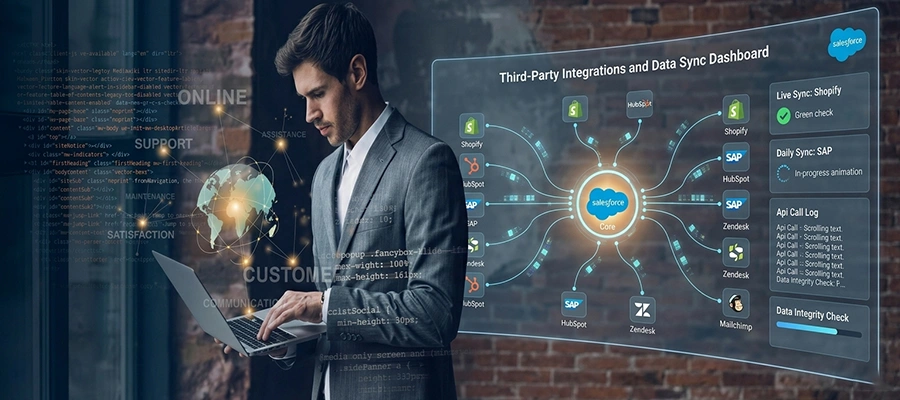
Services for Salesforce API Integration allow organizations to connect Salesforce to other business systems through flexible APIs and middleware architectures. These integrations enable the transfer of information, increase visibility, automate business processes, and streamline workflows between departments. Common integrations include ERP, accounting, online commerce platforms, customer service solutions, and marketing automation.

Several reliable enterprise-class solutions have been developed to connect to the Salesforce API, including REST and SOAP APIs, middleware, custom connectors, authentication schemes, and a real-time synchronization framework. These can be used by companies to report more effectively, automate processes, and maintain consistent customer, service, and operational data.

Going beyond simple api integration, many large growing companies try traditional connectors and find that they can't customize workflows or connect to legacy environments, and move on to more advanced API integration. These integrations are built to address operational complexity, map logic, security requirements, and scalability.

A preferred company offering Salesforce API Integration Services enables businesses to oversee the planning, development, testing, implementation, monitoring, and long-term optimization. This will leave a Salesforce-centric, connected digital environment designed for scalability, automation, and effective system integration.

Business Benefits of Salesforce API Integration Services

The Office for proficient integration of Salesforce API Services also enables businesses to automate data flows, minimize human intervention & increase transparency in business operations. Systems integration enables people to access the right information instantly without switching between screens. Accurate Salesforce integrations enhance reporting capabilities, improve the customer experience, and streamline workflows. Integrating Salesforce with ERP, finance, marketing, and support systems enables organizations to implement scalable automation, accelerate decision-making, and lay a firmer foundation for future digital expansion.

Comparison of Salesforce API Integration Services vs Traditional System Connectivity

CriteriaSalesforce API Integration ServicesTraditional Integrations
Data FlowReal-time synchronizationManual updates and delays
ConnectivityAPI-driven integrationsFile-based or disconnected systems
ScalabilityEasily scalable architectureDifficult to expand
AccuracyConsistent data exchangeHigher risk of duplication
AutomationWorkflow automation enabledLimited automation
MonitoringAPI performance visibilityMinimal tracking
SecurityOAuth and authentication controlsBasic security methods
Operational EfficiencyFaster connected workflowsHigher manual dependency

End-to-End Salesforce API Integration Services Scope

Complete end-to-end management from API strategy to deployment and optimization.

API Strategy, Discovery, and System Assessment

Run smooth and fast Salesforce API Integration Services by first understanding your Business systems, workflows, and operational requirements. We will collect an inventory of existing applications, reporting gaps, manual processes, and API capabilities before building any integrations. This discovery phase is then used to determine automations and achieve strategic solutions compared to a tactical short-term fix.

We review the CRM, ERP, finance, and support tools and all the third-party services that are involved to highlight what information needs to be transferred between the different elements. This allows us to create a unified integration plan that we can then develop on whenever business growth takes us to the next step safely and cost-effectively. A structured API approach helps mitigate implementation risk, facilitates better collaboration across teams, and creates a more resilient platform that supports scalable system-to-system integration and sustainable operational efficiency across connected business ecosystems.

Key Focus Areas:
  • System review of current systems
  • API readiness analysis
  • Integration roadmap
  • Evaluate workflow
API Strategy, Discovery, and System Assessment

REST, SOAP, and Middleware API Development

Different API frameworks may be required by companies. It really depends on how complex the system is, their requirements, and how scalable they want it to be. Our Salesforce API integration approach consists of REST APIs, SOAP APIs, middleware systems, and custom-made connectors based on workflows and specific requirements.

We develop integrations with Salesforce to other ERP systems, accounting software, marketing initiatives, help desk systems, and internal procedures. These API-powered systems facilitate communication between systems, share data seamlessly, and automate processes. Furthermore, the availability of these middleware integrations allows organizations to effectively maneuver through the complicated orchestration between various applications without compromising operational performance. With a scalable API set-up, organizations operate with more flexibility, offering better transparency in reporting and more streamlined handling of the integrated business and online environment.

Key Focus Areas:
  • REST APIs
  • SOAP APIs
  • Custom API connectors
REST, SOAP, and Middleware API Development

Authentication, Data Security, and API Testing

Security: secure API integration services are the absolutely most critical aspect. Because API integration is a provider, we launched an authentication framework, encrypted communication, role-based access permissions, and a standard for secure API governance to facilitate the sharing of business data and client information.

Our internally integrated processes would administer OAuth configurations, tokens, permissions, and access validation between the input programs. Leading business to better management of secure data transfer between Salesforce and third-party apps, in addition to compliance requirements and operational risks. We do in-depth API tests for multiple workflows, synchronisation behavior, error-handling scenarios, as well as performance tests before going live. Proper testing methods can discover problems early, improve reliability, and result in solid performance on a broad range of hardware and workflows.

Key Focus Areas:
  • OAuth configuration
  • Access controls
  • API testing
  • Check security
Authentication, Data Security, and API Testing

API Deployment, Monitoring, and Optimization

Effective API implementation is not automatic and does take some thought, testing, and continuous performance checking in order to ensure systems are working optimally. Our Salesforce API Integration Services offer, amongst other things, the ability to support production applications go-live, sync monitoring, error detection, and optimization.

After the product is live, we constantly track API, synchronization, workflow execution, and overall system health through dashboards and monitoring as well, so that customers can quickly diagnose any issues and resume operations. Continuous optimization is essential to make the APIs scalable, high-performance, and conform to future business requirements. With the business growing and migrating to a new platform, the integration was optimized for performance while relieving the pain points. It allowed the digital transformation program to participate in the ecosystem.

Key Focus Areas:
  • Production deployment
  • Dashboards
  • Error handling
  • Performance tuning
API Deployment, Monitoring, and Optimization

Integration Governance and API Lifecycle Management

Operational sustainability over the long term also rests on the governance and documentation functions, as well as the lifecycle management function. As APIs grow and multiple integrations start to proliferate, the absence of an owner and version management can leave the API environment as unruly as a wild west town.

We establish governance structures that set standards for details of API documentation, change management, security controls, monitoring responsibilities, and version management. When adopted, these practices help organizations deliver consistency, increased transparency, and reduced operational risk throughout impacted systems. Lifecycle management-performance of integrations to provide more effective workflows, refresh the technology, and support new operational requirements. With the integrated governance and continuous API library optimization, lifecycle management is able to provide the enterprise with a scalable, reliable, secure, and future-proofed API environment.

Key Focus Areas:
  • From API documentation
  • Version control
  • Governance frameworks
  • Lifecycle optimization
Integration Governance and API Lifecycle Management

API Reporting and Integration Performance Dashboards

Monitor API health and performance. Track system uptime with real-time reporting and pre-empt API failure. Effective reporting is key to dependable, scalable Salesforce API Integration Services. Businesses need the capabilities to keep tabs on API performance and information, integration status, response time, failures and errors, and processing bottlenecks to continue operations effectively across internal teams and diverse applications.

Dashboards focus on things such as API traffic, performance of the systems, synchronization integrity, workflow availability, and uptime, and are displayed in real time. Such information can help the business owners decide quickly where there are delays and how to fix them to help them make the right decisions within all connected systems. With Advanced reporting, leadership teams will be able to pinpoint where APIs will help you keep farms rolling faster; bring your customers' satisfaction up, and make your businesses more scalable in the first place by tracing trends, finding performance chokepoints, and proactively engineering the API integrations, rather than fixing them post-flight.

Key Focus Areas:
  • Monitoring API traffic and health
  • Sync and uptime counter
  • Reporting on workflow performance
  • Insights for error detection and resolution
API Reporting and Integration Performance Dashboards

Integration with ERP, Marketing, Finance, and eCommerce Platforms

Today's organizations use a variety of platforms for day-to-day operation, such as CRM, Learning Management Platforms, reporting, accounting, manufacturing, communication, and fulfillment. We will create, develop, and provide Salesforce API Integration Services, providing secure, scalable integrations of Salesforce with ERP, accounting packages, marketing automation platforms, web commerce websites, support applications, and other third-party applications.

Such workflows allow the various activities of the organization to be performed more smoothly, ensure that data is consistent throughout the organization, and coordinate activities between different functions more effectively. Sharing data immediately reduces duplication and manual entry, ensuring teams have the most current, correct data in every integrated system. We enable integrations for billing, ordering, inventory, campaign automation, customer service processes, and operational reporting. When various platforms are interconnected using robust API integration, organizations will experience more visibility, a faster pace, and better functioning in their digital universes.

Key Focus Areas:
  • ERP and finance API integrations
  • Marketing automation connectivity
  • eCommerce and inventory synchronization
  • Cross-platform workflow automation
Integration with ERP, Marketing, Finance, and eCommerce Platforms

User Training and API Adoption Strategy

APIs, other than the simplest ones, are not useful unless there is long-term user adoption. Users need to understand how automated workflows, reporting, sync processes, and activity in other systems are impacted by the APIs. If not trained, businesses will find their integrations underused and their processes inconsistent.

We support teams through role-based training, API workflow consulting, documentation of processes, and operational support to hasten user adoption of interactive environments and ensure they are comfortable running integrated systems. As a result of our support, clients see an increase in transparency of their system integrations, and users adopt automated workflows more quickly. Training increases the knowledge of the governance teams about the monitoring, escalation paths, API dependencies, and the order of the reports. As we continue to use it, the organization will gain from enhanced operation standardization, accurate, uniform, and cleaner data, and more efficient integrated business systems.

Key Focus Areas:
  • Role-based API training
  • Workflow and process documentation, monitoring, and escalation guidance
  • API adoption and governance support
User Training and API Adoption Strategy

Post-Go-Live API Support and Optimization

Victory in API integration doesn't end at the implementation stage. Stability, security, unified behavior of all integrated environments, and support after implementation need to be maintained. Our Salesforce API Integration Services include monitoring, troubleshooting, tuning, and enhancement support.

We keep track of API health, forwarder synchronization status, response time, and the health of workflows and operations in multiple environments. Help companies be able to quickly troubleshoot problems, bring down the amount of time of business interruption, and avoid communication problems with other applications in Salesforce. All enhancements, new workflows, or new system integrations are dictated over time depending on business needs changes. We keep on optimizing API requirements to enable enterprise governance, performance, and scalability to enable operational value and digital transformation.

Key Focus Areas:
  • Continuous API monitoring
  • Performance tuning and optimization
  • Workflow enhancement support
  • Sustainable long-term scale management
Post-Go-Live API Support and Optimization

Our 3-Stage Salesforce API Integration Roadmap

The API integration framework is structured to create a scalable, secure, and operationally efficient system.

Step 1

API Discovery, Planning, and Readiness

Designing API integrations involves understanding the business processes, dependencies, and working requirements. Anatomy of existing platform, which areas are to be integrated, and strategic implementation of API strategy to develop scalable, secure, and high-performance Salesforce API integrations.

1. Business System and API Assessment

Based on the current use cases, workflows, and API capabilities, we identify gaps and inefficiencies in integration. Our evaluation helps to prioritize, increase planning accuracy, and provides the right business integration, scalable in both functionality and reliable messaging across all integrated operational environments and platforms in the long run.

2. API Architecture and Integration Planning

We architect scalable API frameworks, middleware layers, authentication mechanisms, and workflow logic with an operational perspective. This planning phase proposes developing secure, reliable, and scalable integrations to support future business growth, with as low an implementation effort as possible, and to increase the robustness of the long-term landscape of connected Salesforce and other business applications.

3. Security and Access Preparation

Before development, we define authentication and access control, OAuth configuration, and API governance policies. These security measures ensure we can safeguard data, maintain compliance, and transmit data securely between Salesforce and external systems while minimizing the operational risk associated with our integrated technology footprint.

Step 2

API Development, Testing, and Deployment

Following the design phase, we commence with the building and testing of APIs on all component systems, with a particular focus on building web services securely, synchronized architectures, process automation, and a controlled deployment environment to ensure dependable and scalable Adobe Salesforce API integration with minimal disruption to existing operations during architecture migration and transition activities.

1. REST and SOAP API Development

Create and deliver REST and SOAP APIs to enable secure Salesforce integration with all ecosystem partners outside the system. These integrations allow us to cross-platform integrate business workflows and ensure the scalability, reliability, and performance of all business, enterprise, and digital applications and spaces our customers use.

2. API Validation and Error Testing

Before going live, we test the API flows and the following logic: synchronization patterns, authentication, and failure scenarios across the multiple integration systems. This validation lowers the operational risks arising from these issues since the system would still work under all circumstances, report what it should, transmit data in a safe way, and stay running.

3. Deployment and Launch Preparation

It's our responsibility to plan and validate deployment; Production is supervised, and meanwhile, going up faster. A successful and controlled deployment methodology can significantly minimize the effects of service disruptions and system instability by maintaining connectivity while the business is rolled into the centralized, integrated Salesforce system with an API architecture and a highly scalable, automated platform.

Step 3

Monitoring, Optimization, and Scaling

After deployment, API integrations must also be continuously monitored and optimized for scalability. The post-implementation phase includes troubleshooting, optimizing workflows, and ongoing performance tuning. Long-term optimization ensures that API integrations can bear the weight of the historical mass of operational and technological improvements across integrated Salesforce sites and external Business systems.

1. API Monitoring and Performance Tracking

Consequently (when integrated), we observe the API response, sync quality, workflow activity, and system health status across all user-defined environments. This history tracking enables operational flows, reduces long-term downtime, enhances consistency and durability of work across Salesforce and 3rd-party systems, and helps operations work effectively over the long term to achieve integrated business targets.

2. Error Resolution and Stability Management

Monitoring alerts, recovery workflows, and troubleshooting frameworks. We feed these processes to identify, diagnose, and track integration issues and stability. Our strategy of stability management is designed to prevent impact on the business, provide stability in the long run, keep partner organizations and business processes that integrate with ours to a minimum, and ensure excellent API performance on connected Salesforce farms as well as third-party platforms.

3. Continuous API Expansion and Optimization

With increased product complexity and operational scale, as the organizations grow, the API adoption and framework should grow and evolve along with the technology needs. We continually improve integrations, add more workflows, and improve the API efficiency to enable organizations to scale without compromising on security, reliability, or future readiness.

Salesforce API Integration Success Stories

Reliably, scalable API integrations to ensure that all stay connected, help unlock automation potential, and expand transparency of operations.

Improving E-Commerce Customer Service with Salesforce Agentforce AI
E-Commerce

Improving E-Commerce Customer Service with Salesforce Agentforce AI

A fast-growing eCommerce retailer in the fashion sector experienced mounting stress from large numbers of customer questions and queries submitted via multiple support channels, such as chat, email, and telephone, among others. Multiple systems and processes created delays and subpar service levels at key business periods. The client needed a single API based solution to support the business.

Dean Infotech leveraged Salesforce Agentforce AI integration to its existing business through more efficient data and process connections into its Customer Data Cloud and Service Cloud via APIs and workflow automation engines. Customer profiles, purchase histories, and workflow have been integrated into a single support platform.

Simple requests were directed intelligently by AI, while complex support requests, with customer context, were directly directed to human customer support agents. The API integrations added operational insight, reduced support lag, and created a more unified customer experience across channels. The business received faster service, improved automation of workflows, and efficiency gains, with scalable Salesforce API integrations.

MetricQueries handled automaticallyAverage response timeSupport cost reductionCustomer satisfaction
Outcome80%+Under 2 minutes35%Increased by 25%
Enhancing Customer Retention with Salesforce Service Cloud and API automation
E-Commerce

Enhancing Customer Retention with Salesforce Service Cloud and API automation

A growing e-Commerce website looked to build customer loyalty by upgrading the many disconnected service processes. The company was experiencing inconsistent support, higher wait times, and inefficient operations due to multiple communication channels, lagging response times, and scattered customer data. The business needed API-enabled integrations to support better workflow.

Dean Infotech–linked Salesforce service cloud to AI-powered automation, integrating support platforms through infrastructure, enabling API architecture. Customers' interactions through chat, email, and digital channels were integrated. Workflows automated processing for tracked requests, returns, and support queries, while live agents handled challenging issues.

The integration improved response time as well as workflow, coordination, and transparency across service teams. With integrated Salesforce API connections, the enterprise saw increased retention, better efficiency, and increased satisfaction within digital support teams.

MetricCustomer retention rateAgent productivityCustomer satisfactionSelf-service usage
OutcomeImproved by 10–15%Increased by 25%Increased by 15–20%40%+ handled by chatbot

Flexible Salesforce API Integration Services Packages

For startups, growing organizations, and large organizations, Jobi's API integration engagement models are flexible.

SCStarter Package for Basic API Connectivity

Starting–focused package and for small businesses, composed of best practice hand-holding to securely link to core business systems using API. Covers API (SOAP, REST) integration, simple workflow automation, sync, and rollout. Benefits: linked systems operate smoothly, offer more control, reliability, and a ready platform for growth in Salesforce API integration and automation.

  • Reduced manual processes
  • Easy system connectivity
  • Faster daily operations
Hire Positioning Experts

GAGrowth Package for Multi-System API Automation

This offering is best for growing businesses with multiple interconnected OS's such as Sales, Finance, Marketing, and Operations. It offers automated processes, desktop monitoring dashboards, a general synchronization framework, middleware integration, and custom API development. Business advantages include enhanced control, dedicated automation, more reporting, and flexible Salesforce API integration.

  • Consistent data synchronization
  • Better reporting accuracy
  • Streamlined business operations
Hire an Automation Team

EEEnterprise Package for Scalable API Ecosystems

Built for commercial customers with complex, functional environments in mind, this bundle can support advanced API governance, scalable integration architecture, cross-platform sync, security policies, and continuous optimization. Enterprise users can deploy enterprise-grade Salesforce API integrations that are dependable, compliant, and scalable in the long run; facilitate long-distance operations; interconnect systems and ecosystems; and support workflow automation across several technology infrastructures.

  • Scalable system architecture
  • Secure and stable data flow
  • Advanced process automation
Hire for Global Scale

Strategic Salesforce API Integration Services

We endeavor to enable companies to harness the power of a safe, reliable, scalable, high-performance API environment that enhances connectivity, significantly streamlines procedures, and builds a resilient platform for sustainable operational expansion.

API Architecture and Connectivity Planning

A sustainable API integration approach starts with a good understanding of the systems, process flows, and operational procedures. We develop a scalable API system that enables smooth, secure data transfer between Salesforce and other third-party applications. At the same time, it enhances the solution's usability and reliability for sustainable development. Our proposed plan will allow us to eliminate integration complexity and improve system coordination.

Middleware and Workflow Integration Strategy

The principles underpinning today's integration are often implemented through middleware, which serves as a 'glue' that enables various business applications and operational systems to interact. We develop middleware integration models that govern workflow automation, reduce manual steps, and maintain data synchronization across integrated systems. Our models enable organizations to optimize the administration of integration environments and support enterprise-wide scaling and resiliency.

Real-Time API Synchronization Framework

Modern businesses depend heavily on accurate information flows across all integrated systems and business divisions, and need them to be up to date, on time, and correct. We are creating API synchronization layers that allow scheduled or event-based automated data dissemination from the Salesforce platform to any third-party system. This way, business processes will be more responsive, delays will be reduced, and business teams can make quicker, better decisions while maintaining consistency and improving teamwork across customer-facing and internal functions.

API Security and Authentication Planning

Secure communication between sensitive business and customer data is an integral part of good API security. Our solutions provide strong authentication methods, OAuth implementations, encrypted communications channels, and access authority configurations. All this ensures that the best practice, maximum API security can be provided to all Salesforce integrations at any point in time, minimizing operational risk, maintaining long-term compliance to regulations, and providing reliable API transfer between Salesforce and operational applications.

API Governance and Lifecycle Management

To assess the long-term effectiveness of an API, it is essential to establish credible processes and practices that support efficient governance and lifecycle management. We establish a range of standards for documentation, versioning, monitoring practices, and operational governance policies that facilitate transparency, minimize operational risk, maintain the integrity of the integration, and support the development of a reliable, serviceable API environment.

Industries We Serve

Industries We Serve for Salesforce API Integration Services

Bespoke enterprise API integrations for workflow, compliance, and operational requirements specific to individual industries. Various types of trades have their own workflows, systems, and protocols. Our Salesforce API Integration Services are required to deliver all the above-mentioned granularity, yet improve the connectivity, automation, and transparency of data across all businesses. We are highly experienced in delivering scalable, secure API environments, compliant with industrial operational requirements, and harnessing digital capabilities.

Explore Industry Solutions

SaaS and Technology Companies

Technology companies often need dozens of cloud systems for customer and partner access, from billing and support to operations and reporting. Our scalable, reliable Salesforce API integrations are designed to roll up and automate these systems while improving reporting. Our services help SaaS and technology companies grow, offering affordable integrations and automation with customer-facing and operational systems and integrated digital platforms.

Healthcare and Life Sciences

Hospitals and health systems require secure, reliable API integrations that transmit prudent data, expedite, and fulfill operational and regulatory requirements. Our products connect Salesforce to clinical systems, patient engagement tools, and administrative systems through secure APIs and authentication frameworks. These integrations provide message fidelity, expedite, and enable operational message fidelity from the cloud to the point of care.

Financial Services and Insurance

Most banking systems are linked together for onboarding, approval, reporting, and client communication. We have implemented Salesforce API integrations, providing a secure connection between financial systems/apps, operational systems, and customer systems. This provides transparency, reduces lag, and enables efficiency, consistency, compliance, and communication, enabling linking of financial and insurance technology platforms.

Retail and eCommerce Business

API Integrations are important for retail or e-commerce companies because they enable software integration of order management, inventory, fulfillment, customer service, or marketing platforms. We developed a scalable API framework for the replication of Salesforce data, which offers lower latency and better visibility of report metrics. These integrations are vital because they enable retail companies to deliver transactions faster without sacrificing productivity by integrating digital business applications or internal enterprise applications.

Manufacturing and Supply Chain Operations

Manufacturing businesses need to operate many different systems across production, inventory, logistics, and service workflows. By integrating these systems via a series of Salesforce APIs, we can reduce manual labor, improve business visibility, and help these enterprises automate processes and drive cross-system interactions. These connected API environments enable manufacturers to improve both reporting and delivery continuity in complex supply chains by relying on a distributed enterprise model.

Education and Nonprofit Organizations

Connected systems are critical to schools and non-profits planning and tracking engagement, reporting, fundraising, and leading other operational functions. We work with organizations to build APIs that connect Salesforce with other operating platforms, share data, and minimize organizational overhead. These integrations enable greater visibility and collaboration, allowing organizations to operate more efficiently and devote more energy to mission-driven actions and to building relationships with their constituents.

Real Estate and Professional Services

Real estate and professional service firms rely on integrated workflows to manage clients, schedule, report, and coordinate their businesses. We are responsible for creating Salesforce API integrations that synchronize data between systems and enhance operational transparency. These integrations allow our customers to eliminate redundancies, improve communication, and sustain dependable workflow automation on both the customer-facing and operational sides of their businesses.

Frequently Asked Questions (FAQs)