In today's fast-paced digital landscape, businesses are under constant pressure to innovate, scale operations, and deliver projects faster than ever before. However, finding and retaining skilled IT professionals remains one of the biggest challenges organizations face. Lengthy recruitment cycles, rising hiring costs, and increasing competition for top talent often make it difficult for companies to build the right team when they need it most. (T he Korn Ferry 2023 report projected a global tech talent shortage of 85 million workers by 2030, potentially costing $8.5 trillion in unrealised revenue. This transforms a vague claim into a cited, dramatic fact right at the hook. )
This is where IT Staff Augmentation Services comes into play. As a flexible workforce strategy, staff augmentation allows businesses to quickly access experienced developers, engineers, designers, consultants, and other technology professionals without the long-term commitments associated with traditional hiring. Organizations can seamlessly extend their existing teams with specialized talent, enabling them to accelerate project delivery while maintaining full control over their processes and workflows.
Whether you're a startup looking to scale rapidly, a growing business facing temporary resource gaps, or an enterprise managing complex digital transformation initiatives, IT Staff Augmentation Services offer a cost-effective and scalable solution. In this guide, we'll explore what staff augmentation is, how it works, its benefits, challenges, pricing models, and how to choose the right staff augmentation partner for your business.
What is IT Staff Augmentation?
IT Staff Augmentation is a smart and flexible way for companies to temporarily add skilled IT professionals to their existing team.
Instead of hiring full-time employees (which takes time and money), businesses partner with staffing companies or platforms to bring in experienced developers, testers, designers, cloud engineers, or other tech experts exactly when they need them.
You stay in full control, you manage the work, set the goals, and direct the person just like your own employee. They usually work remotely or on-site as part of your team.
It’s perfect when you have sudden project demands, skill gaps, or tight deadlines, but don’t want the long-term commitment of permanent hiring. The global IT Staff Augmentation market was valued at USD 299.3 billion in 2024 and is projected to reach USD 857.2 billion by 2032, growing at a CAGR of 13.2%.(Source)
How Staff Augmentation Works
IT Staff Augmentation is a straightforward process that enables businesses to quickly add skilled professionals to their existing teams without going through lengthy recruitment procedures. Unlike outsourcing, where an external vendor manages the entire project, staff augmentation allows organizations to retain full control over project management, workflows, and deliverables while gaining access to specialized talent.
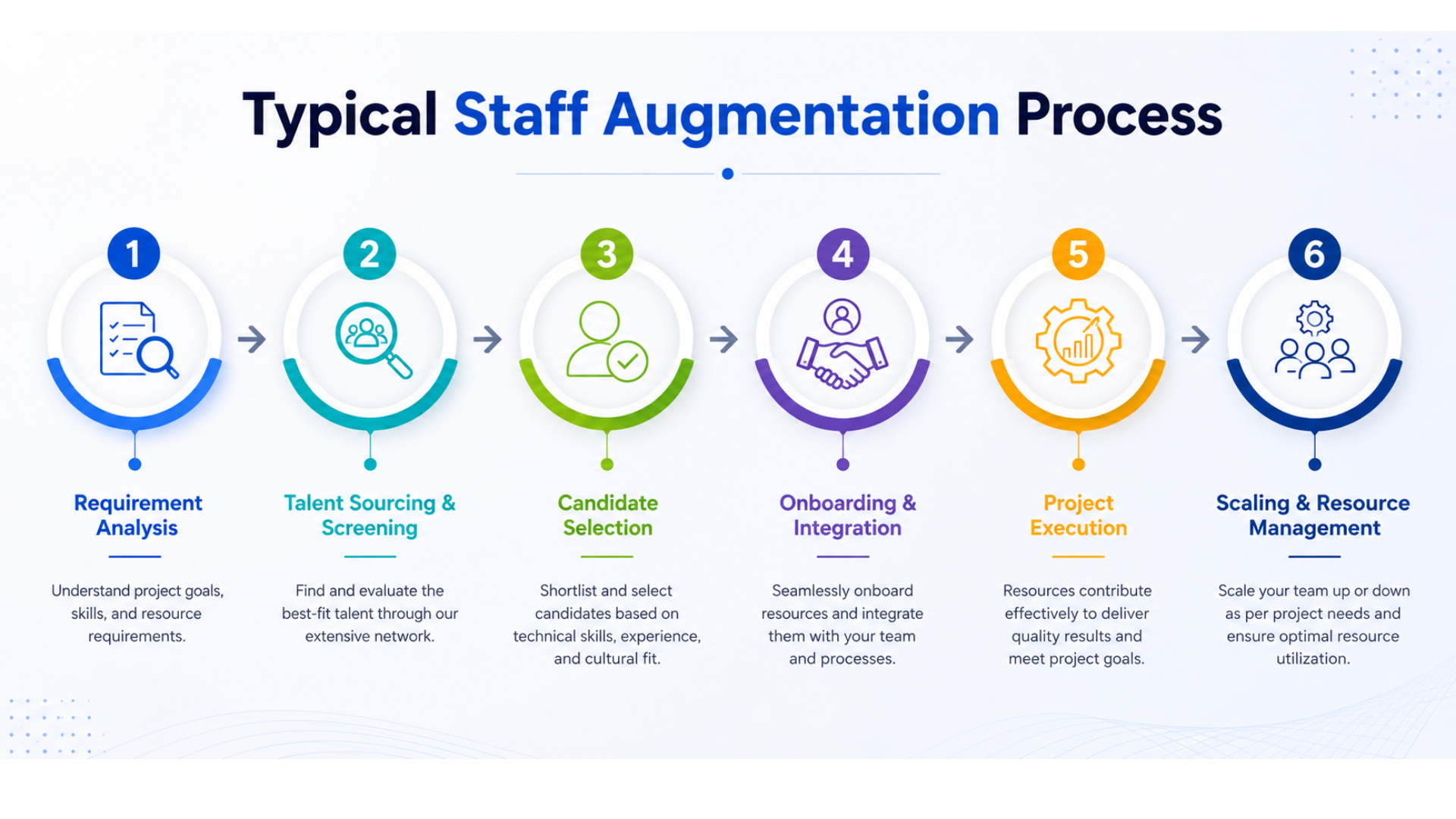
The process typically begins with identifying the skills, experience, and resources required for a project. Once the requirements are defined, a staff augmentation partner sources and screens qualified professionals who match the organization's technical and business needs. After the selection process, the chosen resources are onboarded and integrated into the company's existing team structure.
These professionals work alongside in-house employees, using the same tools, communication channels, and project management processes. Depending on project requirements, businesses can scale the team up or down, add niche expertise for specific tasks, or fill temporary skill gaps without making permanent hiring commitments.
Typical Staff Augmentation Process
- Requirement Analysis – Define project goals, required skills, team size, and engagement duration.
- Talent Sourcing & Screening – The augmentation provider identifies and evaluates suitable candidates.
- Candidate Selection – The client interviews and selects professionals who best fit their requirements.
- Onboarding & Integration – Resources are integrated into existing teams, tools, and workflows.
- Project Execution – Augmented staff collaborate with internal teams to deliver project objectives.
- Scaling & Resource Management – Team size can be adjusted based on changing business needs.
Real-world example: How a fintech startup cut hiring time by 70%
A Mumbai-based fintech startup needed to build a mobile payments feature within 10 weeks — a timeline their existing 4-person dev team couldn't meet. Traditional hiring would have taken 2–3 months and required long-term salary commitments. By partnering with an IT staff augmentation provider, they onboarded two senior React Native developers and one QA engineer within 8 days. The augmented team worked in the same Jira workspace, attended daily standups, and reported directly to the CTO.
The feature launched on time. The startup saved approximately ₹18 lakhs compared to equivalent full-time hires over the same period and retained zero ongoing obligations after project completion.
Key takeaway: Staff augmentation isn't just a cost play — it's a speed play. When your roadmap can't wait for recruitment cycles, it's often the only practical option.
Types of Staff Augmentation Models in IT
Staff augmentation is not one-size-fits-all. Companies use different models based on their specific needs. Here are the three main types of IT Staff Augmentation models explained in simple terms:
1. Duration-Based Augmentation
This model focuses on how long you need the extra talent.
- Short-term Augmentation: Ideal for quick projects, urgent deadlines, or temporary spikes in work (e.g., 2–8 weeks). You might bring in developers to finish a mobile app feature or fix bugs before launch.
- Long-term Augmentation: Used when you need support for several months or even 1–2 years. Many companies treat long-term augmented staff almost like full-time team members while keeping flexibility.
Best for: Seasonal workloads, product launches, or covering employee absences.
2. Skill-Based Augmentation
This model is all about specific expertise you’re missing.
You hire professionals with exact skills your team lacks. For example:
- A cloud architect for migrating to AWS
- React Native developers for a cross-platform app
- Cybersecurity experts for a security audit
- AI/ML engineers for new features
Biggest advantage: You get highly specialized talent fast without training your existing team or hiring permanently. It’s perfect when your in-house team is strong but needs niche skills for a particular project.
3. Geographic-Based Augmentation
This is based on where the augmented staff is located. Offshore staff augmentation currently commands over 52% of total market revenue, with data showing cost savings of up to 60% compared to domestic hiring — particularly through offshore hubs in India, Vietnam, and the Philippines.(Source)
- Onshore: Talent from the same country (same time zone & culture)
- Nearshore: Talent from neighboring countries (similar time zones)
- Offshore: Talent from distant countries (usually most cost-effective)
As per SHRM's 2022 hiring report put the average cost-per-hire at $4,700, with total onboarding costs reaching 3–4× the salary for tech roles. This makes the cost advantage tangible, not theoretical.
Biggest advantage: Each has its own pros and cons in terms of cost, communication, and collaboration.
Also Read : Staff Augmentation: The Secret Weapon for Scaling Your Tech Teams
Why Businesses Choose IT Staff Augmentation
As technology evolves rapidly, businesses often struggle to find the right talent at the right time. IT Staff Augmentation helps organizations overcome hiring challenges by providing access to skilled professionals without the costs and commitments of traditional recruitment. Below are some of the key benefits that make staff augmentation a preferred workforce strategy.
Faster Access to Specialized Talent
Quickly onboard experienced professionals with niche technical skills, eliminating lengthy recruitment cycles and ensuring projects start without unnecessary delays. ManpowerGroup's annual Talent Shortage Survey, covering 40,077 employers across 41 countries; found that 75% of employers globally report difficulty filling roles due to a lack of skilled talent.(Source)
Cost-Effective Resource Management
Reduce expenses associated with full-time hiring, employee benefits, training, and infrastructure while paying only for the expertise you need.
Scalability and Flexibility
Easily scale teams up or down based on project requirements, business growth, seasonal demand, or changing workloads without long-term commitments.
Faster Project Delivery
Fill critical skill gaps immediately and accelerate development timelines by bringing in professionals who can contribute from day one. As per LinkedIn's 2023 Talent Trends report found average time-to-fill for tech roles is 49 days through traditional hiring vs 1–2 weeks via augmentation partners.
Access to Global Talent Pools
Expand beyond local hiring limitations and gain access to highly skilled professionals from different regions and technology domains.
Reduced Recruitment Burden
Minimize the time and effort spent on sourcing, screening, interviewing, onboarding, and retaining technical talent for specialized roles.
Learn more about the full recruitment process in our comprehensive hiring guide.
Greater Focus on Core Business Goals
Allow internal teams to concentrate on strategic initiatives and business growth while augmented professionals handle specialized project requirements.Quickly onboard experienced professionals with niche technical skills, eliminating lengthy
Types of Hiring Models
Staff Augmentation vs Traditional Hiring
Organizations often struggle to decide whether they should hire full-time employees or augment their teams with external talent. While traditional hiring is ideal for building a long-term workforce, it often involves lengthy recruitment cycles, onboarding efforts, and significant employment costs.
- IT Staff Augmentation offers a more flexible alternative by allowing businesses to quickly access skilled professionals for specific projects or temporary resource requirements. Instead of spending months recruiting and training new employees, organizations can onboard experienced talent within days or weeks and scale resources based on changing business needs.
- Traditional hiring works best for core business functions and long-term organizational growth. Staff augmentation, on the other hand, is particularly effective when businesses need specialized expertise, faster project execution, or additional resources without increasing permanent headcount.
For companies operating in fast-paced industries where technology requirements evolve rapidly, staff augmentation provides the agility needed to remain competitive while maintaining control over projects and internal processes.
Staff Augmentation vs Project Outsourcing
Although Staff Augmentation and Project Outsourcing are often used interchangeably, they serve different business objectives.
- In a staff augmentation model, external professionals become an extension of your existing team. The client retains full control over project management, priorities, workflows, and daily operations. Augmented resources work directly with internal teams and follow the organization's processes and tools.
- Project outsourcing, however, involves handing over an entire project or specific business function to an external service provider. The outsourcing partner is responsible for managing resources, timelines, deliverables, and project execution. This approach requires less day-to-day involvement from the client but also provides less direct control over how the work is performed.
- Staff augmentation is typically preferred when businesses need additional expertise while maintaining project ownership. Outsourcing is often chosen when organizations lack internal resources or want a vendor to manage an entire project from start to finish.
The choice between the two depends on factors such as project complexity, desired level of control, available internal expertise, and long-term business goals.
Full Comparison Between Staff Augmentation vs Traditional Hiring vs Project Outsourcing
Factor | Staff Augmentation | Traditional Hiring | Project Outsourcing |
| Hiring Speed | Fast (days to weeks) | Slow (weeks to months) | Fast after vendor selection |
| Cost Structure | Pay for required resources only | Salary, benefits, training, overhead | Fixed-price or project-based fees |
| Scalability | Highly flexible | Limited flexibility | Moderate flexibility |
| Access to Specialized Skills | Excellent | Limited by local talent pool | Depends on vendor capabilities |
| Project Control | Full client control | Full client control | Vendor-managed |
| Team Integration | High | High | Low to Moderate |
| Long-Term Commitment | No | Yes | No |
| Recruitment Effort | Minimal | High | Minimal |
| Best For | Skill gaps, scaling teams, specialized projects | Building a permanent workforce | End-to-end project execution |
| Management Responsibility | Client | Client | Vendor |
| Knowledge Retention | High | High | Lower, vendor-dependent |
| Time to Productivity | Immediate to short-term | Longer onboarding period | Depends on vendor onboarding |
Cost Structure & Pricing Models
One of the biggest advantages of IT Staff Augmentation is its cost flexibility. Unlike traditional hiring, where businesses incur expenses related to recruitment, employee benefits, training, infrastructure, and long-term commitments, staff augmentation allows organizations to pay only for the talent they need and for the duration they require it.
Most IT Staff Augmentation providers offer one of the following pricing models:
1. Hourly Pricing Model
Under this model, businesses pay based on the number of hours worked by the augmented professional. It offers maximum flexibility and is commonly used for short-term projects, ongoing support, and projects with evolving requirements.
Best For: Maintenance projects, consulting engagements, and flexible development needs.
2. Monthly Resource-Based Model
The client pays a fixed monthly fee for dedicated resources working a predefined number of hours each month. This is one of the most popular staff augmentation pricing structures because it provides predictable costs and dedicated team availability.
Best For: Long-term development projects, dedicated teams, and ongoing product enhancements.
3. Project-Based Pricing Model
In some cases, organizations augment their teams for a specific project with clearly defined requirements and timelines. Costs are determined based on project scope, estimated effort, and resource requirements.
Best For: Well-defined projects with fixed deliverables and timelines.
4. Dedicated Team Model
Businesses hire an entire team of developers, engineers, designers, or consultants who work exclusively on their projects. Pricing is typically calculated based on the combined monthly cost of the team members.
Best For: Product development, digital transformation initiatives, and long-term technology partnerships.
By selecting the right pricing model, businesses can optimize costs, maintain budget predictability, and gain access to the specialized talent needed to achieve their project goals without the overhead of traditional hiring.
Common Challenges in Staff Augmentation (and How to Overcome Them)
Here’s a more detailed explanation of the most common challenges businesses face with IT Staff Augmentation, along with practical solutions:
1. Cultural and Team Integration Issues
Challenge: Augmented team members often come from different backgrounds and may not be familiar with your company’s work culture, values, or way of doing things. This can sometimes lead to misunderstandings, lower team morale, or slower collaboration.
How to Overcome: Invest time in a well-planned onboarding process. Introduce them to the whole team through video calls, share your company values and working style, and organize regular team huddles or virtual coffee chats. Building personal connections early helps them feel like a real part of the team.
2. Communication Barriers
Challenge: Especially in offshore or nearshore models, differences in time zones, accents, or language fluency can cause delays, miscommunication, or frustration among team members.
How to Overcome: Establish clear communication guidelines from the start — decide which tools to use (Slack, Teams, Jira, etc.) and set overlapping working hours for daily syncs. Record important meetings, encourage written updates, and be patient while building understanding over time.
3. Quality and Performance Control
Challenge: There’s always a concern that external talent might not match your internal quality standards, coding practices, or attention to detail, which can affect project outcomes.
How to Overcome: Define clear expectations, coding standards, and KPIs right at the beginning. Conduct technical interviews before onboarding, do regular code reviews, and schedule weekly progress meetings. Starting with a short paid trial period is also a smart way to test the fit.
4. Data Security and Intellectual Property Risks
Challenge: Sharing sensitive information, source code, or customer data with external professionals increases the risk of data breaches or IP leakage.
How to Overcome: Partner only with reputed staffing companies that have strong security certifications (like SOC 2, ISO 27001, or GDPR compliance). Use secure tools, implement strict access controls, sign solid NDAs, and avoid giving unnecessary access to critical systems.
5. Hidden Costs
Challenge: Sometimes the total expense ends up higher than expected due to additional training, rework, knowledge transfer, or extra tool licenses.
How to Overcome: Ask for a transparent and detailed pricing structure before signing the contract. Clarify what is included and what may cost extra. Negotiate clear SLAs and regularly review expenses to avoid surprises.
6. Knowledge Transfer and Dependency
Challenge: When the augmented staff leaves at the end of the contract, important project knowledge and context often walk out the door with them.
How to Overcome: Make documentation and knowledge sharing a regular habit throughout the engagement. Pair external members with internal employees for mentoring, conduct proper handover sessions, and maintain updated project wikis or repositories.
What to Look for in the Right IT Staff Augmentation Partner
Choosing the right staff augmentation partner can make or break your experience. Here are 6 important things to evaluate before making a decision:
1. Proven Track Record & Experience
Look for a partner with several years of experience in IT staff augmentation and a strong history of successful placements.
Check their client testimonials, case studies, and how long they have been in business. An experienced partner understands your industry challenges and can provide reliable talent faster.
2. Quality of Talent Pool
The best partners maintain a large, pre-vetted pool of skilled professionals.
Ask about their screening process — do they conduct technical assessments, interviews, and background checks? Ensure they can quickly provide candidates with the exact skills you need rather than just anyone available.
3. Transparency in Pricing & Contracts
Choose a partner who is upfront about costs, with no hidden fees.
They should offer clear pricing models (hourly, monthly, etc.) and flexible contract terms. A good partner explains everything in simple language and avoids locking you into long, complicated agreements.
4. Strong Security & Compliance Practices
Data security is critical. The right partner should have certifications like ISO 27001, SOC 2, or GDPR compliance.
They must follow strict NDAs, secure data handling processes, and provide clear policies on intellectual property protection.
5. Excellent Communication & Support
A reliable partner acts as a true extension of your team.
They should offer dedicated account managers, quick response times, and proactive support throughout the engagement — from initial hiring to project completion and offboarding.
6. Focus on Cultural Fit & Long-term Partnership
The best partners don’t just fill seats — they try to match candidates who align with your company culture and values.
Look for partners who provide good onboarding support and are interested in building a long-term relationship rather than just completing one project.
Conclusion
In an increasingly competitive and technology-driven business environment, having access to the right talent at the right time can make all the difference. IT Staff Augmentation has emerged as a powerful hiring model that enables businesses to bridge skill gaps, accelerate project delivery, reduce recruitment overhead, and scale teams with greater flexibility.The global IT staffing market was valued at $429 billion in 2023 and is projected to reach $681 billion by 2031 at a 6% CAGR (Grand View Research).
Whether you're looking to hire a single specialist, build a dedicated development team, or support a large-scale digital transformation initiative, staff augmentation provides a cost-effective way to access top-tier talent without the long-term commitments of traditional hiring. By understanding the various augmentation models, pricing structures, benefits, and challenges, organizations can make informed decisions that align with their business objectives.
If you're searching for a trusted IT and Non IT Staff Augmentation partner, Dean Infotech offers experienced developers, CRM consultants, cloud experts, AI specialists, and technology professionals who seamlessly integrate with your existing team. With proven expertise across Salesforce, HubSpot, custom software development, web applications, mobile apps, and emerging technologies, Dean Infotech helps businesses scale faster and deliver projects with confidence.
Ready to Extend Your Team with Top IT Talent?
Partner with Dean Infotech to quickly access skilled professionals, accelerate project delivery, and achieve your business goals without the hassle of traditional hiring.
Contact Dean Infotech today to discuss your IT Staff Augmentation requirements and build the team your business needs to succeed.
Need expert help with your next project?
Get expert guidance across Salesforce, HubSpot, GoHighLevel (GHL), AI, and web development — tailored to your business.









Comments