Moving to a new CRM is much more than simply moving data; it is a strategic decision that, if implemented correctly, could allow you to manage your customer relationships more easily, become more agile, report more effectively, and ultimately grow your business. But it can be a catastrophic experience, which is why more and more companies are choosing to outsource Professional Salesforce Migration Services for large CRM migrations. The Salesforce State of Sales shows that 94% of sales teams are currently testing or using AI.
The shift would require a world-class CRM solution to enhance automation, analytical tools, and intelligent, data-driven decision-making. This changeover to Salesforce is not simply a replacement of an application, but it is an effort to “create a logical justification for the functions of digital Enterprise.” Whether you are replacing a legacy CRM, migrating from a number of business systems, or simply upgrading an existing Salesforce system, you stand to benefit from executing a migration strategy.
What are Salesforce Migration Services?
Salesforce Migration Services: we concentrate on planning and transferring of your business data, business workflows and applications, validating and optimising it as a result of moving to the Salesforce environment or migration of already existing Salesforce environment.
Migration is not only just Import of data. Migration can also include many activities, such as starting from evaluating the current system, cleansing the quality of data, reengineering business operations, customising Salesforce objects, rebuilding automations, integrating 3rd-party apps, and finally testing that after the migration, all business features work.
Depending on business requirements, migration projects may involve:
Moving the office workflow
Migration of a custom object
Integration migration
Migration of documents
Reports and dashboards
Security settings
Why Businesses Migrate to Salesforce
Each company's migration will be different. The general overall trend, however, is similar: to become more efficient and prepare for the future. Several companies will outgrow their age Contact CRM solution as they win more customers or add additional operational procedures. Others will have multiple disconnected systems, causing the recording of the same data, inconsistent reporting, and unnecessary manual manipulation.
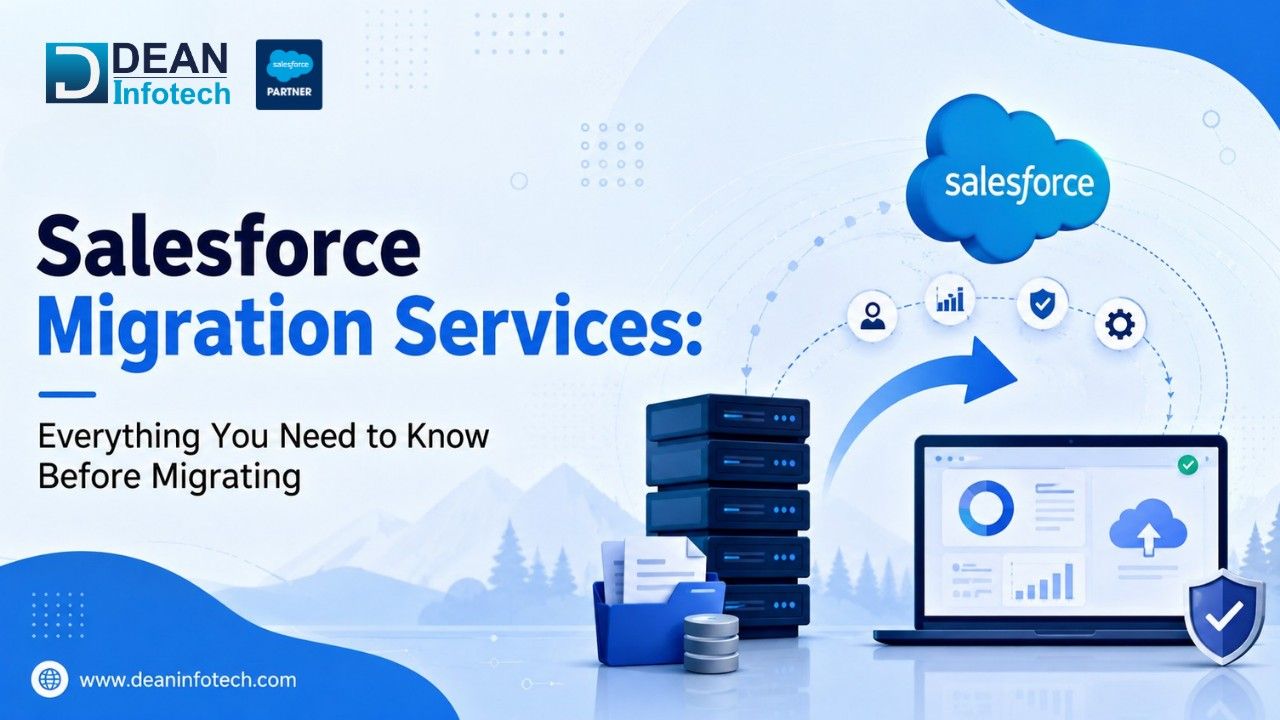
This transition to Salesforce is an ideal occasion to consolidate these operations and establish a unified platform for sales, marketing, service and analytics. Companies also adopt Salesforce in order to:
Enhance the visibility of statistics to departments
Automate boring business activities
Enhance the Customer Experience
Support AI-supported decisions
Optimise the scaling of operations
Enterprises considering CRM strategies usually undertake one or more migration projects to ensure that the enterprise's business applications continue to be available post- implementation, using the services of Salesforce Integration Services. Many rapidly growing companies choose Dean Infotech to develop the migration plan that reduces the risks associated with the migration process and keeps the business operating.
Types of Salesforce Migration
The effort required to port data between different Salesforce implementations varies depending on the business objective, existing technological infrastructure, and the overall size of the project.
CRM Migration
The most common case is importing existing customer data, including leads, contacts, opportunities, accounts, and activities, into Salesforce from another CRM. This includes leaving legacy CRMs, such as migrating off HubSpot or old legacy CRMs like Microsoft Dynamics or Zoho CRM.
Data Migration
Salesforce Data Migration migrates business data in structured formats along with all associated relationships, data formats, and integrity. Sometimes, data cleansing is used before migrating data to avoid duplicate or obsolete data.
Cloud-to-Cloud Migration
Existing customers & Current Salesforce users can migrate from their existing cloud/enter into Salesforce Cloud. For example, customers can migrate from a competing service platform to Salesforce Service Cloud, or combine multiple Salesforce instances into one.
Legacy System Migration
Nevertheless, many companies still use spreadsheets, custom databases, and outdated CRM applications without the recent automation features. Moving these into Salesforce increases operational efficiency and reduces manual administration.
Common Salesforce Migration Challenges
While Salesforce has a very powerful set of migration tools, it is not all that simple. The most difficult task is dealing with the poor data quality. Too many duplicate records and misplaced customer data, customers with outdated contacts, and fields with non-standard formats will make migration a nightmare if corrections are not made.
The other challenge is to keep the business running. Sales, customer service, and operations people use the CRM data daily. Temporary system outages can damage productivity and customer experience. Additionally, businesses need to consider application integrations, user adoption, workflow redesign, security permissions, and compliance requirements before the migration.
Most companies employ a knowledgeable partner, such as a seasoned migration expert, who is well-versed in Salesforce architecture, business processes, and enterprise data management.
Salesforce Migration Process: Step by Step
Salesforce CRM Migration We need to ensure that not only is all customer data migrated successfully, but the complete resolution of business impact, including planning, validation, testing and user adoption to keep the business running smoothly, is considered. A good migration process will significantly reduce risks and increase CRM performance in the future.
1. Assess Your Existing CRM Environment
The initial phase is to comprehend your present system. Organizations need to assess the quality of their customer data, identify redundancies, examine custom fields, workflows, reports, and integrations, and define data requirements. It also allows an assessment of which outdated processes can be improved, rather than just copied into Salesforce.
2. Define Migration Objectives
Clear migration objectives should be established for organizations before data is transferred. Common objectives include: enhancing report accuracy, automating manual processes, collating customer information, improving cooperation, and supporting business expansion.
Every business needs quantifiable objectives to evaluate the achievement of the migration.
3. Clean and Prepare Data
The influence of data quality on CRM performance. Before migration, organizations will want to de-duplicate, verify, and clean customer records; convert data to a common format; archive data that is no longer relevant (which may require a server migration, so keep archived data separate); and accurately verify customer data. Poor data quality is carried over from one platform to another during migration to Salesforce.
4. Configure Salesforce
Instead of copying the previous CRM, companies should design Salesforce based on upcoming business needs. This may include:
Custom objects
Validation rules
Workflow of automation
Security roles
Reports and dashboards
Approval procedures
Numerous users are even taking this opportunity to reengineer ineffective business processes rather than replicating existing workflows.
5. Migrate and Validate Data
When Salesforce is set up, the migration process begins. After importing records, teams should verify record accuracy, object-to-object relationships, attachments to files, reports, and dashboards, and the functionality of the workflow. Validation is one of the most important stages because minor mistakes can affect customer service, the sales process, and reporting.
6. User Testing and Training
End users should be working with the system in real business scenarios before going live. Training sessions familiarise employees with all aspects of the new application, including new workflows, reports, automation features, and navigation, helping ensure adoption after go-live.
Migration, followed by a formal change management strategy, is associated with higher adoption levels. Enterprises undertaking enterprise CRM transformation often combine migration projects with SFDC Service Cloud initiatives to enhance customer service and sales.
Best Practices Before Migrating to Salesforce
All successful migration projects start way before the data is moved. Some best practices can greatly reduce the implementation risks if taken ahead of time. Begin by establishing clear business goals, not just technical specifications. Migration should enhance business productivity and not just change software.
Then dedicate some effort to data cleansing: clean duplicate, obsolete, and incomplete records. After data migration, it can enhance reporting and increase users' confidence in the system.
It is also essential to involve stakeholders from sales, marketing, customer service and IT during planning. Their contributions will reveal how to set up Salesforce to support actual business processes rather than assumptions.
Lastly, perform several rounds of testing in the new environment before it goes live. Testing will help catch mapping problems, broken workflows, incomplete records, and integration errors before we start using the system.
Furthermore, very few firms recognise and visualise the importance of migration and approach the process by working with a growing number of Dean Infotech consultants, who design migration strategies that leverage technical skills and focus on improving business processes.
DIY Migration vs Professional Salesforce Migration Services
Feature | DIY Migration | Professional Salesforce Migration Services |
Planning & Assessment | Limited | Comprehensive |
Data Cleansing | Manual | Structured & Automated |
Risk of Data Loss | Higher | Significantly Lower |
Downtime | Higher Risk | Minimized |
Custom Object Migration | Complex | Expert Handling |
Integration Support | Limited | End-to-End |
Post-Migration Testing | Basic | Comprehensive |
Long-Term Optimization | Limited | Included |
Although small organizations with simple CRM needs can opt for a DIY approach, medium- or large-sized businesses with large volumes of data, complex custom workflows, or multiple integration paths are more likely to need a professional migration service.
Conclusion
Moving to Salesforce is not just a technical upgrade but also a chance to streamline your business processes, deliver enhanced customer service and put in place a flexible CRM platform to sustain future growth.
The successful Salesforce Data Migration involves planning, data cleansing, workflow design, testing, and user adoption. However, a well-planned, structured migration process, combined with a proactive approach to mitigating challenges in advance, will result in minimal disruption and maximum return on your Salesforce investment.
Whether you are considering a full Salesforce CRM Migration, consolidating several CRM systems, or upgrading back-office legacy systems, selecting the appropriate migration approach will enhance efficiency and maximise business performance.
Need expert help with your next project?
Get expert guidance across Salesforce, HubSpot, GoHighLevel (GHL), AI, and web development — tailored to your business.







Comments