
HubSpot vs. Salesforce vs. Pipedrive: Which CRM Is Best for Small Teams?

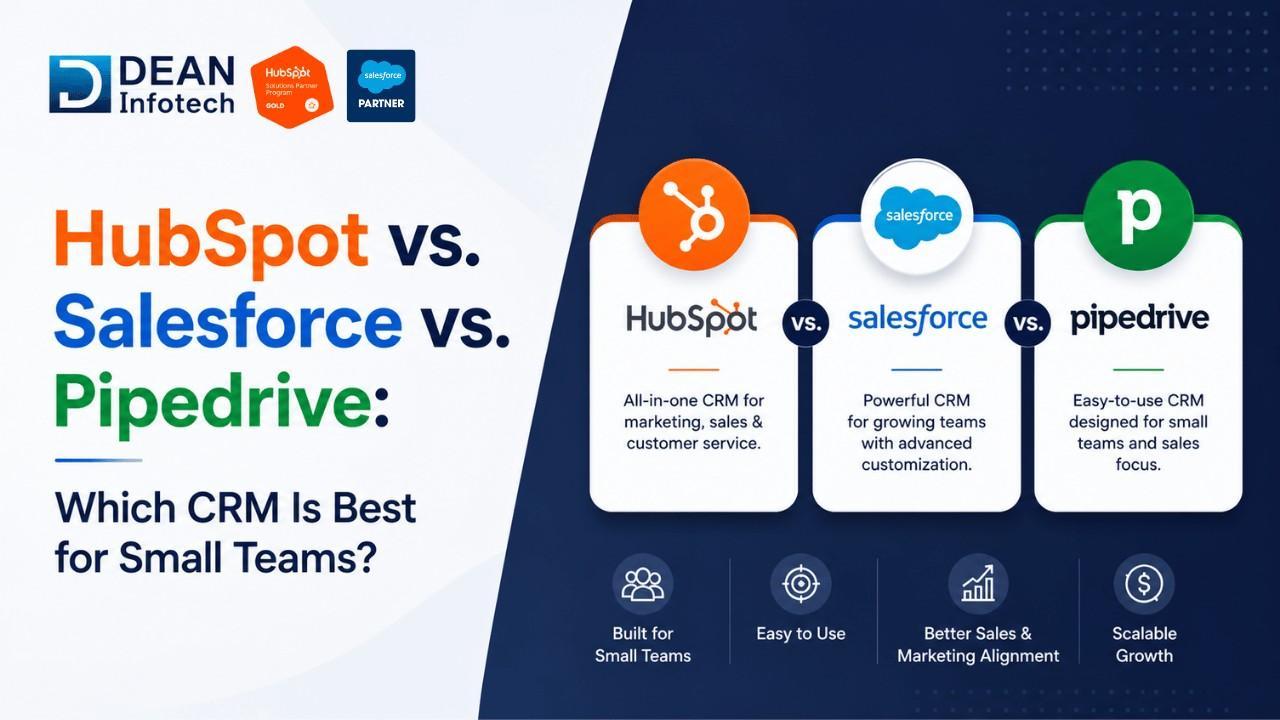
Selecting the most suitable CRM can be a turning point for SMBs. This solution should allow businesses to follow up, manage contacts, conversations & workflows, and close deals faster without adding any complexity.
There are dozens of different CRM platforms out there today, but three names always stay at the top of the list: HubSpot, Salesforce, and Pipedrive. They all bring something different to the table, but they are built for different types of businesses and different growth stages.
Here is a comprehensive comparison of HubSpot, Salesforce, and Pipedrive to support business owners, entrepreneurs, and sales executives in selecting the most suitable CRM solution for small organizations in 2026.
Why Small Teams Need the Right CRM
By definition, Small Teams Work differently from large organizations.
They often work with:
Sensitive to small budgets
Growing sales teams and accounts
Operational formats (e.g. lean structures)
Quicker decision-making frequency
Technical resources
Therefore, when choosing a CRM, your application needs to be easily configured, easy to use, inexpensive, and scalable to grow with your business.
In considering small business CRM software, think about things beyond features that the larger enterprise apps focus on.
Overview of the Three CRM Platforms
HubSpot CRM
HubSpot is a customer platform that merges CRM, marketing, sales, customer service and operations tools into one.
It is considered by many as one of the best CRM for startups. It is because of its simple interface and a wide range of free features.
HubSpot allows businesses to:
Manage contacts and companies
Track deals and pipelines
Automate marketing campaigns
Design workflows
Create reports
Handle customer service operations
Most growing businesses first experiment with critical HubSpot CRM features designed to make teams more productive and efficient, not more complicated.
Salesforce CRM
Salesforce is known to be one of the most powerful CRM available. It offers advanced capabilities across:
Sales
Marketing
Service to the customers
Analytics
Automation
Insights using AI
One of the biggest advantages of Salesforce is that it is highly customizable and scalable. This popularity among large companies is due to its ability to customize its technical environment according to its needs.
But it can sometimes be difficult to implement for a small business due to the complexity.
Pipedrive CRM
Pipedrive was designed for sales teams. Comprehensively covers pipeline visibility, deal management, and sales productivity.
Its strengths include:
Visual sales pipelines
Tacking activity
Deal forecasting
Email integrations
Many see Pipedrive as an affordable CRM for small teams due to the simple and cheap billing.
CRM Comparison for Small Businesses at a Glance
Feature | HubSpot | Salesforce | Pipedrive |
Ease of Use | Excellent | Moderate | Excellent |
Free Plan | Yes | Limited | No |
Marketing Tools | Excellent | Excellent | Basic |
Sales Features | Excellent | Excellent | Excellent |
Customer Service | Excellent | Excellent | Limited |
Automation | Strong | Advanced | Good |
Scalability | Excellent | Excellent | Moderate |
Setup Complexity | Low | High | Low |
Best For | Growing businesses | Enterprises | Sales-focused teams |
Ease of Use
For small teams, ease of use may be an incentive to adoption and to the associated productivity that it implies.
HubSpot
Must have usability, the company states.
Teams can:
Navigate dashboards(Without having us do extra work! Tarajndo)
Create workflows without programming
Access reporting tools with little training
What makes things worse is that it is one of the reasons why HubSpot is especially suitable for start-ups and gradually expanding businesses.
Salesforce
This is a very powerful tool, but customization and setup can be quite a task.
Small teams may need:
Technical expertise
Administrators on duty
External consultants
This increases both the time and the costs of implementation.
Pipedrive
Pipedrive is easy to use. A simple visual pipeline layout facilitates keeping the sales team up-to-date with the opportunities in hand.
Winner: HubSpot and Pipedrive
Sales and Marketing Capabilities
A CRM should help grow the number of customers and revenues.
HubSpot
CRM and marketing. HubSpot is combining both.
Businesses can manage:
Generating leads
Email marketing
Marketing automation
Landing pages
The sales pipeline comprises 13 steps, which focus on establishing the potential sales opportunities for AWE Investment Group. The sales pipeline is used to predict whether prospective customers will buy from the business and then categorize the sales opportunities by probability of success.
Sales automation can be used effectively for large and small teams in order to reduce administrative work, make for more effective company follow-up, and be more productive.
Salesforce
Salesforce provides more powerful Sales and Marketing capabilities, but may need multiple products (Sales Cloud, Marketing Cloud, etc).
This buys freedom, but at the same time adds complexity.
Pipedrive
Pipedrive is best for sales pipeline management but has fewer marketing features when compared with HubSpot and Salesforce.
Additional third-party tools may be needed for advanced marketing automation.
Winner: HubSpot
Pricing and Affordability
Pricing is also an important consideration when choosing the best sales CRM for a small business.
HubSpot
HubSpot offers:
Free CRM access
Flexible upgrade options
Flexible (e.g., fairly large increments, or a significant jump in price)
Begin on a small scale with only a few features that can be expanded later.
Salesforce
Salesforce typically involves:
Increasing the cost of subscription
Implementation expenses
Cost of customization
Un- ongoing Administration fees
Total owner costs will be far greater for small teams.
Pipedrive
Pricing is predictable by Pipedrive and is still one of the most affordable CRM tools comparison in the market.
However, businesses are required to have extra software for better marketing and customer service.
Winner: cheapness-Pipedrive, value-Hubspot
Integrations and Scalability
With the growth and diversification of a business, its CRM needs become more complex.
HubSpot
HubSpot integrates with hundreds of applications across:
Marketing
Finance
Customer support
ECommerce
Analytics
Knowing what integrations are possible at HubSpot can assist businesses in creating a connected ecosystem of technology that is able to grow naturally.
Salesforce
Salesforce has the largest number of integration ecosystems available. But such integrations do need technical knowledge to handle.
Pipedrive
Pipedrive has a decent use of integrations, but not as vast as HubSpot or Salesforce.
Winner: HubSpot and Salesforce
What CRM is Suitable for a New Startup?
When evaluating the best CRM for startups, several factors matter:
Fast implementation
Cost less than $100
User friendly
Growth potential
Automation features
Indeed, overall, HubSpot excels in each of the metrics outlined above.
Free tools can be used to start a project and then grow features as required.
Pipedrive also works well as it is built for sales-focused startups that need pipeline management.
An increasing number of people, processes, applications and time zones makes Salesforce more attractive.
Best CRM for Small Business
For a small business, a reliable CRM comparison should be relevant to how it benefits the overall business, instead of comparing how many features it has.
Choose HubSpot If You Need:
Alignment of marketing and sales
Customer service functionalities
Automation
Scalability
Adoption made simple
Choose Salesforce If You Need:
Enterprise-specific customization
More sophisticated reporting
More complex workflows
Choose Pipedrive If You Need:
Practical aspects of pipeline management
Cheap price
Sales-oriented functionality
Rapid implementation
Final Result: Which CRM comes out on top?
Category | Winner |
Ease of Use | HubSpot / Pipedrive |
Marketing Capabilities | HubSpot |
Sales Management | HubSpot / Pipedrive |
Enterprise Flexibility | Salesforce |
Affordability | Pipedrive |
Scalability | HubSpot / Salesforce |
Overall Value for Small Teams | HubSpot |
Overall Value for Small Teams HubSpot
When stacked up against HubSpot vs Salesforce vs Pipedrive, the right one would be a subjective matter and entirely rests on your goal.
Pipedrive continues to be a good option for sales teams looking for a low-cost, easy CRM.
Salesforce remains the leading solution for enterprise environments that need a high degree of customization and a rich feature set.
Nevertheless, the best solution for most startups and small companies remains HubSpot, as it has the best trade-off in terms of features, usability, flexibility, and cost. Its focus on integrating CRM, marketing, sales, customer service, and automation is what makes it the best CRM for small teams to grow in 2026.
Grow Smarter with Dean Infotech
Choosing a CRM is just the starting point. It is the effective implementation, integration, and optimization that will really determine what your business gets out of it.
Dean Infotech provides the best HubSpot consulting and CRM services, which optimize CRM performance, integrations, automation, and growth strategy.
No matter if you are comparing HubSpot, Salesforce, or Pipedrive, our consultants can help you select and implement the platform that most suits your business needs.








Comments