B2B companies face ongoing pressures to increase revenue, deliver better customer experiences, and show measurable marketing results. But many organizations continue to have fragmented systems, departments working in silos, inconsistent reporting, and laborious processes.
It is common for marketing groups to work in silo‘s from sales, customer success and operations, and it's therefore easy to lose valuable customer data, create inconsistent delivery of sales leads and miss revenue opportunities.
Hence, Revenue Operations (RevOps) is such a vital business approach. Gartner forecasts that by 2026, 75% of the highest-growth B2B companies will adopt a RevOps model, up from less than 30% today.
Align the Marketing, Sales, Customer Success, and Operations teams behind goals and common data, and you'll have a more predictable, scalable revenue engine created with RevOps.
This is where HubSpot comes in handy. This is because the ease of integration with its automation, reporting, and customer lifecycle management features makes the CRM the ideal solution for companies to develop a RevOps environment that will allow them to carry out smart business-to-business marketing management and sustainable growth.
What Is RevOps?
RevOps is a strategic approach that brings together the revenue teams, processes, technology and data to create stable revenue growth. It breaks down silos in departments to create a unified strategy for customer acquisition, transformation and retention.
Marketing and sales teams are not alone, either; RevOps ties them together with common objectives and strategies and with trustworthy data sources. This will reduce the time taken and make the customer happy and create a steady income.
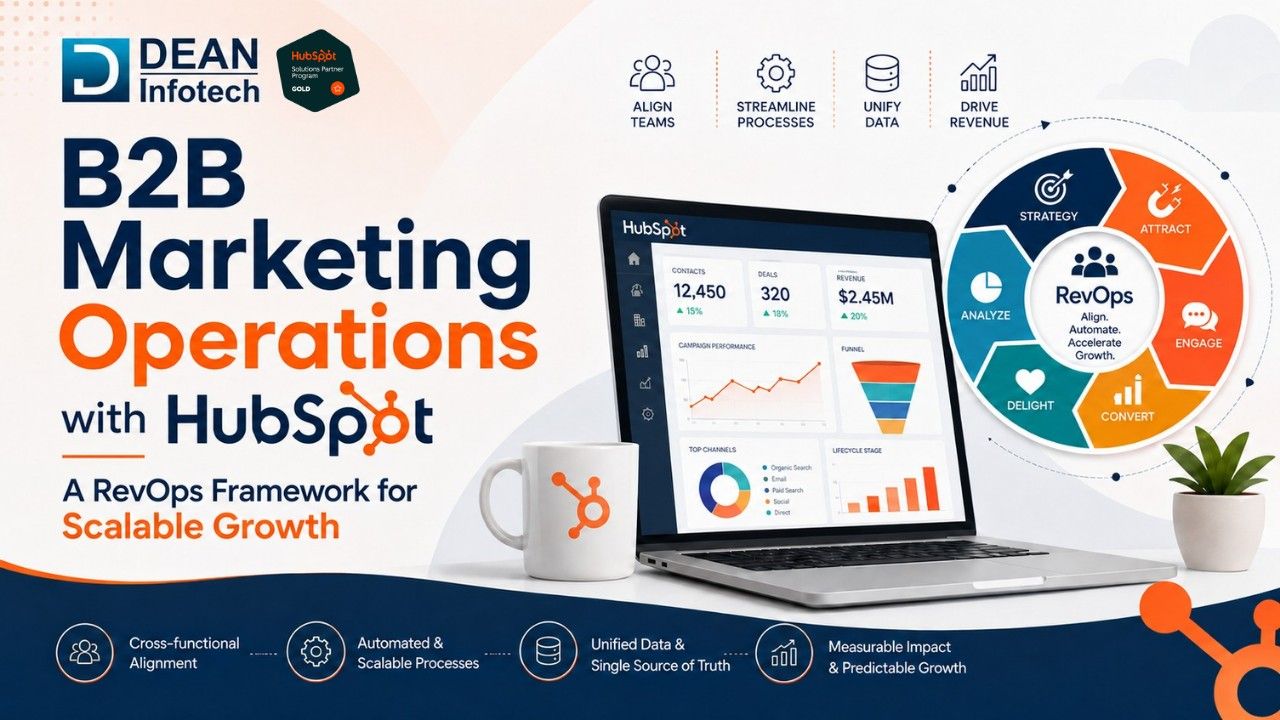
Typically, a RevOps organization includes key business functions such as marketing, sales, customer success, customer support, and operations. With everyone on the team having the same info and streamlined processes, businesses can make better decisions, improve collaboration, and complete the whole customer journey—from lead to relationship growth and satisfaction.
Why HubSpot Is Ideal for RevOps
Most businesses have more than one CRM and marketing automation, customer support and reporting solution. For businesses with onboarding Marketing Hub, they can get more alignment between marketing and sales teams, improve lead management and have better reports and numbers.
This consequently causes inefficiency and fragmented data. Here's a platform that consolidates these functions.
Core HubSpot components include:
Smart CRM
Marketing Hub
Sales Hub
Service Hub
Operations Hub
Content Hub
This shared ecosystem means that companies have greater visibility and a higher degree of collaboration.
This is precisely why the ability to deploy a RevOps framework makes HubSpot so effective.
The Core Pillars of a HubSpot RevOps Framework
People
No technology alone can resolve operational issues. Effective RevOps begins with team alignment.
Organizations should establish:
Shared goals
Common KPIs
Responsibilities are clearly delineated
Transparent communication routes
Processes
Documented processes provide a means of ensuring consistency and accountability.
Examples include:
Workflows for Lead qualification
Opportunity management
Customer onboarding
Renewal management
Customer support escalation
A great tool that can provide all of these answers in time is the lightning-fast HubSpot workflow's ability to schedule and send automated emails.
Data
Reliable data underpins all of our RevOps efforts. Businesses should prioritize:
Data quality
Standardized fields
Managing stages of the life cycle
Reporting consistency
HubSpot's single CRM solution removes data silos from the business and increases clarity.
Technology
Technology should lead us to support business goals, not to bring more confusion.
HubSpot allows organizations to integrate marketing, sales, service, and operations on one all-in-one system, so that the benefits are one platform, rather than many disconnected systems.
Building a B2B Marketing Operations Framework in HubSpot
Creating a successful B2B marketing ops framework goes beyond just implementing tech. You need a solid plan too that brings teams together, establishes standards and adds transparency throughout. HubSpot's the guy who's there and provides you with tools that let you have Marketing, Sales and Customer Success on one platform. This allows for goal setting, customer journey planning and determining lifecycle stages. This can not only boost team productivity, it could also streamline reporting and even optimize the flow of revenues.
Here are the steps to building that awesome framework in HubSpot:
Step 1: Define Revenue Goals
All RevOps initiatives need to have well-defined objectives.
Examples include:
Growing qualified pipeline
Teaching how to improve the conversion rate
Reducing the costs of acquiring customers
More customer retention, increasing recurring revenue
Other teams should be involved in these goals.
Step 2: Map the Customer Journey
The customer journey is an essential aspect of marketing activities.
Typical stages include:
Awareness
Consideration
Decision
Onboarding
Adoption
Retention
Advocacy
Step 3: Establish Lifecycle Stages
Lifecycle stages help to visualize the progression of customers.
A few of the most typical HubSpot stages are:
Subscriber
Lead
Marketing qualified lead (MQL)
Sales Qualified Lead (SQL)
Opportunity
Customer
Evangelist
Read More Blogs: How AI Is Transforming HubSpot RevOps Workflows in 2026
Marketing Operations Within a RevOps Framework
Lead Generation
Marketers leverage HubSpot to generate leads:
Content marketing
SEO
Paid advertising
Email marketing
Social media campaigns
The sales team is able to see all the lead activity in the CRM.
Lead Scoring
Lead scoring gives HubSpot the ability to prioritize leads by:
Engagement
Firmographic information
Behavioral cues
Purchase intention
This will enhance lead quality and Sales productivity.
Marketing Automation
The level of engagement with HubSpot Marketing Automation can be quickly ramped up by any business.
Examples include:
Lead nurturing campaigns
Webinar follow-ups
Education methods for products.
Not only will marketing automation free up some of the work that would be done by hand, but it will also help to ensure consistent communication.
Campaign Attribution
One of the major difficulties in B2B is measuring its impact. HubSpot attribution reporting enables companies to gain insight into:
Which channels do leads come from?
What is the conversion of which activities?
This gives an opportunity to make more rational investments.
Sales Alignment and Revenue Growth
Marketing and sales alignment is a key to the success of marketing operations.
HubSpot simplifies sales teams' lives by enabling them to:
View historical details of leads.
Track engagement signals.
Prioritize opportunities.
Automate follow-ups.
This improves communication, and makes the buyer's journey smoother.
Benefits include:
Improved lead response.
Strengthen conversion rates.
More sales productivity.
Attain improved and more engaging customer experiences.
Customer Success & Retention
While it's true RevOps can be used on prospects & new customers, it is not only limited to these. Revenue growth is important, and as much as profit growth, for the retention and growth.
HubSpot has the following approaches to accomplishing customer success:
Ticket management
Customer feedback tools
Automated onboarding
Security for the well-being of customers.
Renewal workflows
This helps the companies to enhance the customer experience and customer retention.
Reporting and Analytics
One of the other key advantages of a RevOps approach is the ability to streamline reporting. HubSpot's features include:
Pipeline performance
Marketing ROI
Revenue attribution
Retaining the customer
Sales productivity
These tools enable making decisions rapidly with efficiency.
Common Challenges When Implementing RevOps
Teams are not necessarily inclined to think about focusing; they may be resistant to change. Your leadership and communication is very important.
Poor Data Quality: Bad Data Quality can Break Your Reporting and Automation. Regular data auditing can also help in the integrity of the CRM.
Absence of Workflows: When there are no documented workflows, overshoot is an issue. Companies require to have standards of operation.
When using too many tools that are not integrated, things can get complex. All important features are centralized, making HubSpot easier to get things done.
Best Practices for Long-Term RevOps Success
Creating a successful RevOps strategy means lots of teamwork and tweaking. Companies need to do several things to boost results:
Get teams on board with common revenue goals
Standardize lifecycle stages and processes
Keep CRM data clean and accurate, automate mundane tasks
Foster collaboration between departments
Review and optimize performance regularly.
The key is seeing RevOps as an ongoing drive for improvement rather than a quick-fix project. This way, they're more likely to experience steady growth, better alignment, and predictable revenue outcomes.
Final Thoughts
Marketing operations in B2B are becoming yet more complex as customer journeys evolve and revenue expectations increase.
A RevOps model enables organizations to address these issues through integrated goals and shared data across marketing, sales, customer success, and operations.
HubSpot offers a technology system to enable this alignment with CRM integrations, automation, reporting, and customer lifecycle management.
When adopting a well-organized RevOps structure, companies can become more efficient, enhance customer experience and establish a clearer, more predictable revenue pipeline.
Accelerate Growth with Dean Infotech
Dean Infotech supports B2B companies to streamline marketing operations, enhance sales alignment, implement HubSpot solutions, and develop scalable revenue engines that translate into business results.
Need expert help with your next project?
Get expert guidance across Salesforce, HubSpot, GoHighLevel (GHL), AI, and web development — tailored to your business.









Comments