The need to select an appropriate AI solution in 2026 is no longer a future discussion, but a business-based choice, with a direct correlation with operational efficiency, customer experience, and overall ROI. When considering AI agents, chatbots, or LLMs in the case of businesses, the answer is not just about choosing the most advanced technology but rather about choosing the appropriate tool that fits your business interests, workflow, and scaling needs.
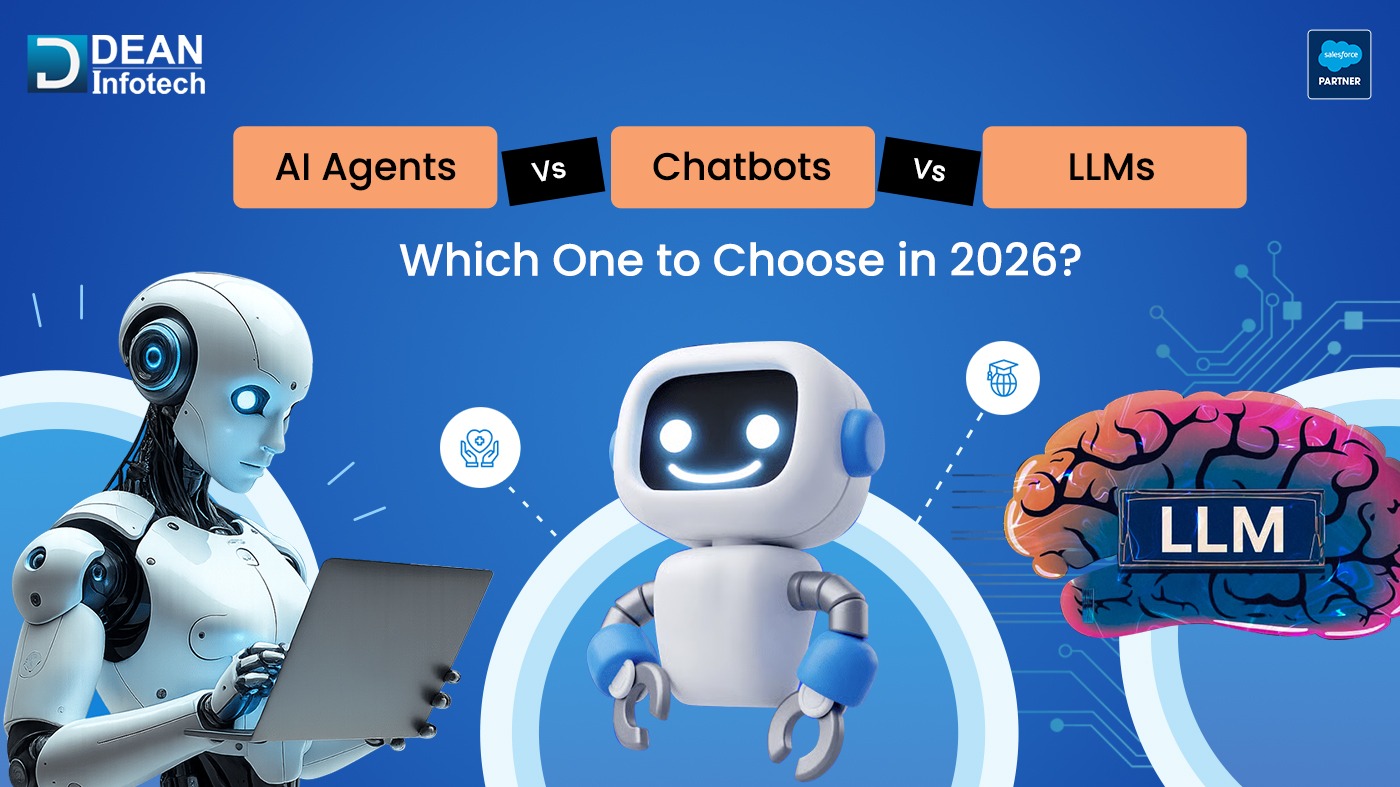
The AI world has quickly developed beyond basic scripted bots to true AI agents, able to perform multi-step processes without human guidance. Simultaneously, enterprise chatbot systems have been made smarter, more situational, and embedded within enterprise ecosystems, such as CRM systems. In the meantime, Large Language Models (LLMs) are driving the intelligence facade of most of these systems.
To help you make an informed decision, we will deconstruct definitions, comparisons, use cases, implementation strategies, and ROI considerations in this blog. When you are aiming at enhancing automation, lowering operational expenses, and achieving quantifiable results, this guide will provide you with a first answer perspective.
Understanding the Basics
What Are Large Language Models (LLMs)?
Large Language Models (LLMs) are highly developed AI models that are trained on huge amounts of data to comprehend, produce, and process human language with extraordinary precision. These are the brains of most of the current AI applications, such as chatbots and AI agents.
Business LLMs are mostly applied in:
Content generation
Customer support automation
Data summarization
Generation and analysis of codes.
Knowledge retrieval systems
By 2026, LLMs will no longer be an independent tool, but part of the enterprise operations, driving intelligent automation at scale.
Trend Insight: According to industry reports, over 70% of enterprise AI applications now rely on LLM-based architectures, especially for customer engagement and internal productivity tools.
What Are Chatbots?
Chatbots are conversational interfaces designed to interact with users via text or voice, typically following predefined flows or AI-enhanced responses.
Business chatbots are much more sophisticated than previous rule-based bots. They use LLMs to learn the context, intent, and sentiment to have more natural interactions.
Chatbot solutions in business are prevalently used in:
Customer support
Lead generation
Automation of FAQs and knowledge base
Appointment scheduling
Nevertheless, the vast majority of chatbots continue to work within a limited scope and are not completely independent in performing complex workflows.
What Are AI Agents?
Enterprise AI is evolving into AI agents. In contrast to chatbots, business agents (AI) are able to plan, execute, and optimize tasks across various systems independently.
These agents can:
Decision making on the basis of data
Perform multi-step workflows
Communicate with APIs and enterprise applications
Get to know and get better with time
Multi-agent AI systems and autonomous AI agents are finding more applications in complex business processes like supply chain optimization, financial forecasting, and automated software development.
Simply put, when the brain is the LLMs and the interface is the chatbots, the agents of AI are the doers who, in fact, get tasks done.
Key Differences
To explain the differences, the comparison is simplified below:
Feature | LLMs for Businesses | Chatbots for Businesses | AI Agents for Businesses |
Core Function | Language understanding & generation | Conversational interface | Task execution & automation |
Autonomy | Low | Medium | High |
Complexity Handling | High (text-based) | Moderate | Very High |
Integration Capability | Limited standalone | Integrated with systems | Deep system integration |
Use Case | Content, analysis | Customer interaction | End-to-end workflows |
Insight:
LLMs are used when you need to process language and intelligence.
Select chatbots when you have to communicate with customers.
Choose AI agents in case you require autonomous execution and automation of business processes.
Use Cases and Real-World Applications in 2026
Best Scenarios for LLMs
LLMs are the best when you have a business and require a strong language comprehension, yet complete automation is not essential.
Examples include:
Legal document summarization
Generation of marketing content on a large scale.
Internal knowledge assistants
AI-powered tools to generate code.
ROI Perspective:
LLMs can save up to 60% of manual labor in content-rich processes, thus affordable to the knowledge-based industry.
When to Use Chatbots
Chatbots are still the most suitable option in case of organized customer communication, when time is of the essence.
Typical applications are:
E-commerce customer support
Banking and financial enquiries correction.
Healthcare appointment scheduling
SaaS onboarding assistance
The latest chatbot development in business is combined with customer relationship management applications such as Salesforce, allowing one to interact with customers individually depending on their data.
Cost Consideration:
The implementation cost of chatbots in 2026 will be moderate to high based on the customization, but it is hoped to present ROI in 6-9 months due to the decreased support cost.
Where AI Agents Shine
AI agents are good in situations where they involve multi-step thinking and action.
Examples:
Automated sales pipeline management.
AI-driven financial reporting
Supply chain decision-making
DevOps automation
Multi-agent AI may collaborate as an agent may be tasked with data retrieval, another agent may be tasked with data analysis, and a third agent may be tasked with action execution- generating a completely automated workflow.
Outcome Insight:
Companies involved with AI agents claim to have as much as 40 percent quicker operations and huge decreases in human interaction.
Hybrid Approaches: Combining All Three for Maximum Impact
It is not one of the three that are being chosen by the most successful enterprises in 2026, but a combination of them.
A typical hybrid architecture looks like:
LLMs provide intelligence
Chatbots provide interaction
Execution is done by AI agents
As an example, a customer query to a chatbot may activate an AI agent to offer refunds or CRM data updates, whereas an LLM makes sure to communicate correctly and contextually.
What Tools and Platforms to explore in 2026
Businesses need to use a contemporary AI stack to be competitive and combine automation with human knowledge.
AI Development & Coding:
GitHub Copilot
Tabnine
Testing & QA:
Selenium AI
Applitools
Code Quality & Security:
SonarQube and AI plugins.
Snyk
Workflow Advantage
The conventional methods of development are lengthy and consumptive. The contemporary strategy incorporates AI in all the development phases.
Traditionally
Weeks/months to code and run through testing cycles.
The Dean Infotech Way:
AI applications such as GitHub Copilot can produce boilerplate code immediately, and cut development times by 40 or more, allowing experienced developers to work on architecture, optimization, and business logic.
Such a hybrid method guarantees faster delivery without affecting quality.
Implementation Guide
1. Define Business Objectives
Determine what you require: communication, intelligence, or automation.
2. Select the Appropriate AI Layer
Intelligence LLMs
Chatbots for interaction
Execution AI agents
3. Interoperate with Existing Systems
Make sure it has easy integration with CRM, ERP, and cloud platforms.
4. Measure ROI Early
Monitor KPIs like cost savings, response time, and customer satisfaction.
Pricing and ROI Considerations
Solution Type | Initial Cost | Maintenance Cost | ROI Timeline |
LLMs | Medium | Medium | 6–12 months |
Chatbots | Medium–High | Medium | 6–9 months |
AI Agents | High | Medium–High | 9–18 months |
Key Insight:
Although that investment in AI agents may be more costly in the short term, the ROI is highest over time because it is fully automated.
Conclusion
By 2026, the question of whether to adopt AI or not will have been settled, but what will be required is how to implement AI in the most strategic way to maximize its impact on businesses. Business AI agents, business chatbots, and business LLMs have their own roles that are complementary but not equivalent, and the wisest companies are using a combination of all three to create business-scale intelligent ecosystems.
The companies that intend to remain competitive should focus on outcome-based AI implementation, cutting costs, increasing efficiency, and providing customers with high-quality experiences based on smart automation.
Being a Salesforce Gold Consulting Partner and a Salesforce Crest Consulting Partner, Dean Infotech has a combination of profound knowledge in CRM and the latest AI-powered skills to provide personalized enterprise solutions. Of course, you may be developing autonomous AI agents, deploying a multi-agent AI system, or rolling out business chatbot solutions, but the appropriate approach can revolutionize your digital operations.
Contact Dean Infotech to explore how AI-driven solutions can accelerate your business growth and deliver measurable ROI.
Need expert help with your next project?
Get expert guidance across Salesforce, HubSpot, GoHighLevel (GHL), AI, and web development — tailored to your business.









Comments